Silver Nanoparticles Improve Healing of Infected Wounds

Jenn Hoskins
25th March, 2025

Silver Nanoparticles Improve Healing of Infected Wounds

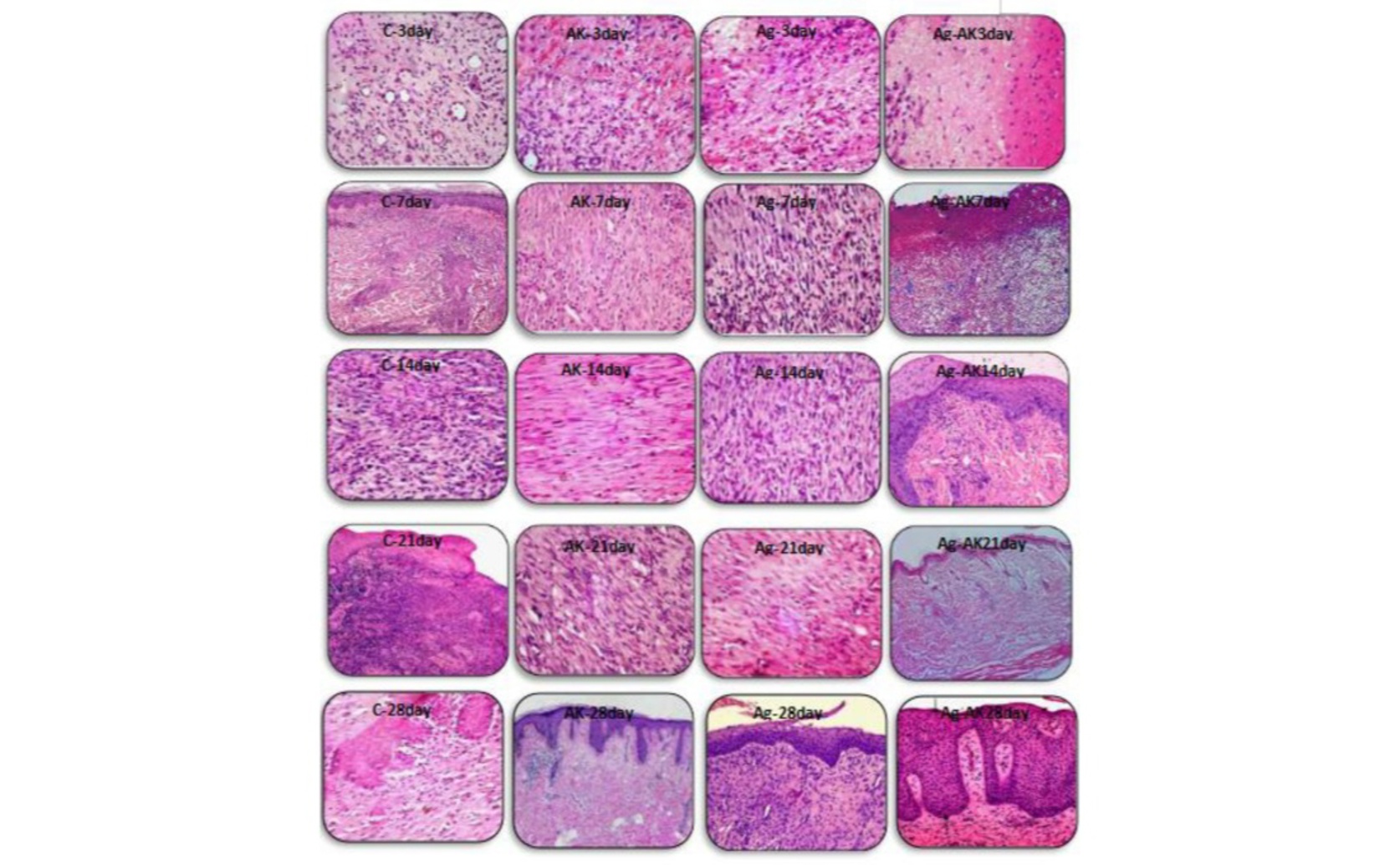
Histological examination reveals that wounds treated with AgNPs (Ag) and AgNPs-Amikacin (Ag-AK) exhibit accelerated re-epithelialization, enhanced collagen deposition, and reduced inflammatory cell infiltration compared to Amikacin (AK) and untreated control (C) wounds across days 3, 7, 14, 21, and 28, demonstrating the superior wound healing efficacy of biosynthesized silver nanoparticles against Pseudomonas aeruginosa-infected wounds in dogs.

Image adapted from: Aldujaily et al. / CC BY (Source)

Key Findings

  • Researchers at the University of Kufa found that silver nanoparticles effectively treated infected dog wounds caused by P. aeruginosa
  • Silver nanoparticles healed wounds faster and eliminated bacteria quicker than the traditional antibiotic Amikacin
  • Combining silver nanoparticles with Amikacin further sped up healing and infection control, showing the best results
Environmental factors such as injuries and bacterial infections can significantly impede the wound healing process. One common and challenging bacterial pathogen involved in such infections is Pseudomonas aeruginosa, known for its resistance to multiple antibiotics and its role in severe infections, especially in vulnerable populations[2]. Traditional treatments often involve antibiotics like Amikacin, but rising antibiotic resistance necessitates alternative approaches. A recent study conducted by researchers at the University of Kufa[1] explored the use of silver nanoparticles (AgNPs) as a potential treatment for P. aeruginosa-infected wounds in dogs. Silver nanoparticles are tiny particles of silver that have been found to possess strong antibacterial and anti-inflammatory properties. In this study, the effectiveness of AgNPs was compared to that of Amikacin, a commonly used antibiotic, to determine which treatment better promotes wound healing and controls infection. The study involved sixteen dogs that were divided into four groups. Each dog received a full-thickness skin wound on the right side of the costal-abdominal area. After creating these wounds, the researchers introduced a bacterial suspension containing P. aeruginosa to each wound to simulate an infection. The dogs were then treated with either AgNPs, a combination of AgNPs and Amikacin, Amikacin alone, or no treatment as a control. To ensure the AgNPs were effective, the researchers synthesized them using a plant called Tribulus terrestris. They thoroughly characterized the nanoparticles using various techniques, including UV-visible spectroscopy, scanning electron microscopy (SEM), and X-ray diffraction (XRD), to confirm their size and shape. These properties are crucial because they determine how well the nanoparticles can interact with and kill bacteria. The results of the study were promising. Wounds treated with AgNPs healed in an average of 20 days, compared to 28 days for those treated with Amikacin. Notably, when AgNPs were used in combination with Amikacin, the healing time was reduced even further to 18 days. This suggests that AgNPs not only are effective on their own but may also enhance the efficacy of traditional antibiotics when used together. In terms of infection control, AgNPs showed significant antibacterial activity. The bacterial counts in the wounds treated with AgNPs decreased to the same extent as those treated with Amikacin within 14 days. However, AgNPs alone were able to eradicate the P. aeruginosa infection in just 7 days, compared to 14 days with Amikacin. This rapid reduction in bacterial load is particularly important in preventing the spread of infection and promoting faster healing. Furthermore, AgNPs contributed to the healing process by reducing inflammation and promoting the deposition of collagen fibers, which are essential for skin repair. The treated wounds exhibited fewer hemorrhagic areas and inflammatory cells, indicating that AgNPs help create a more favorable environment for tissue regeneration. These findings align with previous research from the University of Kufa[3], which demonstrated that platelet-rich plasma (PRP) could decrease bacterial counts and inflammation in infected wounds, although through different mechanisms. The use of nanoparticles in wound healing is part of a broader trend towards nanotechnology-based medical treatments. As highlighted by researchers at Alexandria University[4], nanotechnology platforms like nanoparticles, nanofibers, and nanohydrogels offer innovative solutions for complex medical issues, including chronic diabetic wounds. These technologies can enhance wound healing by providing targeted delivery of therapeutic agents, reducing side effects, and improving overall treatment outcomes. The study from the University of Kufa builds on this foundation by showcasing how AgNPs can serve as a powerful antimicrobial and anti-inflammatory agent. By effectively controlling bacterial infections and accelerating the healing process, AgNPs present a viable alternative to traditional antibiotics, especially in the face of rising antibiotic resistance[2]. This aligns with the growing need for new strategies to manage infections that are both effective and minimize the risk of developing resistant strains. In conclusion, the research demonstrates that silver nanoparticles are a highly effective treatment for P. aeruginosa-infected wounds in dogs, outperforming traditional antibiotics like Amikacin in both healing time and antibacterial activity. The ability of AgNPs to reduce inflammation and promote tissue repair further underscores their potential as a superior wound healing agent. As antibiotic resistance continues to pose a significant challenge in healthcare, studies like this highlight the importance of exploring and developing alternative treatments that can ensure effective patient care and improve healing outcomes.

MedicineHealthAnimal Science

References

Main Study

1) The effect of biosynthesized silver nanoparticles on Pseudomonas aeruginosa-infected dogs wounds

Published 25th March, 2025

https://doi.org/10.1371/journal.pone.0313166


Related Studies

2) Pseudomonas aeruginosa Lifestyle: A Paradigm for Adaptation, Survival, and Persistence.

https://doi.org/10.3389/fcimb.2017.00039


3) Comparison effects of platelet-rich plasma on healing of infected and non-infected excision wounds by the modulation of the expression of inflammatory mediators: experimental research.

https://doi.org/10.1007/s00068-022-01907-0


4) Nanotechnology-based therapeutic applications: in vitro and in vivo clinical studies for diabetic wound healing.

https://doi.org/10.1039/d1bm01211h


Related Articles

An unhandled error has occurred. Reload 🗙