Comparing Pet and Robot Therapy for Children with Autism or Down Syndrome

Jim Crocker
20th March, 2025

Comparing Pet and Robot Therapy for Children with Autism or Down Syndrome

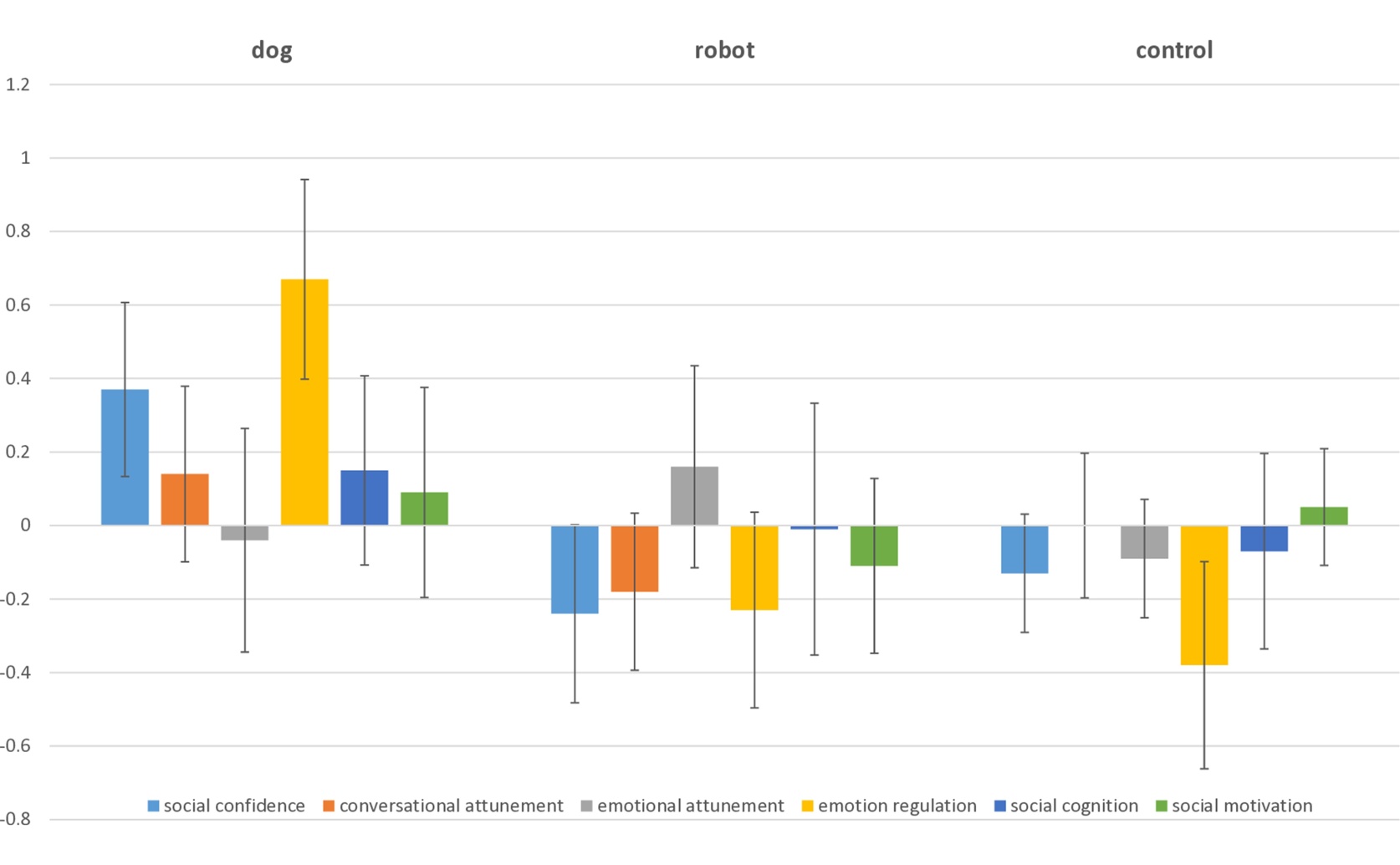
Dog-assisted therapy produced significantly greater reliable change in emotion regulation compared to both robot dog-assisted therapy and no-treatment control conditions in children with autism or Down syndrome.

Image adapted from: Steen et al. / CC BY (Source)

Key Findings

  • In Dronten, Netherlands, real dog therapy helped children with autism or Down syndrome better understand and manage their emotions compared to robot dogs or no therapy
  • The study found no significant improvements in other social skills, such as confidence or communication, between the different groups
  • Individually, more children showed meaningful progress with real dog therapy, indicating it may be especially beneficial for certain children
Animal-assisted therapy (AAT) has gained attention as a potential tool to support children with autism spectrum disorder (ASD) and Down syndrome (DS). These therapies typically involve interactions between children and animals, such as dogs, with the aim of improving social and emotional skills. However, understanding the true effectiveness of AAT has been challenging due to varying study designs and outcomes[2]. A recent study conducted by researchers at the Aeres University of Applied Sciences in Dronten, the Netherlands[1], sought to address some of these challenges by comparing the effects of traditional dog-assisted therapy with robot dog-assisted therapy and a no-treatment control group. This study included 65 children aged between 7 and 16 years, all diagnosed with either ASD or DS. The children were divided into three groups: 24 received dog-assisted therapy, 21 participated in sessions with a robot dog that could respond autonomously to their actions, and 20 did not receive any treatment during the study period. The primary goal of the study was to evaluate improvements in social and emotional skills, specifically emotional attunement and emotion regulation. To achieve this, parents completed questionnaires assessing their children's abilities before and after the therapy sessions, as well as at a follow-up 4-6 weeks later. The findings revealed that children who engaged in dog-assisted therapy showed significant improvements in emotional attunement and emotion regulation compared to those in the robot-assisted and no-treatment groups. This suggests that the presence of a real dog may offer unique benefits in helping children manage their emotions and connect emotionally. Interestingly, the study did not find significant differences between the groups in other areas such as social confidence, conversational attunement, social cognition, and social motivation. This indicates that while dog-assisted therapy may enhance certain emotional skills, its impact on broader social abilities might be limited or require more intensive intervention. Additionally, the improvements observed did not significantly change from the post-test to the follow-up, highlighting the need for ongoing support to maintain these benefits. On an individual level, the study used the Reliable Change Index (RCI) to measure meaningful changes in each child’s progress. Most of the highest RCIs were found in the dog-assisted therapy group, while the robot-assisted group had more of the lowest RCIs. This suggests that dog-assisted therapy may be particularly effective for certain children, aligning with earlier research that emphasized the importance of tailored interventions[3]. For instance, a study by the University of Groningen demonstrated that synchrony between children with ASD and therapy dogs increased over time, potentially underlying the positive effects observed in AAT[3]. The use of a robot dog as an active control in this study was innovative, addressing concerns highlighted in previous literature about methodological rigor in AAT research[2]. By comparing dog-assisted therapy with a robot counterpart, the researchers could better isolate the effects of interacting with a live animal versus a mechanical one. This approach helps clarify whether the benefits of AAT are due to the animal's presence and behavior or other factors such as attention and structured activities. Moreover, the study contributes to the ongoing discussion about the most effective outcome measures for evaluating AAT. Previous research has called for careful selection of outcome measures to avoid missing significant effects[4]. In this study, using parental questionnaires provided valuable insights into the emotional changes experienced by the children. However, incorporating additional methods such as direct observations or self-reports could further enhance the understanding of how and why AAT works[5]. The findings from this study align with other research indicating that animal-assisted interventions can positively impact emotional and social skills in individuals with ASD and DS. For example, earlier studies have shown that interactions with therapy dogs can lead to more secure body postures and improved self-esteem in adults with ASD[5]. Similarly, research on equine-assisted interventions has demonstrated improvements in social and communication skills, although different measurement tools can yield varying results[4]. In conclusion, the study from Aeres University of Applied Sciences provides robust evidence supporting the benefits of dog-assisted therapy for improving emotional attunement and emotion regulation in children with ASD and DS. By using a well-designed control group and reliable measurement tools, the research addresses previous methodological concerns and highlights the unique advantages of interacting with live animals. Future research should continue to refine these approaches, explore individualized therapy plans, and incorporate diverse outcome measures to fully understand and maximize the potential of animal-assisted therapy.

HealthMental HealthAnimal Science

References

Main Study

1) A randomized controlled trial of the effects of dog-assisted versus robot dog-assisted therapy for children with autism or Down syndrome

Published 19th March, 2025

https://doi.org/10.1371/journal.pone.0319939


Related Studies

2) Animal-Assisted Interventions for Autism Spectrum Disorder: A Systematic Review of the Literature from 2016 to 2020.

https://doi.org/10.1007/s40489-021-00291-6


3) Changes in behavioural synchrony during dog-assisted therapy for children with autism spectrum disorder and children with Down syndrome.

https://doi.org/10.1111/jar.12682


4) Evaluating Animal-Assisted Interventions: An Empirical Illustration of Differences between Outcome Measures.

https://doi.org/10.3390/ani9090645


5) Social Development of Adults with Autism Spectrum Disorder During Dog-Assisted Therapy: A Detailed Observational Analysis.

https://doi.org/10.3390/ijerph17165922


Related Articles

An unhandled error has occurred. Reload 🗙