New Snail Host Found for Intestinal Schistosomiasis

Jim Crocker
18th February, 2025

New Snail Host Found for Intestinal Schistosomiasis

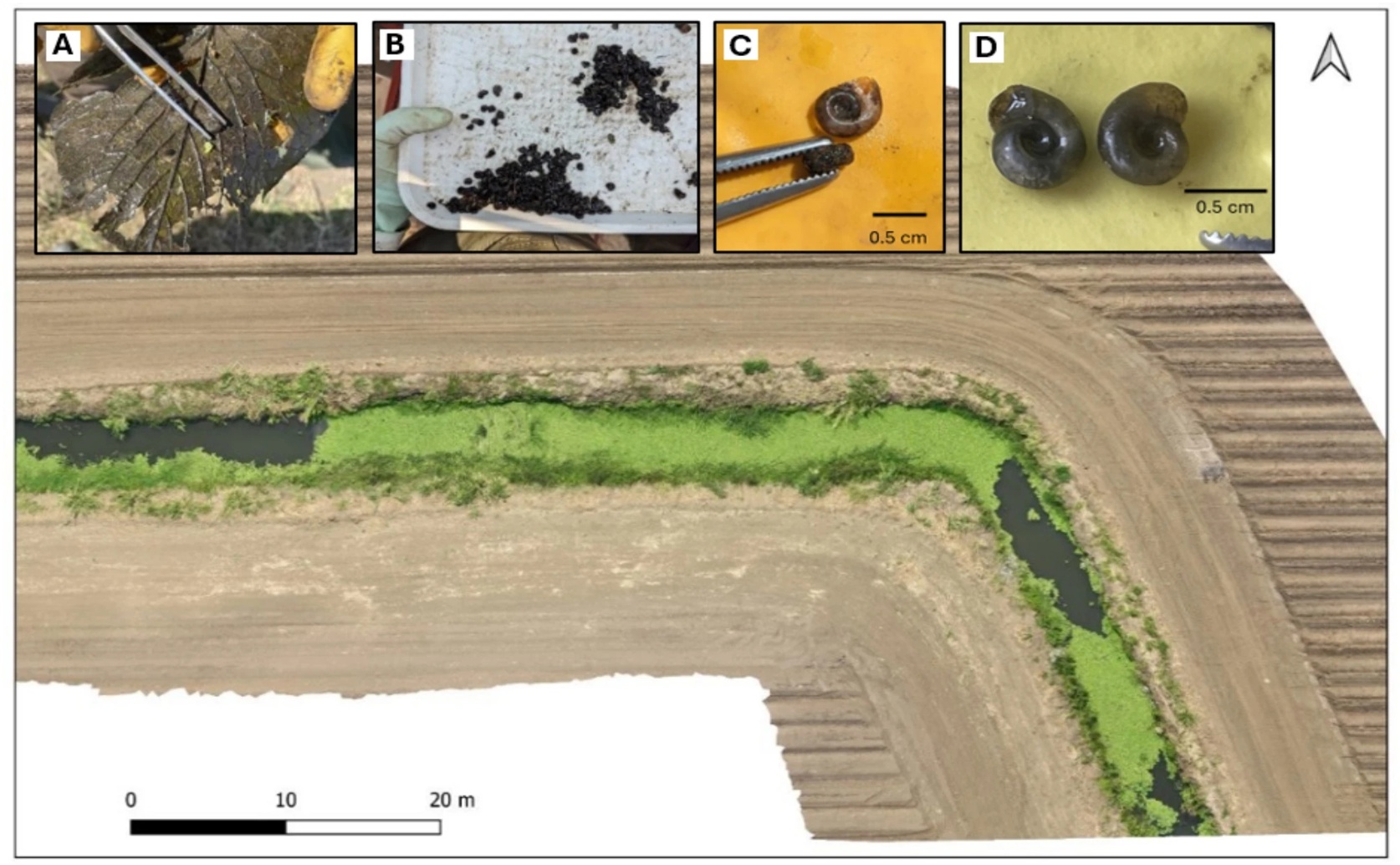
This figure documents the first discovery of the intestinal schistosomiasis host snail, Biomphalaria pfeifferi, in Chikwawa, showing its specific irrigation canal habitat (a), its collection in large numbers (b), and key morphological features of its shell (c, d).

Image adapted from: Nkolokosa et al. / CC BY (Source)

Key Findings

  • Researchers in southern Malawi discovered Biomphalaria pfeifferi snails in the Lower Shire Valley, a key area for schistosomiasis
  • They found that water conductivity, dissolved salts, and elevation are the main factors affecting snail populations
  • These insights help target snail control efforts, improving strategies to prevent the disease
Intestinal schistosomiasis is a significant public health issue in many parts of Africa, caused by parasitic worms of the genus Schistosoma. These parasites rely on freshwater snails of the Biomphalaria species as intermediate hosts to complete their life cycle. Once inside the human body, adult schistosome worms live in blood vessels, evading the immune system while releasing eggs that cause various health problems, including anemia and organ damage[2]. Controlling the spread of intestinal schistosomiasis heavily depends on managing the populations of Biomphalaria snails. Biomphalaria pfeifferi, in particular, is one of the most important snail species involved in transmitting Schistosoma mansoni, the parasite responsible for intestinal schistosomiasis[3]. Understanding the distribution and environmental preferences of these snails is crucial for developing effective control strategies. Previous studies have highlighted the role of environmental factors in snail distribution. For instance, research in Brazil identified that areas with natural vegetation and specific climatic conditions are more conducive to the presence of Biomphalaria glabrata, another key snail species[4]. Similarly, studies in Uganda revealed that snails can thrive at varying altitudes, expanding the regions at risk for schistosomiasis beyond previously recognized boundaries[5]. These findings underscore the complexity of schistosomiasis transmission and the need for targeted interventions based on local environmental conditions. In this context, the Malawi-Liverpool-Wellcome Programme conducted a recent study to investigate the distribution of Biomphalaria snails in southern Malawi, specifically in the Chikwawa and Nsanje Districts within the Lower Shire Valley[1]. The research aimed to identify the presence of Biomphalaria populations and understand the environmental factors that influence their distribution. Over multiple surveys, researchers examined 45 freshwater sites, measuring variables such as water conductivity, pH, temperature, total dissolved salts (TDS), and geographical elevation. Using advanced modeling techniques, the study employed Random Forest algorithms to predict the presence and abundance of snails based on the collected environmental data. The analysis revealed that water conductivity, TDS, and geographical elevation were the most significant factors in determining snail populations. Temperature and pH also played roles but were less influential compared to the other variables. One of the key findings of this study is the first report of Biomphalaria pfeifferi in the Lower Shire Valley. This discovery enhances the understanding of the environmental conditions that support the survival and proliferation of these snails in southern Malawi. By identifying the specific factors that correlate with snail abundance, the study provides valuable insights for predicting snail distribution in other regions with similar environmental profiles. Integrating these findings with previous research, it becomes evident that controlling schistosomiasis requires a multifaceted approach. While mass drug administration with praziquantel remains a primary control measure, understanding the ecological preferences of Biomphalaria snails allows for more targeted interventions. For example, areas with high water conductivity and TDS might be prioritized for snail control efforts, such as environmental management or biological control methods. The presence of Biomphalaria pfeifferi in new areas also indicates a potential shift in schistosomiasis transmission dynamics. This aligns with findings from Uganda, where snails were found at higher altitudes than previously thought, suggesting that the at-risk population for schistosomiasis may be larger than estimated[5]. By incorporating environmental and geographical data into risk assessments, health authorities can better allocate resources and design interventions that are tailored to specific local conditions. Moreover, the genomic resources developed for Biomphalaria pfeifferi in earlier studies provide a foundation for future research aimed at understanding the genetic factors that influence snail susceptibility to Schistosoma infection[3]. This genetic insight could lead to innovative strategies for reducing snail populations or making them less capable of transmitting the parasite. In conclusion, the study conducted by the Malawi-Liverpool-Wellcome Programme represents a significant advancement in the fight against intestinal schistosomiasis. By elucidating the environmental factors that govern the distribution of Biomphalaria snails, the research paves the way for more effective and targeted control measures. Combining these insights with existing knowledge from previous studies offers a comprehensive approach to mitigating the impact of this neglected tropical disease, ultimately improving health outcomes for millions affected by schistosomiasis in Africa.

HealthEcologyAnimal Science

References

Main Study

1) A first report of Biomphalaria pfeifferi in the Lower Shire Valley, Southern Malawi, a major intermediate snail host species for intestinal schistosomiasis.

Published 15th February, 2025

https://doi.org/10.1038/s41598-025-88930-4


Related Studies


3) A genome sequence for Biomphalaria pfeifferi, the major vector snail for the human-infecting parasite Schistosoma mansoni.

https://doi.org/10.1371/journal.pntd.0011208


4) Identification of Risk Areas for Intestinal Schistosomiasis, Based on Malacological and Environmental Data and on Reported Human Cases.

https://doi.org/10.3389/fmed.2021.642348


5) Intestinal schistosomiasis in Uganda at high altitude (>1400 m): malacological and epidemiological surveys on Mount Elgon and in Fort Portal crater lakes reveal extra preventive chemotherapy needs.

https://doi.org/10.1186/s40249-017-0248-8


Related Articles

An unhandled error has occurred. Reload 🗙