Spawning Patterns Shape Nutrient Signatures in Boreal Stream Ecosystems

Greg Howard
9th February, 2025

Spawning Patterns Shape Nutrient Signatures in Boreal Stream Ecosystems

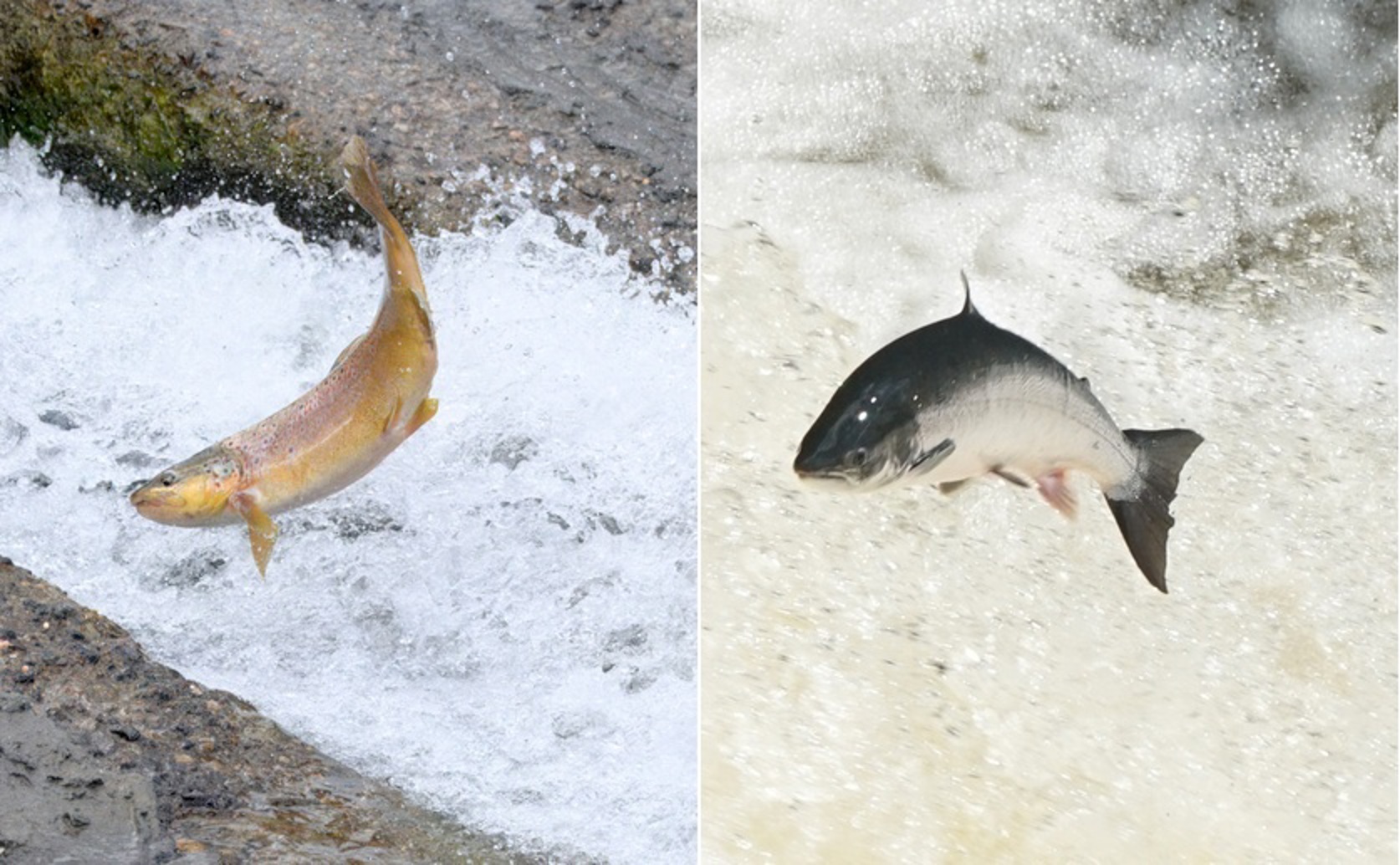
Brown Trout (Salmo trutta) (left) and Atlantic Salmon (Salmo salar) (right)

Composite: Natural Science News / CC BY. [Sources]
Adapted from photos by:

Key Findings

  • In boreal streams of Sweden, nutrients from Atlantic salmon and sea trout enrich the ecosystem, benefiting algae, streambed organisms, and resident fish like brown trout
  • Sites with spawning salmon and sea trout showed higher nutrient levels, traced through isotopes, compared to sites without these fish
  • Different fish species and life stages contribute unique nutrient profiles, influencing food web dynamics and ecosystem productivity
The role of marine-derived nutrients (MDN) transported by anadromous fish, such as Atlantic salmon (Salmo salar) and sea trout (Salmo trutta), in shaping freshwater ecosystems has been a topic of growing interest. A recent study by the Swedish University of Agricultural Sciences[1] investigated how MDN, carried from the Baltic Sea by these fish, contributes to the dynamics and structure of boreal stream food webs. The research focused on stable isotopes of carbon (δ13C) and nitrogen (δ15N) to measure nutrient incorporation into different food web components, including periphyton (algae attached to surfaces), benthic macroinvertebrates (organisms living on streambeds), and freshwater-resident brown trout. The study compared four sites: two with active salmonid spawning and two without. The results revealed significant differences in isotopic enrichment between these site types. At the MDN-enriched sites, where salmon and sea trout spawn and experience high overwinter mortality, all food web components showed elevated δ15N and δ13C values compared to reference sites without these fish. Specifically, periphyton, macroinvertebrates, and brown trout in MDN sites had δ15N values of 3.3‰, 4.3‰, and 7.8‰, respectively, compared to 1.8‰, 2.0‰, and 6.5‰ at reference sites. This enrichment indicates that marine nutrients from the fish are being incorporated into the stream ecosystem, influencing both primary producers and higher trophic levels. The findings expand on earlier research that demonstrated the importance of anadromous fish in delivering MDN to freshwater ecosystems. For instance, previous studies have shown that Pacific salmon significantly enhance nutrient availability and isotopic enrichment in streams[2][3]. These nutrients, derived from decomposing carcasses and excretion, stimulate growth in biofilms and macroinvertebrates, which are then consumed by resident fish. The current study confirms that similar processes occur in boreal streams with Atlantic salmon and sea trout, highlighting the universal role of anadromous species as nutrient vectors across different geographical regions. Interestingly, the study also found that Atlantic salmon were more enriched in δ15N than sea trout, and their eggs contained higher δ15N and lower δ13C values compared to their muscle tissue. This suggests that different life stages and species contribute varying nutrient profiles to the ecosystem. A Bayesian mixing model further revealed diet variations in brown trout across streams, emphasizing the complexity of MDN incorporation into food web dynamics. The research aligns with earlier findings that MDN inputs can alter community structures and nutrient pathways in freshwater ecosystems[3][4]. For example, studies in the Pacific Northwest have shown that salmon influence not only aquatic organisms but also terrestrial ecosystems by fertilizing riparian vegetation[4]. Similarly, the current study underscores the interconnectedness of marine and freshwater systems, with implications for ecosystem management. Declining populations of anadromous fish, as noted in previous research[3], could reduce MDN delivery, potentially diminishing productivity and biodiversity in affected streams. The methodology employed, including stable isotope analysis, allowed the researchers to trace the flow of marine nutrients through the food web. This approach is consistent with prior studies that used isotopic composition to quantify MDN incorporation[3]. However, the current study adds to the literature by focusing on boreal streams and comparing Atlantic salmon and sea trout, species that have received less attention than their Pacific counterparts. In conclusion, the study by the Swedish University of Agricultural Sciences provides robust evidence that MDN transported by Atlantic salmon and sea trout significantly enriches boreal stream ecosystems. These findings reinforce the ecological importance of anadromous fish as nutrient vectors and highlight the need to conserve their populations to maintain the productivity and structure of freshwater food webs. The research builds on earlier work[2][3][4], offering new insights into the global relevance of MDN in aquatic ecosystems.

EnvironmentEcologyAnimal Science

References

Main Study

1) The presence of iteroparous salmonid spawning grounds affects the stable isotope signatures of food web components in Swedish boreal streams.

Published 15th February, 2025 (future Journal edition)

https://doi.org/10.1016/j.heliyon.2025.e42173


Related Studies

2) Pacific salmon effects on stream ecosystems: a quantitative synthesis.

https://doi.org/10.1007/s00442-008-1249-x


3) Aquatic food-web dynamics following incorporation of nutrients derived from Atlantic anadromous fishes.

https://doi.org/10.1111/jfb.13519


4) Impacts of salmon on riparian plant diversity.

Journal: Science (New York, N.Y.), Issue: Vol 331, Issue 6024, Mar 2011


Related Articles

An unhandled error has occurred. Reload 🗙