
Climate Change Affects Freshwater Fish Populations
Greg Howard
10th December, 2024


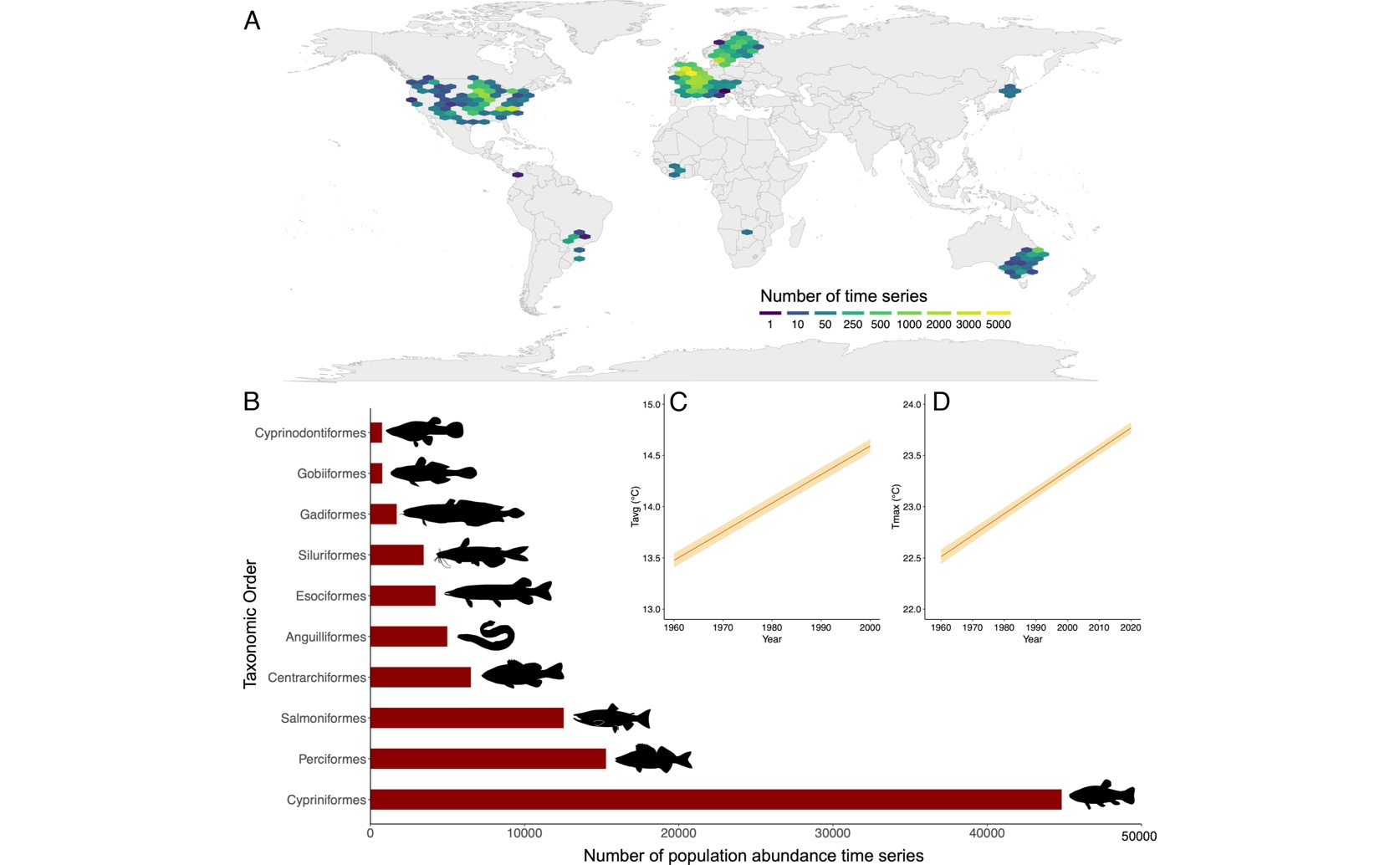
The multicontinental dataset of riverine fish populations analyzed in this study (a, b) confirms a significant increase in both average and extreme stream temperatures between 1958 and 2019 (c, d), the key climate trend driving the observed shifts in fish abundance across their geographical ranges.
Key Findings
- The study by the University of Bristol examined riverine fish populations' responses to climate change using data from 1958 to 2019
- Waters in the studied areas warmed by 0.21°C per decade
- Fish populations increased at cooler poleward limits and decreased at warmer equatorward limits, aligning with climate warming predictions
EnvironmentEcologyAnimal Science
References
Main Study
1) Climate warming drives population trajectories of freshwater fish.
Published 17th December, 2024 (future Journal edition)
https://doi.org/10.1073/pnas.2410355121
Related Studies
2) Rapid range shifts of species associated with high levels of climate warming.
3) A globally coherent fingerprint of climate change impacts across natural systems.
Journal: Nature, Issue: Vol 421, Issue 6918, Jan 2003
4) Climate-Related Local Extinctions Are Already Widespread among Plant and Animal Species.
Related Articles
 17th July, 2024 | Greg Howard