Understanding Antibiotic Resistance in Different Farming Systems

Jenn Hoskins
9th February, 2025

Understanding Antibiotic Resistance in Different Farming Systems

Despite ducks exhibiting a higher overall antimicrobial resistance (AMR) load (a) and greater taxonomic diversity of resistance-carrying species (d), broilers possess more unique AMR types (b), with both species demonstrating a significant decrease in AMR diversity that is inversely correlated with an increase in AMR abundance through the production phases (c).

Image adapted from: Szoke et al. / CC BY (Source)

Key Findings

  • A study in Hungary analyzed antimicrobial resistance (AMR) in chickens and ducks over 15 months, revealing shared and species-specific resistance patterns
  • AMR diversity decreased during production, but resistance marker frequency increased, especially in the finisher phase, highlighting the need for ongoing monitoring
  • Prophylactic antibiotic use reduced multidrug-resistant bacteria, but overuse risks worsening resistance, with the grower phase identified as a key intervention point
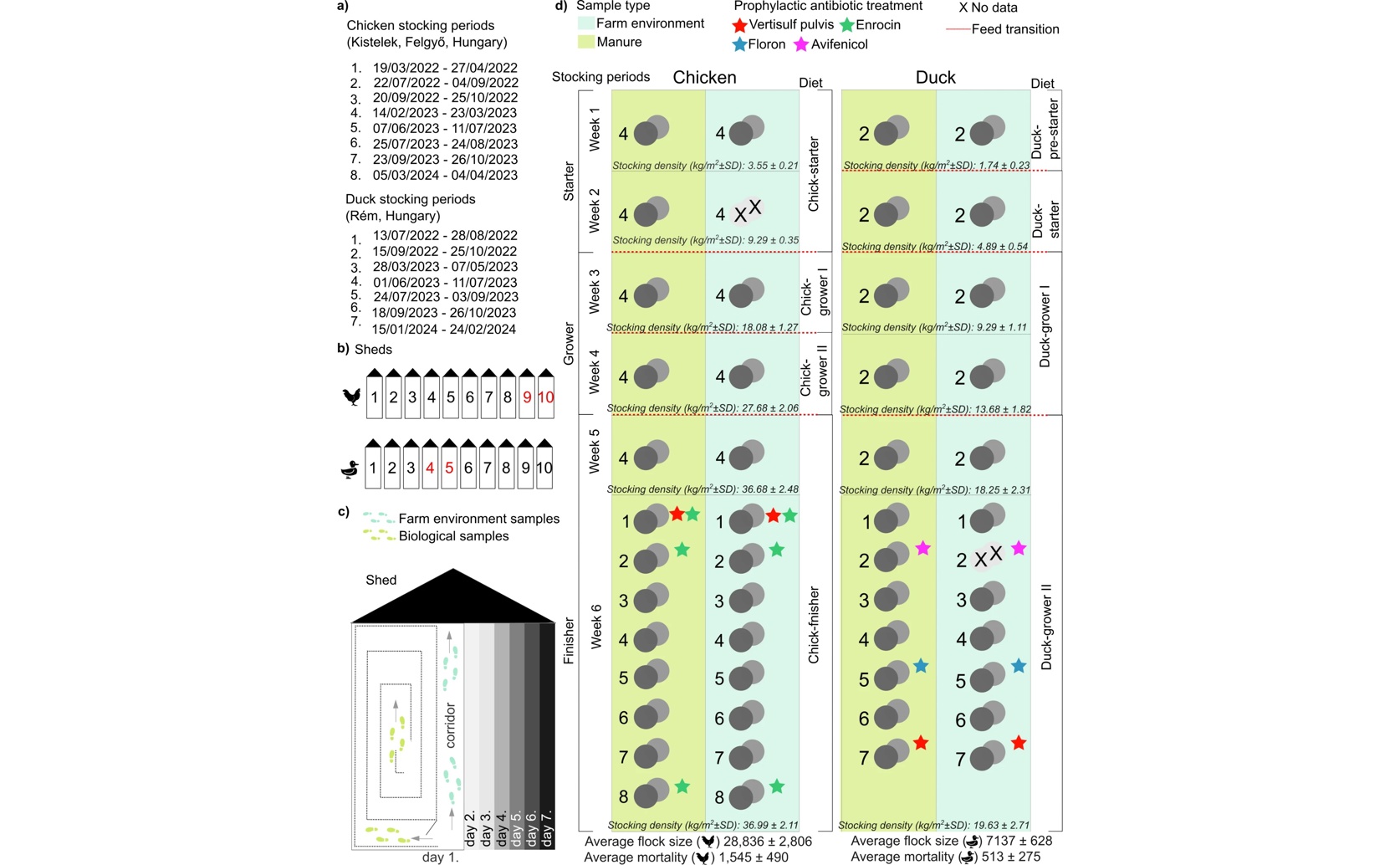
Antimicrobial resistance (AMR) is a pressing global health concern that threatens the effectiveness of antibiotics, which are critical for treating infections in humans and animals. AMR arises when microorganisms such as bacteria evolve to withstand the effects of antibiotics, rendering treatments less effective. While much research has focused on chickens in poultry farming, ducks remain underexplored in this context. A recent study conducted by the University of Debrecen[1] investigates AMR dynamics in two major poultry species—Ross 308 broilers (chickens) and Cherry Valley ducks—over a 15-month period, offering insights that could inform targeted interventions and sustainable management strategies. The study analyzed 96 pooled samples—50 from broiler farms and 46 from duck farms—collected across 15 production cycles under consistent rearing conditions. Using next-generation shotgun sequencing, researchers identified 3,665 distinct AMR types: 1,918 in broilers and 1,747 in ducks. Approximately 56.7% of these were shared between the two species, while 25.3% were specific to broilers and 18% to ducks. Interestingly, AMR diversity declined over the production phases, with broilers losing 641 AMR types and ducks losing 308. However, the frequency of AMR markers increased significantly by the finisher phase, underscoring the importance of monitoring resistance trends throughout the production cycle. The findings align with earlier research on the environmental and health impacts of intensive poultry farming[2]. Broilers exhibited higher levels of hospital-acquired infection-associated AMRs at the start of production, which declined significantly by the end of the rearing period. This suggests that the farm environment and rearing practices play a pivotal role in shaping resistance profiles. The study identified tetracycline and phenicol as the most prevalent resistance types, with specific resistance genes linked to bacterial species such as Bacteroides coprosuis, Pasteurella multocida, and Acinetobacter baumannii. These findings provide a clearer understanding of how resistance genes are distributed across different poultry species and production stages. Prophylactic antibiotic use—administering antibiotics to prevent disease rather than treat it—was found to significantly reduce the prevalence of multidrug-resistant bacteria in both broilers and ducks. This supports the broader One Health approach, which emphasizes the interconnectedness of human, animal, and environmental health in combating antibiotic resistance[3]. However, the study also highlights the risks of over-reliance on antibiotics in farming, as improper use can exacerbate the development and spread of resistance[4]. The grower phase emerged as a critical intervention point, suggesting that targeted measures during this stage could significantly mitigate resistance development. Environmental samples revealed biomarker species strongly correlated with high-resistance carriers (HRCs), which are bacterial species that harbor multiple resistance genes. Broiler farms exhibited higher abundances of key resistance genes compared to duck farms, with broiler-specific HRCs showing significantly higher relative frequencies. This finding underscores the role of farm environments in shaping species-specific resistance dynamics. Previous studies have documented the environmental footprint of poultry farming, including the role of waste by-products in disseminating resistance genes[2]. The current research builds on these findings by identifying specific bacterial species and resistance markers associated with environmental contamination. Despite its limitations, such as the focus on two poultry species and the reliance on in silico data, this study provides valuable insights into the dynamics of AMR in poultry farming. By identifying critical intervention points and species-specific resistance patterns, the research offers a foundation for developing targeted strategies to mitigate AMR risks. These findings are particularly relevant in the context of sustainable poultry production, where balancing productivity with environmental and public health considerations is paramount. The study also reinforces the importance of integrating environmental monitoring into AMR research, as highlighted in earlier work[4]. In conclusion, the University of Debrecen’s research sheds light on the complex interaction between poultry species, farm environments, and antimicrobial resistance. By addressing gaps in our understanding of AMR dynamics in ducks and broilers, the study contributes to a growing body of evidence supporting cross-sectoral approaches to combat this global health challenge.

AgricultureHealthAnimal Science

References

Main Study

1) Comprehensive analysis of antimicrobial resistance dynamics among broiler and duck intensive production systems.

Published 8th February, 2025

https://doi.org/10.1038/s41598-025-89432-z


Related Studies

2) Intensive poultry farming: A review of the impact on the environment and human health.

https://doi.org/10.1016/j.scitotenv.2022.160014


3) Antibiotic Resistance: One Health One World Outlook.

https://doi.org/10.3389/fcimb.2021.771510


4) Environmental factors influencing the development and spread of antibiotic resistance.

https://doi.org/10.1093/femsre/fux053


Related Articles

An unhandled error has occurred. Reload 🗙