Do more diverse, attractive parks help people recover from stress?

Jim Crocker
15th February, 2026

Do more diverse, attractive parks help people recover from stress?

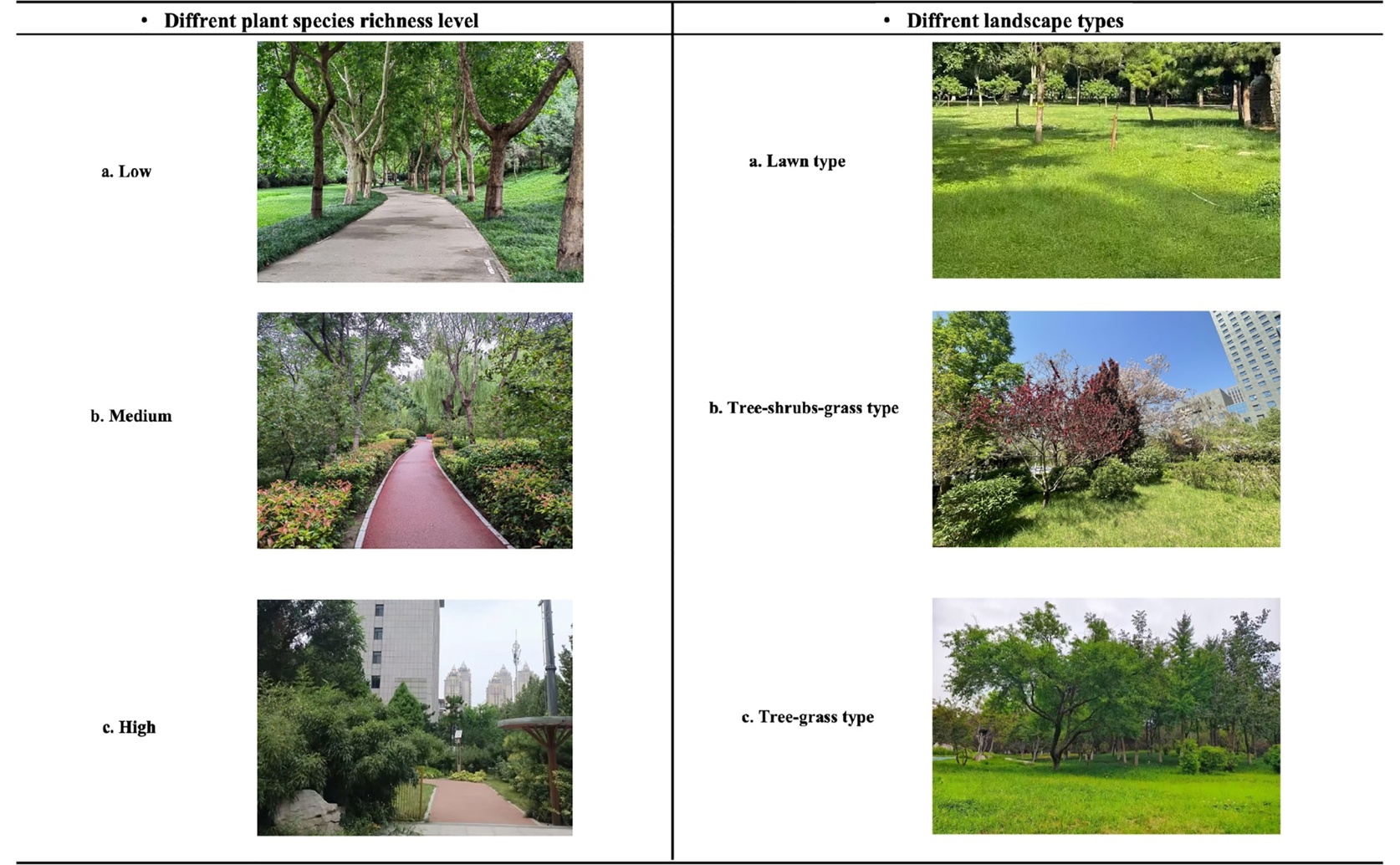
Of the various pocket park environments tested, landscapes with medium plant species richness and open lawns provided the greatest stress recovery for urban residents, outperforming those with lower or higher plant diversity (a–c) and more complex vegetation types (d–f).

Image adapted from: Wang et al. / CC BY (Source)

Key Findings

  • This study, conducted in Shijiazhuang China, investigated how plant arrangements in pocket parks affect stress levels in urban residents
  • Parks with a moderate number of plant species were most effective at reducing stress compared to parks with very few or many species
  • Surprisingly, parks featuring traditional lawns had the greatest stress recovery effect, suggesting a preference for maintained green spaces and visual order
Stress levels in Chinese cities are a growing concern, impacting the health of urban populations. Green spaces offer a potential solution, but understanding how these spaces contribute to well-being is crucial for effective urban planning. Pocket parks – small, accessible green areas within cities – are particularly important in densely populated environments. Recent research from Taylor’s University and the Hebei Institute of Communication[1] investigated how different plant arrangements within these pocket parks affect stress recovery, specifically looking at the number of plant species and the types of plant landscapes present, and whether people’s perception of beauty (aesthetic quality) plays a role. The study addressed a gap in existing knowledge; previously, there was limited research focusing on the specific plant elements that aid stress recovery in Chinese pocket parks. While the benefits of nature for mental health are well-established[2], the specifics of which natural elements are most effective, and why, remained unclear. The researchers hypothesized that both the variety of plants (species richness) and the design of the landscape would influence how much stress people felt after spending time in a park, and that this effect would be linked to how aesthetically pleasing people found the space. To test this, researchers used a ‘before-and-after’ design. They selected six pocket parks in China with varying plant landscapes and recruited 605 urban residents through random sampling. Participants completed questionnaires to measure their stress levels before visiting a park and after spending time there. This allowed the researchers to assess the change in stress levels associated with each park. The results revealed that parks with a moderate number of plant species were the most effective at reducing stress. Surprisingly, parks with traditional lawns had the greatest stress recovery effect. This finding contrasts with some recent trends promoting more ‘naturalistic’ planting schemes, such as spontaneous groundcovers[3], suggesting a preference for maintained green spaces in this context. Importantly, the study also showed that perceived aesthetic quality partially explained the link between plant landscapes and stress recovery. In other words, people experienced more stress reduction in parks they found visually appealing. This supports the idea that the beauty of a space isn’t just a nice-to-have, but actively contributes to its restorative benefits. This aligns with work demonstrating the potential for landscape assessment tools to predict aesthetic quality[4]. The research builds upon the concept of ‘Park Prescription’ programs[5], which encourage doctors to prescribe time in nature for health benefits. However, the study goes beyond simply recommending park visits. It identifies specific landscape characteristics – medium species richness and lawn landscapes – that appear to be most effective for stress recovery. The inclusion of aesthetic quality as a mediating factor is also significant, highlighting the importance of landscape design in maximizing the therapeutic potential of pocket parks. The findings provide valuable evidence for urban planners and landscape architects in China. It suggests that maintaining a balance between plant diversity and a well-kept appearance is important when designing pocket parks to support the well-being of urban residents. The study also reinforces the importance of considering people’s preferences when creating green spaces, as aesthetic perception plays a key role in stress recovery.[2] showed that urban dwellers experienced heightened stress levels during the pandemic, and that greenery helped reduce this, and this study expands on that by identifying which greenery is most effective.

EnvironmentMental HealthPlant Science

References

Main Study

1) Assessing stress restorative potential of plant species richness and plant landscape types of pocket parks: The mediating role of aesthetic quality

Published 13th February, 2026

https://doi.org/10.1371/journal.pone.0343001


Related Studies

2) The Role of Greenery in Stress Reduction among City Residents during the COVID-19 Pandemic.

https://doi.org/10.3390/ijerph20105832


3) Lawn or spontaneous groundcover? Residents' perceptions of and preferences for alternative lawns in Xianyang, China.

https://doi.org/10.3389/fpsyg.2023.1259920


4) A method for aesthetic quality modelling of the form of plants and water in the urban parks landscapes: An artificial neural network approach.

https://doi.org/10.1016/j.mex.2021.101489


5) Developing a Pocket Park Prescription Program for Human Restoration: An Approach That Encourages Both People and the Environment.

https://doi.org/10.3390/ijerph20176642


Related Articles

An unhandled error has occurred. Reload 🗙