How pores in sandstone affect fluid flow, revealed by advanced imaging

Greg Howard
11th January, 2026

How pores in sandstone affect fluid flow, revealed by advanced imaging

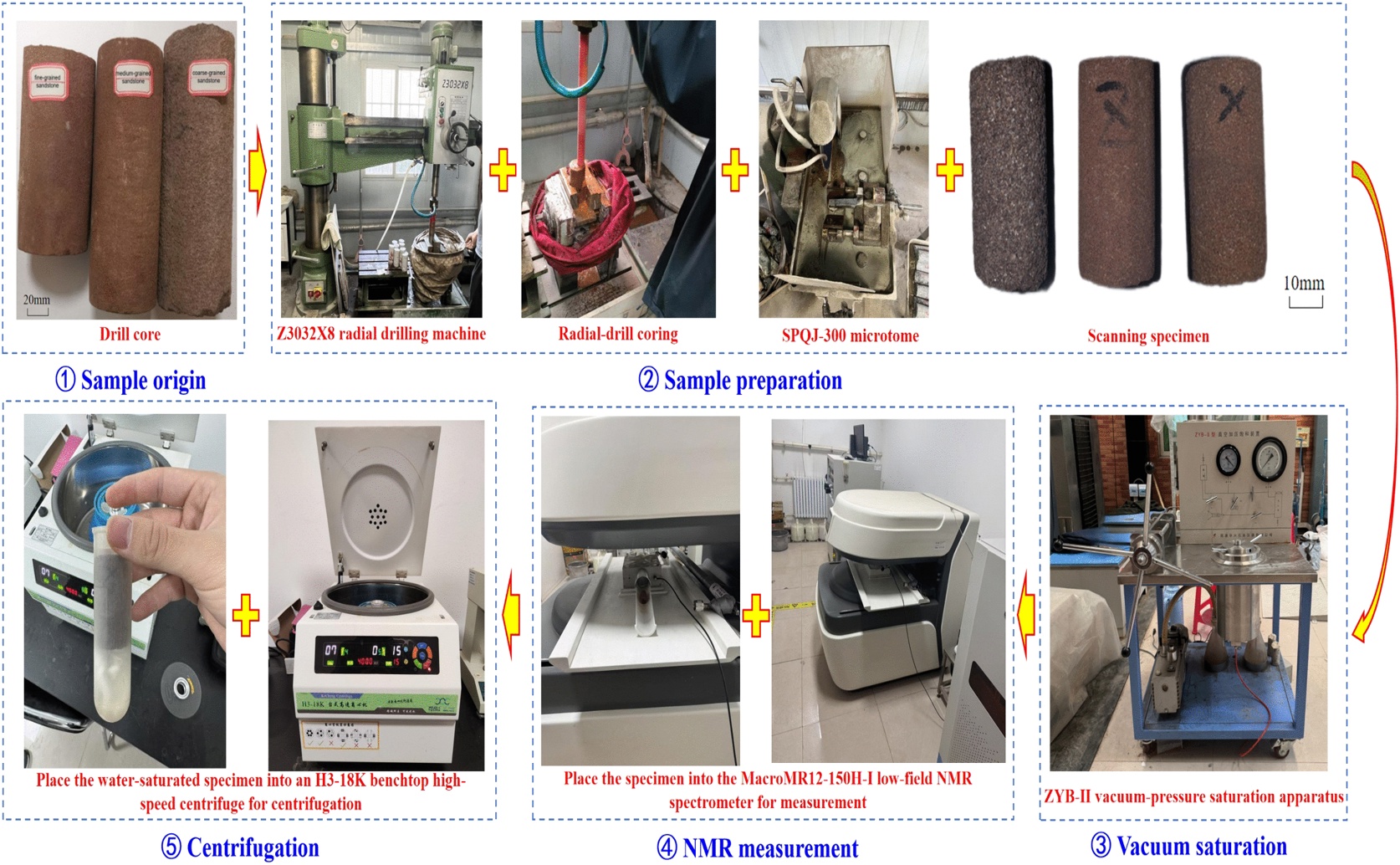
The experimental workflow for Nuclear Magnetic Resonance (NMR) analysis involves preparing, saturating, and centrifuging sandstone samples to measure the pore characteristics that determine fluid storage and flow capacity.

Image adapted from: Zhao et al. / CC BY (Source)

Key Findings

  • This study, conducted in the Gaojiapu coal mine, Ordos Basin, examined sandstone layers overlying coal seams to understand water flow and prevent potential disasters
  • Coarse sandstone has the most open pore structure and highest permeability, allowing water to flow easily through continuous pathways, while fine sandstone restricts flow due to isolated pores
  • Simulation results confirm that water flow is generally slow (below 0.08 m/s) in both coarse and fine sandstone, suggesting predictable flow under normal conditions
Coal mining operations frequently encounter the challenge of water ingress from the roof of coal seams, posing significant risks to safety and efficiency. Understanding how water flows through the rock layers above the coal is crucial for predicting and preventing these disasters. Researchers at Xijing University and Sichuan University of Science and Engineering recently undertook a detailed investigation of the Luohe Formation sandstones in the Gaojiapu coal mine, Ordos Basin, to characterize the pathways water takes through these rocks[1]. The study focused on three types of sandstone – coarse, medium, and fine – examining their internal structure and how easily water can move through them. Traditional methods of assessing these properties often provide limited insight into the complex pore networks within the rock. To overcome this, the research team employed a suite of advanced techniques, including Nuclear Magnetic Resonance (NMR), X-ray Computed Tomography (X-CT), and computational modeling using Avizo, Netfabb, and Comsol software. NMR works by detecting the magnetic properties of hydrogen atoms within the rock, providing information about the size and connectivity of pores – the tiny spaces within the rock that can hold water. X-CT creates detailed 3D images of the rock’s internal structure, allowing visualization of pores and fractures. Avizo and Netfabb were used to process and reconstruct these images, while Comsol was used for simulating fluid flow. The results revealed variations in porosity and permeability between the different sandstone types. Porosity, the percentage of void space in a rock, ranged from 14.36% in coarse sandstone to 17.82% in medium sandstone and 16.09% in fine sandstone. Permeability, a measure of how easily fluids flow through the rock, followed a similar trend, with coarse sandstone exhibiting the highest permeability at 38.77 millidarcy (mD) and fine sandstone the lowest at 0.87 mD. A darcy is a unit of permeability; higher values indicate greater ease of flow. Importantly, the study went beyond simply measuring total porosity. It differentiated between ‘movable’ and ‘immobile’ porosity. ‘Fully movable porosity’ – the portion of pore space readily connected and able to conduct water flow – was highest in coarse sandstone (68%) and lowest in fine sandstone (29%). This highlights that a significant portion of the pore space in the finer sandstones is isolated and doesn’t contribute to water flow. The researchers also analyzed the fractal dimensions of the pore networks, providing a mathematical description of their complexity. Further analysis using X-CT confirmed these findings, showing high connectivity (around 98% for all sandstone types) meaning the pores are well-linked, despite variations in total porosity. The average pore diameter and throat radius – the size of the openings connecting pores – were also relatively consistent across the three sandstone types, averaging around 17 μm and 30 μm respectively. Absolute permeability, measured independently, corroborated the NMR data, ranging from 10.88 darcy in coarse sandstone to 8.40 darcy in fine sandstone. The team then used Comsol to simulate water flow through the sandstones, revealing that low velocities (below 0.08 m/s) dominated in both coarse (80.14%) and fine (97.54%) sandstone. This finding is particularly significant, as it suggests that water flow is relatively slow and predictable under normal conditions. These findings build upon earlier research demonstrating the critical role of fractures in hydrocarbon reservoirs[2]. While the previous study focused on fractures enhancing permeability for oil and gas migration, the current study highlights the importance of understanding pore structure for water flow. In fact, the study reveals that the fractures aren’t necessarily the primary conduits for water flow, but rather macropores and micro-fractures are the main pathways. The earlier research also noted that fractures are often concentrated in specific zones, controlled by paleotectonic stresses[2], a concept that could be applied to understanding the distribution of water-bearing pathways in the Gaojiapu coal mine. The results of this study provide a theoretical basis for developing strategies to prevent roof water disasters. By understanding the flow behavior in different sandstone types, mining operations can better predict where water ingress is likely to occur and implement appropriate preventative measures.

AgricultureEnvironmentPlant Science

References

Main Study

1) Study on characterization of sandstone pore structure and seepage mechanism based on NMR and CT technology

Published 8th January, 2026

https://doi.org/10.1371/journal.pone.0337448


Related Studies

2) Characteristics and distribution of tectonic fracture networks in low permeability conglomerate reservoirs.

https://doi.org/10.1038/s41598-025-90458-6


Related Articles

An unhandled error has occurred. Reload 🗙