Plant hormones boost tea’s ability to withstand drought stress

Greg Howard
17th October, 2025

Plant hormones boost tea’s ability to withstand drought stress

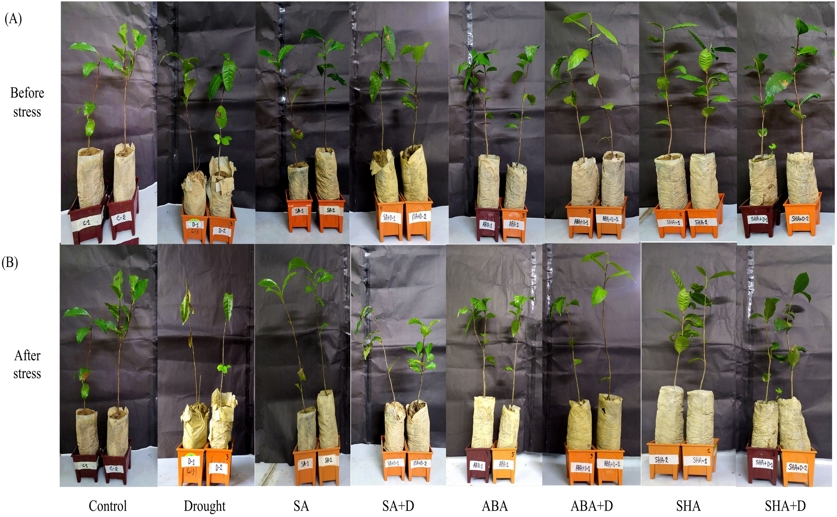
Tea plants treated with salicylic acid (SA), abscisic acid (ABA), and shikimic acid (ShA) showed significantly less physical damage under drought stress compared to untreated plants, which exhibited notable deterioration.

Image adapted from: Sheuli et al. / CC BY (Source)

Key Findings

  • In Bangladesh tea-growing regions, drought reduces tea yield by 14–33% and causes plant mortality, prompting research into improving drought tolerance
  • Foliar application of salicylic acid (SA), abscisic acid (ABA), and shikimic acid (ShA) reduced drought stress in tea plants by lowering oxidative damage and increasing antioxidant activity
  • Salicylic acid (SA) proved most effective, enhancing chlorophyll levels, proline accumulation, and antioxidant defenses, suggesting it’s a promising treatment for drought resilience
Drought is a significant threat to tea production worldwide, impacting both the growth and yield of this important crop. Plants, being stationary organisms, are constantly exposed to various environmental stresses, including drought, which can lead to cellular damage and reduced productivity[2]. A key aspect of a plant’s response to drought is the build-up of reactive oxygen species (ROS), molecules that can be both signalling agents and damaging agents within the plant[2][3]. Maintaining a balance between ROS production and removal is crucial for plant survival, and researchers are exploring ways to bolster this system to improve drought tolerance. A recent study by researchers at Shahjalal University of Science and Technology and University of Agricultural Sciences[1] investigated the potential of using three compounds – salicylic acid (SA), abscisic acid (ABA), and shikimic acid (ShA) – to help tea plants withstand drought conditions. These compounds were applied to tea plants before subjecting them to a period of water deprivation. The researchers then examined various indicators of plant health, including levels of antioxidants, chlorophyll, and a molecule called proline, which helps plants maintain water balance. The results showed that all three compounds helped to reduce the negative effects of drought stress. Treated plants exhibited lower levels of oxidative damage – a consequence of excessive ROS – and increased activity of antioxidant enzymes, which neutralize ROS. They also had higher levels of chlorophyll, essential for photosynthesis, and proline, suggesting improved ability to cope with water loss. Notably, salicylic acid (SA) proved to be the most effective in enhancing drought tolerance. This research builds upon earlier work demonstrating the utility of non-destructive methods for assessing drought stress in tea plants. Traditionally, measuring drought resistance relied on physiological and biochemical tests, which often damaged the plant and were time-consuming. However, studies have shown that hyperspectral imaging, combined with machine learning algorithms, can accurately predict drought-related changes in tea leaves without harming the plant[4]. This allows for faster and more efficient monitoring of water stress in tea gardens. The study further delved into the mechanisms behind SA’s effectiveness by examining the activity of 76 genes associated with SA and ShA pathways during drought. Using computational tools like Gene Ontology (GO) enrichment and KEGG pathway analysis, the researchers identified key genes and biological processes involved in the drought response. This analysis revealed that SA and ShA treatments strengthened the plant’s antioxidant defenses and helped maintain the integrity of cells under stress. The findings align with the understanding that ROS play a complex role in plant stress responses. While excessive ROS can be harmful, moderate levels are essential for signalling and activating defense mechanisms[2][3]. The Asada-Halliwell pathway, involving antioxidants like ascorbate and glutathione, is a crucial component of ROS detoxification[5]. The study suggests that SA, ABA, and ShA treatments enhance this pathway, allowing plants to better manage ROS levels and mitigate oxidative damage. The researchers propose that applying SA, ABA, and ShA could be a practical strategy for improving drought resilience in tea production. They suggest that combining these compounds with other approaches, such as genetic modification or the use of beneficial microbes, could further enhance the plants’ ability to withstand drought conditions.

AgricultureEnvironmentPlant Science

References

Main Study

1) Exogenous salicylic acid, abscisic acid, and shikimic acid enhance drought tolerance in tea by modulating antioxidant defense and osmotic regulation

Published 16th October, 2025

https://doi.org/10.1371/journal.pone.0331456


Related Studies

2) Abiotic Stress and Reactive Oxygen Species: Generation, Signaling, and Defense Mechanisms.

https://doi.org/10.3390/antiox10020277


3) Reactive Oxygen Species and Antioxidant Defense in Plants under Abiotic Stress: Revisiting the Crucial Role of a Universal Defense Regulator.

https://doi.org/10.3390/antiox9080681


4) Prediction of Drought-Induced Components and Evaluation of Drought Damage of Tea Plants Based on Hyperspectral Imaging.

https://doi.org/10.3389/fpls.2021.695102


5) Regulation of Ascorbate-Glutathione Pathway in Mitigating Oxidative Damage in Plants under Abiotic Stress.

https://doi.org/10.3390/antiox8090384


Related Articles

An unhandled error has occurred. Reload 🗙