How Irrigation Affects Soil Temperature Over Time and Space

Jenn Hoskins
19th September, 2025

How Irrigation Affects Soil Temperature Over Time and Space

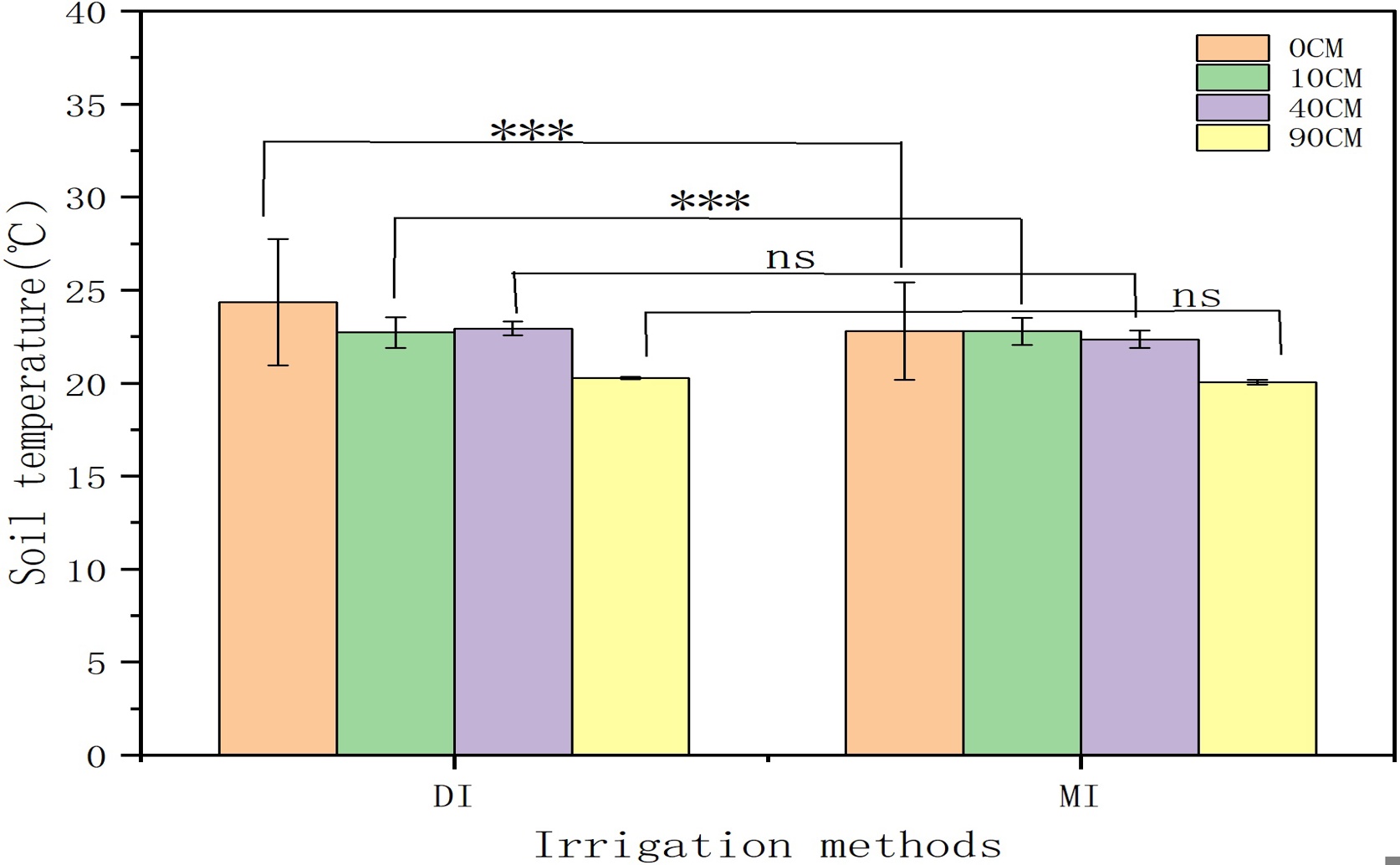
Correlation of soil temperature at different depths and positions in drip and flood irrigation.

Image adapted from: Chen et al. / CC BY (Source)

Key Findings

  • In maize fields in Northwest China, drip irrigation increased soil temperature by an average of 1.4% compared to flood irrigation over five years
  • Drip irrigation specifically raised the temperature in the root zone by 0.5% to 2.25%, creating more favorable conditions for crop growth
  • Soil temperature is closely linked to air temperature, with the surface layers being most affected by daily fluctuations, but drip irrigation helps maintain more stable root zone temperatures
Maintaining optimal soil temperature is crucial for successful agriculture, as it directly impacts the rate of physical, chemical, and biological processes within the soil[2]. However, understanding how different irrigation methods affect soil temperature, particularly over extended periods, has remained a challenge, especially in arid regions like Northwest China. Researchers at Yili Normal University, Xinjiang Academy of Agricultural Reclamation Science, and Ardakan University addressed this gap with a five-year field experiment[1]. The study focused on comparing drip irrigation and traditional flood irrigation in maize fields, examining soil temperature at various depths (0cm, 30cm, 60cm, 90cm) and locations – directly under the dripper (dripper source), within the root zone, and in the space between rows (inter-row buffer). The goal was to comprehensively assess the impact of water-saving drip irrigation on the soil’s thermal environment. The findings revealed a strong relationship between soil temperature and air temperature (p<0.001), meaning changes in the air temperature were closely mirrored in the soil, particularly in the surface layers. This aligns with previous research demonstrating air temperature as a primary control factor in soil moisture changes, especially in drier climates[3]. However, the study also highlighted that drip irrigation increased soil temperature by an average of 1.4% compared to flood irrigation. This increase was most pronounced in the root zone, with temperatures rising by 0.5% to 2.25%. Interestingly, soil temperature decreased with depth. The greatest temperature variations were observed at the soil surface (0cm), ranging from 19.79°C to 28.38°C, while temperatures at 90cm remained relatively stable between 19.98°C and 21°C. This finding supports the idea that soil temperature is not uniform throughout the soil profile, and the deeper layers are less susceptible to daily fluctuations[2]. The researchers emphasize the importance of multi-year monitoring, across multiple depths and positions, to fully understand the complex interplay between irrigation, soil, and climate. Previous studies, such as those investigating sloping land use in loess hilly regions, have also underscored the importance of considering different environmental factors and their interactions when assessing soil conditions[3]. The study builds upon this by specifically focusing on the long-term effects of drip irrigation and its impact on the soil’s hydrothermal conditions. The observed increase in root zone temperature due to drip irrigation suggests improved conditions for crop growth. By delivering water directly to the roots, drip irrigation not only conserves water but also optimizes the thermal environment, potentially enhancing nutrient uptake and overall plant health. This research provides a valuable theoretical framework for improving water use efficiency and crop productivity in arid agroecosystems, offering a scientific basis for developing sustainable agricultural practices in water-scarce regions.

AgricultureEnvironmentPlant Science

References

Main Study

1) Effects of different irrigation methods on the spatial and temporal distribution of soil temperature

Published 18th September, 2025

https://doi.org/10.1371/journal.pone.0332649


Related Studies

2) Soil temperature forecasting using a hybrid artificial neural network in Florida subtropical grazinglands agro-ecosystems.

https://doi.org/10.1038/s41598-023-48025-4


3) Land use affects the response of soil moisture and soil temperature to environmental factors in the loess hilly region of China.

https://doi.org/10.7717/peerj.13736


Related Articles

An unhandled error has occurred. Reload 🗙