How City Greenspace and Home Values Changed Before and After the Pandemic

Jenn Hoskins
9th September, 2025

How City Greenspace and Home Values Changed Before and After the Pandemic

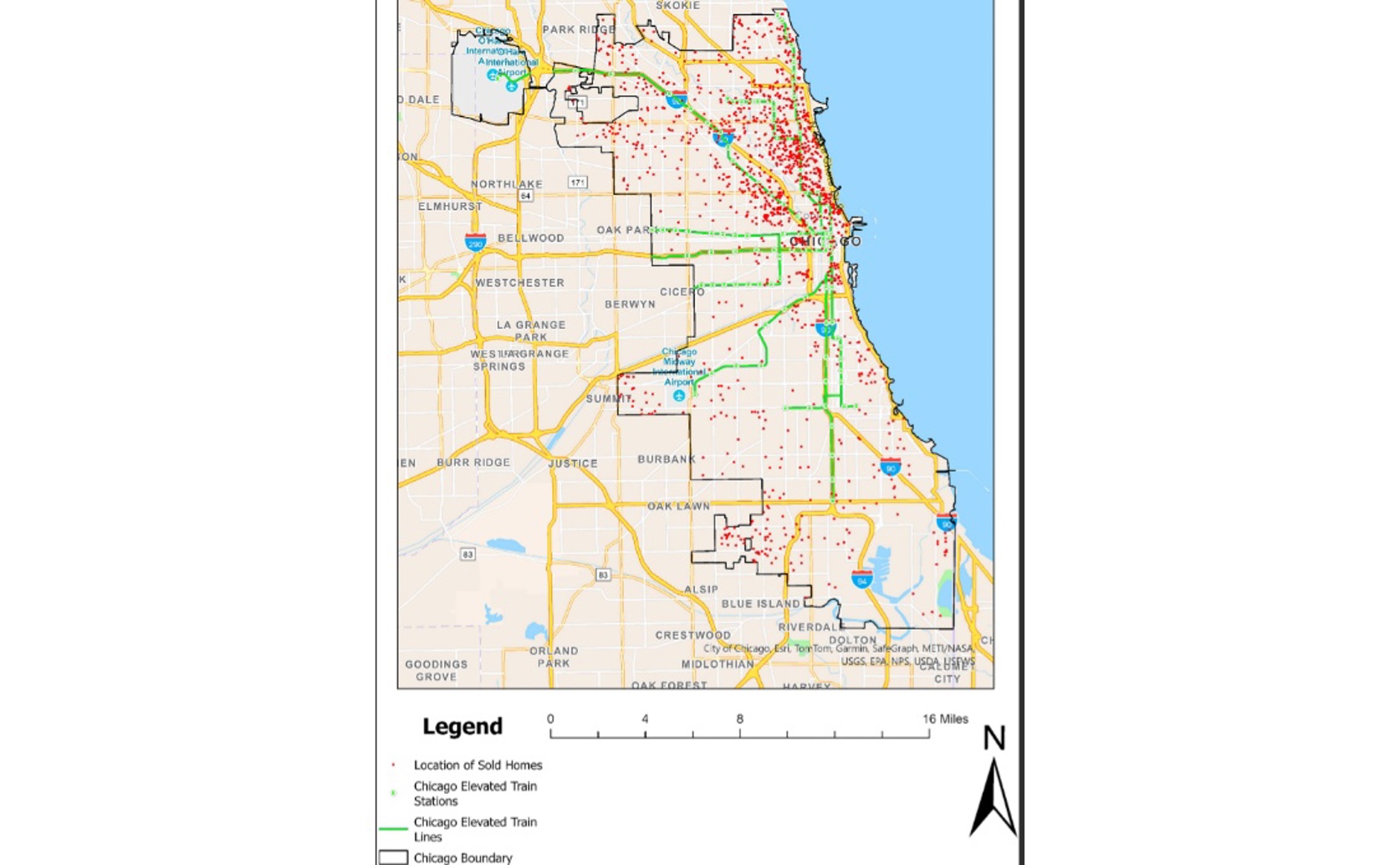
Distribution of housing transaction data in Chicago.

Image adapted from: Han et al. / CC BY (Source)

Key Findings

  • This Chicago study investigated how changes in green space affected home values before and after the COVID-19 pandemic
  • While more vegetation generally increased housing prices, this benefit wasn’t universal; neighborhoods on Chicago’s South Side saw property values decrease with increased green space
  • Local socioeconomic factors are critical, with wealthier neighborhoods showing more stable housing prices and less impact from green space changes than historically disadvantaged areas
The relationship between urban green spaces and property values is often assumed to be straightforward: more green space equals higher prices. However, this isn’t always the case, and the context of a city’s neighborhoods – their economic status and history – plays a crucial role. Researchers at Hanyang University and Gebze Teknik Universitesi[1] recently investigated this complex interplay in Chicago, looking at how the value of homes changed both before and after the COVID-19 pandemic. The study focused on understanding if the positive effect of green space on housing prices was consistent across all areas of Chicago, or if certain neighborhoods experienced different outcomes. To do this, they analyzed data on vegetation levels and housing prices, comparing pre-pandemic (before early 2020) and post-pandemic (after early 2020) trends. They used two main statistical methods: Ordinary Least Squares (OLS) and Multiscale Geographically Weighted Regression (MGWR). OLS is a standard technique for identifying general relationships between variables, while MGWR is more sophisticated; it allows for those relationships to vary across different locations, acknowledging that the impact of green space might be different in one neighborhood compared to another. The OLS model confirmed the general expectation: more vegetation tended to be associated with higher housing prices. However, the more detailed MGWR analysis revealed a far more nuanced picture. It showed that the benefits of green space weren’t evenly distributed. Specifically, neighborhoods on Chicago’s South Side exhibited a surprising trend – increases in green space were correlated with declines in property values, and this effect became more pronounced after the pandemic began. In contrast, the North Side, a wealthier area of the city, showed greater stability. Housing prices there were less affected by changes in green space and were more resilient to the economic disruptions caused by COVID-19. This finding challenges the simplistic notion that green space universally boosts property values. The researchers suggest that local socio-economic conditions are critical. The South Side has historically faced disinvestment and economic hardship, and the introduction of green spaces may not have been perceived as a positive amenity in the same way as in more affluent areas. It’s possible that residents had concerns about gentrification, or that the new green spaces weren’t of the same quality or accessibility as those in wealthier neighborhoods. These results build upon earlier research highlighting the importance of green spaces, particularly during times of crisis[2][3][4]. Studies during the COVID-19 pandemic consistently showed that people valued access to parks and green areas for their mental and physical wellbeing, and that visitation rates often increased when other recreational options were limited. However,[2] and other studies also noted that access wasn’t equal, and that the benefits of green space were often concentrated in more privileged communities. The Chicago study adds to this understanding by demonstrating that simply adding green space doesn’t automatically translate into economic benefits for all neighborhoods. Furthermore,[5] showed that park use, even during the pandemic, wasn’t necessarily associated with increased COVID-19 transmission, particularly in areas with well-distributed green spaces. This suggests that the quality and accessibility of green spaces are important factors, not just their mere presence. The Chicago study supports this idea by showing that the economic benefits of green space are contingent on the local context. The research from Hanyang University and Gebze Teknik Universitesi underscores the need for careful urban planning. Promoting sustainable development and equitable economic growth requires a nuanced understanding of how different communities perceive and value green spaces. Simply increasing the amount of green space isn’t enough; urban policymakers need to consider the specific needs and concerns of each neighborhood, and to ensure that new green spaces are high-quality, accessible, and integrated into the existing social fabric of the community.

AgricultureEnvironmentPlant Science

References

Main Study

1) The spatial dynamics of urban vegetation and housing prices: Insights from pre- and post-pandemic Chicago using OLS and MGWR models

Published 5th September, 2025

https://doi.org/10.1371/journal.pone.0330932


Related Studies

2) The impact of the COVID-19 pandemic on the importance of urban green spaces to the public.

https://doi.org/10.1016/j.landusepol.2021.105925


3) Impacts of COVID-19 pandemic on urban park visitation: a global analysis.

https://doi.org/10.1007/s11676-020-01249-w


4) Effects of the COVID-19 pandemic on the use and perceptions of urban green space: An international exploratory study.

https://doi.org/10.1016/j.ufug.2020.126888


5) Associations between COVID-19 transmission rates, park use, and landscape structure.

https://doi.org/10.1016/j.scitotenv.2021.148123


Related Articles

An unhandled error has occurred. Reload 🗙