Herbicide Amounts and Grain Crop Damage Risk in Sandy Soil

Greg Howard
24th August, 2025

Herbicide Amounts and Grain Crop Damage Risk in Sandy Soil

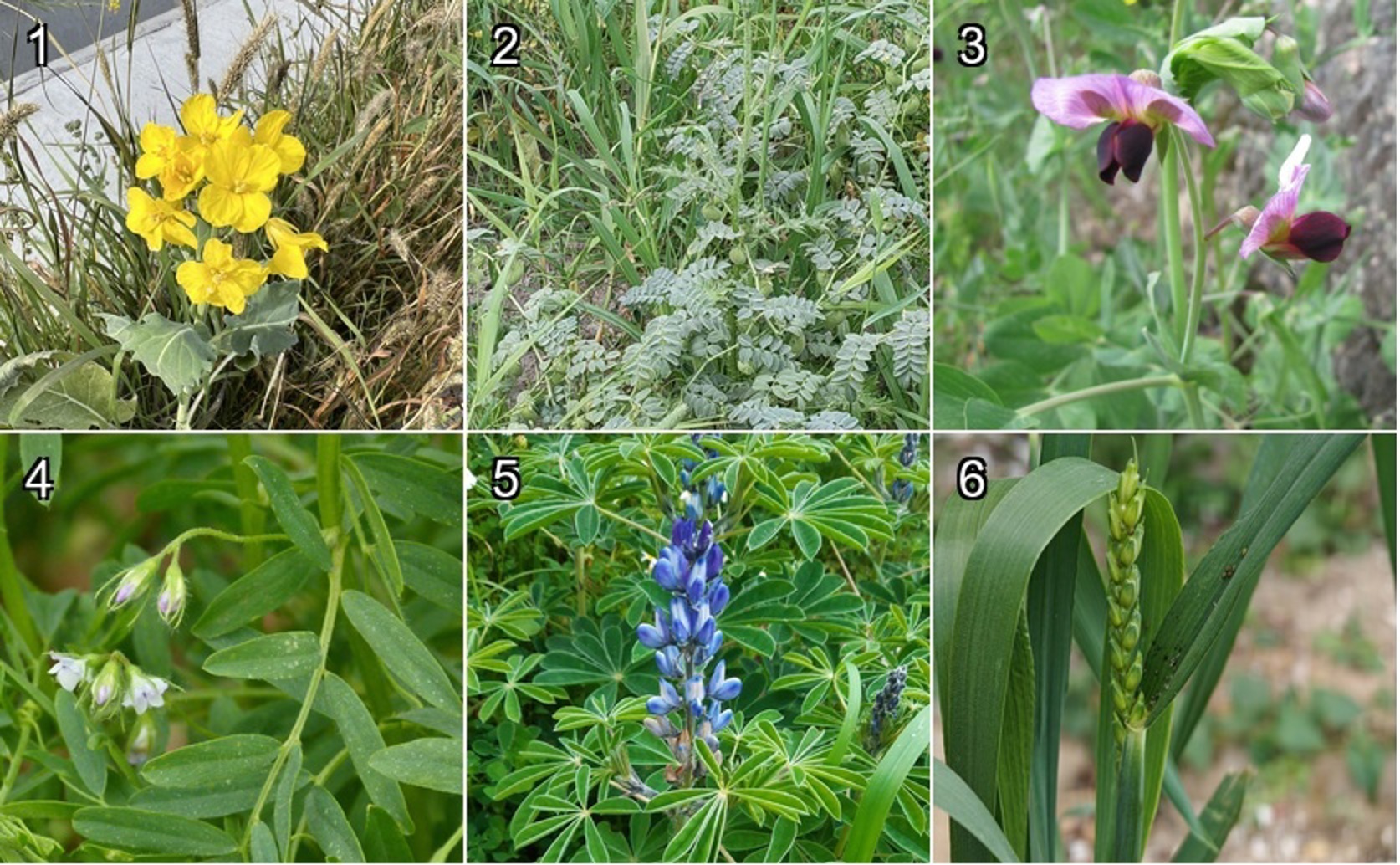
The six winter grain crops assessed for herbicide sensitivity in this study: (1) Canola (Brassica napus), (2) Chickpea (Cicer arietinum), (3) Fieldpea (Pisum sativum), (4) Lentil (Lens culinaris), (5) Lupin (Lupinus albus), and (6) Wheat (Triticum aestivum).

Composite: Natural Science News / CC BY-SA. [Sources]

Key Findings

  • This Australian study investigated how residual herbicides affect winter grain crops, revealing potential harm even at concentrations lower than typical application rates
  • Legumes like lentils were particularly sensitive to clopyralid, experiencing 50% growth reduction at just 29 micrograms per kilogram of soil
  • Wheat was highly susceptible to propyzamide and trifluralin, with complete growth inhibition at 100 and 375 micrograms per kilogram of soil, respectively
Herbicide residues remaining in soil after crop treatments can negatively impact subsequent plantings, causing reduced growth or even crop failure. While herbicides are vital for modern agriculture, understanding their persistence and potential harm to rotational crops is crucial for sustainable farming practices. A recent study conducted by researchers at Murdoch University, High Performance Soils CRC, WA Department of Biodiversity, Conservation & Attractions, Southern Cross University, and La Trobe University[1] investigated the sensitivity of six common winter grain crops to four widely used herbicides. The research focused on determining phytotoxicity thresholds – the concentration of a herbicide that causes a measurable negative effect on plant growth – for canola, chickpea, fieldpea, lentil, lupin, and wheat exposed to clopyralid, pyroxasulfone, propyzamide, and trifluralin. These thresholds are vital for assessing risk, as they allow farmers to understand the potential for damage based on residue levels in their fields. The study’s approach involved growing these crops in soil containing varying concentrations of each herbicide and observing the resulting impact on shoot and root development. The findings revealed significant sensitivity across all crops, often at concentrations lower than those typically applied in the field. Lentils proved particularly vulnerable to clopyralid, exhibiting a 50% reduction in emergence at just 29 micrograms per kilogram of soil (μg kg-1). Wheat emergence was also affected by propyzamide and trifluralin, with complete growth inhibition at 100 μg kg-1 and 375 μg kg-1 respectively. Legumes (chickpea, fieldpea, and lentil) – excluding lupin – showed substantial reductions in shoot and root parameters when exposed to clopyralid, with ED50 values ranging from 3 to 27 μg kg-1. Canola was most sensitive to pyroxasulfone, with shoot and root biomass reduced by 50% at 21 and 8 μg kg-1, respectively. Perhaps most concerningly, pyroxasulfone severely impacted root length in all crops tested, with ED50 values between 6 and 53 μg kg-1. These findings build upon earlier research demonstrating the widespread presence of herbicide residues in Australian grain cropping soils[2]. That study, conducted across numerous fields, consistently detected glyphosate and its breakdown product AMPA in almost all samples, alongside other herbicides like 2,4-dichlorophenoxyacetic acid, trifluralin, and diflufenican. The current study highlights that even at the concentrations found in those field surveys, there is a potential for phytotoxic effects, particularly in sensitive crops. The susceptibility of wheat to propyzamide and trifluralin is particularly noteworthy, given that resistance to trifluralin is increasing in annual ryegrass populations[3]. This resistance, identified through investigations into both target-site and non-target-site mechanisms, often involves enhanced herbicide metabolism within the plant. While resistance reduces the herbicide’s effectiveness in controlling weeds, it doesn’t necessarily eliminate the risk of phytotoxicity to sensitive rotational crops. Indeed, the increased reliance on herbicides due to resistance could lead to higher residue levels in the soil, exacerbating the problem. Furthermore, the study’s findings align with previous research on diuron toxicity[4], which also demonstrated that soil composition influences herbicide effects. The current study found that the impact of herbicides varied between crops, suggesting that factors like plant physiology and root structure play a role. The earlier diuron study[4] showed higher toxicity in sand compared to loamy sand due to reduced bioavailability in soils with higher organic matter content. The research team at Murdoch University et al. emphasize the need for further investigation into the effects of these herbicides on different soil types and, crucially, on actual crop yields. The study focused on early growth stages, and the long-term impact on yield may differ. This expanded research will be vital for developing accurate spatial and economic risk assessments, allowing farmers to make informed decisions about crop rotations and herbicide management practices.

AgricultureEnvironmentPlant Science

References

Main Study

1) Herbicide dose-response thresholds in sands to assess the risk of non-target damage to winter grain crops

Published 21st August, 2025

https://doi.org/10.1371/journal.pone.0330225


Related Studies

2) Herbicide residues in Australian grain cropping soils at sowing and their relevance to crop growth.

https://doi.org/10.1016/j.scitotenv.2022.155105


3) Enhanced Trifluralin Metabolism Can Confer Resistance in Lolium rigidum.

https://doi.org/10.1021/acs.jafc.8b02283


4) Phytotoxicity risk assessment of diuron residues in sands on wheat, chickpea, and canola.

https://doi.org/10.1371/journal.pone.0306865


Related Articles

An unhandled error has occurred. Reload 🗙