Storing Ginseng Sustainably

Jenn Hoskins
21st June, 2025

Storing Ginseng Sustainably

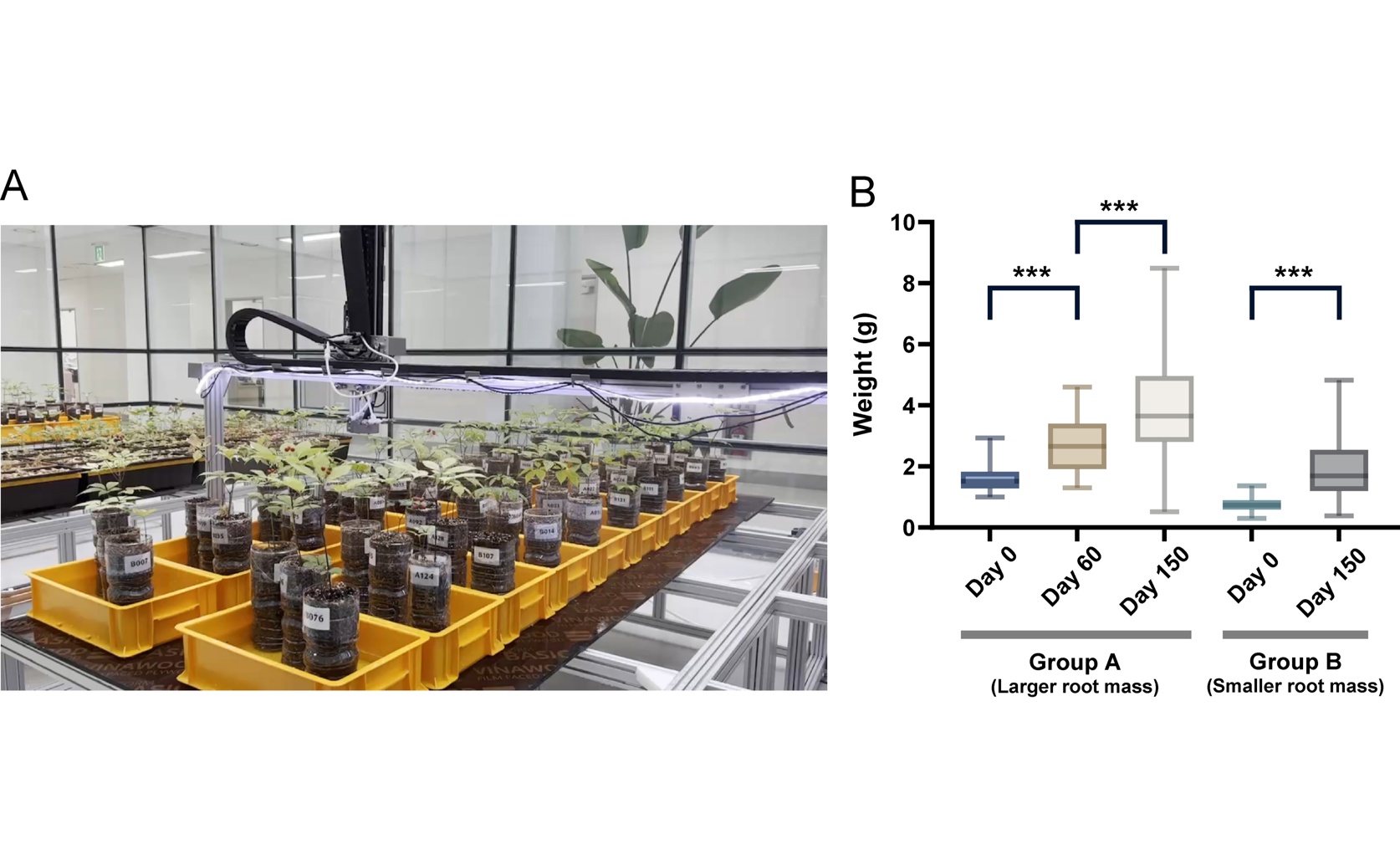
A five-month, climate-smart post-harvest treatment successfully enhanced the development of Wild-simulated ginseng (Panax ginseng), significantly increasing root weight while achieving a survival rate of over 96% (B).

Image adapted from: Kim et al. / CC BY (Source)

Key Findings

  • Researchers at Jeonbuk National University developed a "climate-smart" method that significantly boosts wild-simulated ginseng growth and survival
  • This new approach increased root weight by 2.5 times and ensured a 97% survival rate, while preserving the ginseng's valuable medicinal compounds, including rare ones
Ginseng, particularly the wild or wild-simulated varieties, has long been revered in traditional medicine for its wide array of health benefits. These benefits stem largely from unique active compounds known as ginsenosides, which are a type of triterpene saponin[2]. Modern scientific studies have increasingly validated these traditional uses, showing that ginsenosides possess significant therapeutic potential, including anticancer and anti-inflammatory properties[3]. However, acquiring wild ginseng is challenging due to its scarcity, slow growth, and low survival rates in traditional cultivation methods. This has led to the development of wild-simulated ginseng (WSG), which aims to mimic the natural growing conditions of wild ginseng to achieve a similar quality. Yet, even WSG cultivation faces hurdles like declining survival rates and lengthy growth periods. Addressing these challenges, researchers at Jeonbuk National University recently conducted a study[1] to develop an improved post-harvest treatment for WSG. Their goal was to enhance the survival rate and root growth of WSG while preserving its characteristic profile of ginsenosides, which are crucial for its medicinal value. The study involved transplanting three-year-old WSG roots into a controlled 'climate-smart' facility. Within this facility, conditions such as light and irrigation were precisely regulated, and a certified organic ginseng soil medium was used. For five months, the growth performance of the WSG was carefully monitored, and its ginsenoside composition was analyzed using a technique called ultra-performance liquid chromatography, which allows for precise identification and measurement of different compounds. The results were highly promising. After the treatment period, the WSG roots showed a remarkable 2.5-fold increase in weight, and the overall survival rate was an impressive 97%. Crucially, the total amount of ginsenosides reached 10.458 milligrams per gram of dried ginseng. The analysis also revealed notably high levels of a specific ginsenoside called Re, along with the presence of rare compounds such as Compound K (CK) and Rg3. The root-to-shoot ratio, an indicator of how efficiently the plant allocates its resources to the valuable root, exceeded 1.23, demonstrating robust root development. These findings from Jeonbuk National University demonstrate that a controlled, climate-smart post-harvest treatment can effectively boost the growth and survival of wild-simulated ginseng while maintaining its high medicinal quality. This is particularly significant when considering the known differences between wild and cultivated ginseng. Earlier research has shown that wild ginseng is often considered superior in medicinal quality, largely due to a greater diversity and abundance of active components, especially ginsenosides[4]. Specifically, rare ginsenosides like Compound K (CK), F1, Rg5, Rh1, PPT, and Rg3 have been found to be enriched in wild ginseng[4]. The presence of these rare compounds in the WSG treated in the current study suggests that this controlled cultivation method can help bridge the gap between traditionally cultivated ginseng and the highly prized wild varieties. The ability to enhance root development and maintain a rich ginsenoside profile under controlled conditions offers a promising solution to the limitations of conventional ginseng cultivation, such as its long growth periods and susceptibility to environmental factors. The precise control over light and irrigation in the 'climate-smart' facility could be a key factor. For instance, previous research has indicated that the composition of ginsenosides within the ginseng plant can vary significantly depending on the plant's growth stage and even the specific organ, such as the leaf versus the root[5]. It was observed that higher levels of certain ginsenosides, like PPT-type ginsenosides, in leaves could be positively correlated with light exposure[5]. While the current study focused on roots, the controlled light environment in the smart facility likely played a role in optimizing the overall plant metabolism to favor root development and ginsenoside accumulation. Furthermore, the general understanding of Korean Panax ginseng's pharmacological efficacy, ranging from improved brain function to anti-tumor activity[2], underscores the importance of studies like this one. By improving the yield and quality of wild-simulated ginseng, this research contributes to a more sustainable and commercially viable supply of a plant whose main active components, ginsenosides, are increasingly recognized for their potential in treating severe diseases like cancer, either alone or in combination with other therapies[3]. This approach not only addresses the practical challenges of cultivation but also supports the continued exploration of ginseng's therapeutic benefits by ensuring a consistent and high-quality source of its valuable compounds.

AgricultureEnvironmentPlant Science

References

Main Study

1) Post-harvest treatment of wild-simulated ginseng under climate-smart environmental conditions

Published 18th June, 2025

https://doi.org/10.1371/journal.pone.0326237


Related Studies

2) Botanical characteristics, pharmacological effects and medicinal components of Korean Panax ginseng C A Meyer.

https://doi.org/10.1111/j.1745-7254.2008.00869.x


3) Anticancer Activities of Ginsenosides, the Main Active Components of Ginseng.

https://doi.org/10.1155/2021/8858006


4) Comparison of the metabolomic and proteomic profiles associated with triterpene and phytosterol accumulation between wild and cultivated ginseng.

https://doi.org/10.1016/j.plaphy.2023.01.020


5) Ginsenoside profiles and related gene expression during foliation in Panax ginseng Meyer.

https://doi.org/10.1016/j.jgr.2013.11.001


Related Articles

An unhandled error has occurred. Reload 🗙