Image Segmentation With Active Contours For Better Brick Design

Jim Crocker
24th August, 2025

Image Segmentation With Active Contours For Better Brick Design

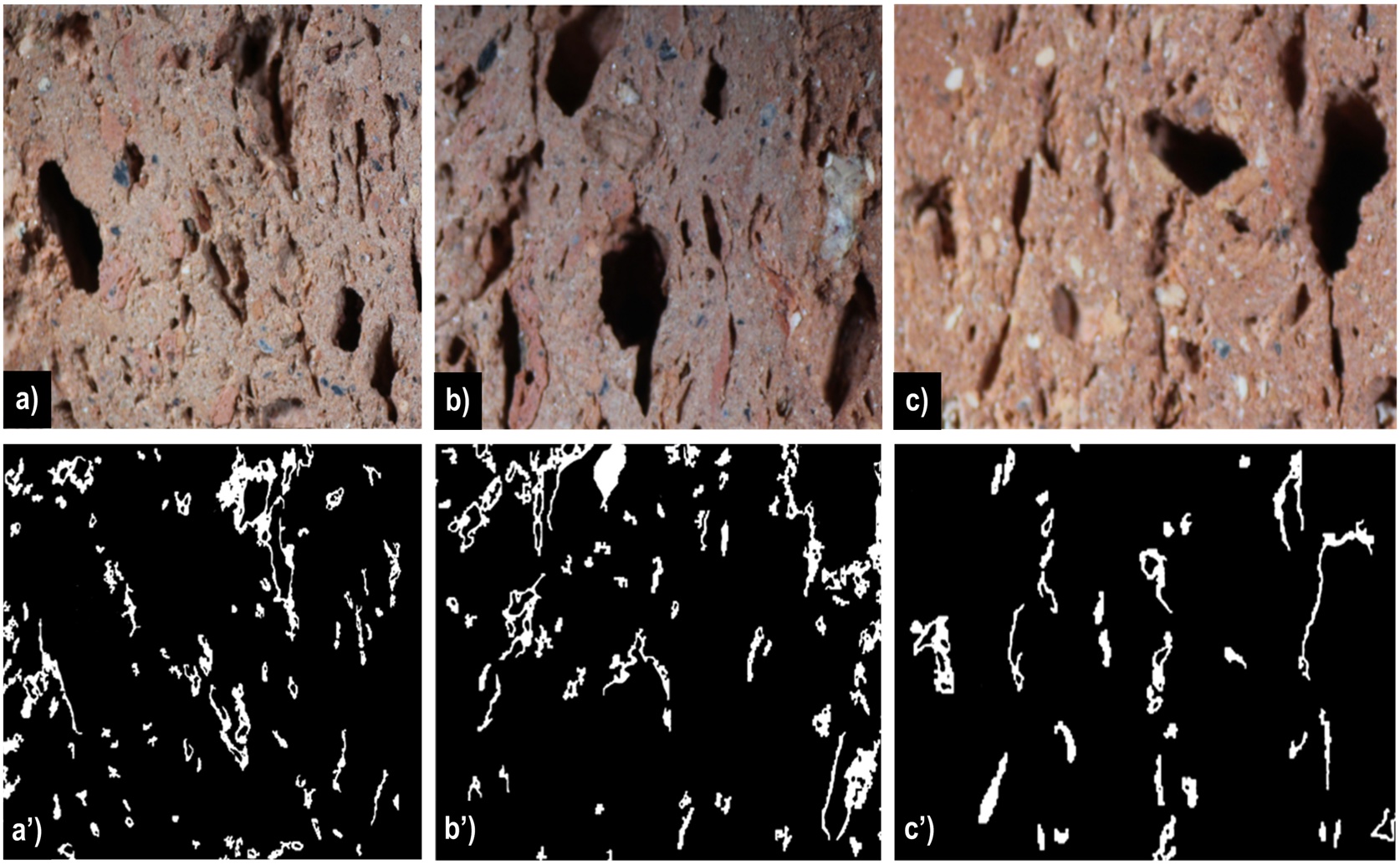
The alignment of defocus masks (a’–c’) with visible pore structures (a–c) confirms that utilizing optical blur enables accurate porosity quantification in bricks containing 15% sewage sludge.

Image adapted from: Baloi et al. / CC BY (Source)

Key Findings

  • Researchers in Bucharest studied using wastewater sludge in fired clay bricks to reduce waste and improve thermal insulation
  • Adding up to 15% sewage sludge to bricks maintained acceptable strength standards while increasing porosity for better heat retention
  • A new image analysis technique accurately measured pore size, revealing a trade-off between increased sludge content, improved insulation, and reduced brick strength
The disposal of wastewater sludge – the semi-solid material remaining after sewage treatment – presents a significant environmental challenge. Traditionally, this sludge is landfilled, a practice with potential drawbacks including land usage and release of harmful substances. However, sludge is rich in organic matter and can, in principle, be repurposed. Finding viable applications for this waste product is a growing area of research, focused on converting a problem into a resource. Recent work by researchers at the University of Bucharest[1] investigates incorporating dry wastewater sludge into the production of fired clay bricks. The core idea is to use the sludge as a ‘pore-forming agent’ – a material that creates voids within the brick structure. These voids can enhance the brick’s thermal insulation properties, reducing energy consumption in buildings. The study focused on optimising the mix of ingredients: ash, clay, and varying amounts of wastewater sludge. A key challenge in assessing the suitability of these mixtures is accurately measuring porosity – the amount of empty space within the brick. Traditional methods can be unreliable due to the complex and uneven structure of the material. The researchers developed a new image analysis technique using ‘active contours’ to more precisely identify and quantify pores in microscopic images of the bricks. This technique accounts for factors like light reflections and blurring, providing a more accurate assessment of the brick’s internal structure. The thermal performance of the bricks was assessed using two methods: infrared thermography (measuring heat flow) and thermogravimetric analysis (measuring weight changes with temperature). Results confirmed that increasing the sludge content increased porosity, leading to improved thermal insulation. However, this came at a cost: higher sludge levels also reduced the mechanical strength of the bricks. Interestingly, this finding aligns with earlier research exploring the use of alternative materials in 3D-printed concrete[2]. That study found that while substituting natural sand with limestone powder could improve printability and even enhance mechanical properties up to a certain point (around 40% replacement), further increases led to reduced flowability and ultimately, decreased strength. Both studies highlight a common trade-off: modifying concrete or brick compositions with waste materials can improve some properties while potentially compromising others. The research team found that even with reduced strength, a mixture containing 15% sewage sludge still met the standards for ‘first-class’ bricks as defined by ASTM C62, a widely used standard in brick manufacturing. This is a crucial finding, suggesting that incorporating sludge is practically feasible without sacrificing essential performance characteristics. Similar success was observed in previous work utilizing sewage sludge in ceramic brick production[3], which demonstrated that up to 15% sludge incorporation was viable, maintaining acceptable compressive strength. Furthermore, the study builds on broader understanding of sludge production and potential uses. Analyses performed by researchers[4] indicate that a substantial amount of wastewater sludge is generated annually – 12.56 Tg/y globally – and a significant portion is currently not being beneficially utilized. This highlights the potential impact of finding effective recycling pathways like the one proposed in. The work also complements efforts to aggregate sludge feedstock regionally, supporting the scalability of waste-to-energy and waste-to-material conversion technologies. The research, conducted collaboratively by the University of Bucharest, Graphit Innovation Factory, National Institute for Research and Development of Isotopic and Molecular Technologies, and Monash University, demonstrates that incorporating sewage sludge into fired clay brick production is a sustainable and practical approach to waste management, offering both environmental and economic benefits.

AgricultureEnvironmentPlant Science

References

Main Study

1) Light microscopy image segmentation using active contours driven by local image information for environmentally friendly fired-clay bricks design and characterization

Published 21st August, 2025

https://doi.org/10.1371/journal.pone.0328270


Related Studies

2) Utilization of solid mine waste in the building materials for 3D printing.

https://doi.org/10.1371/journal.pone.0292951


3) Potential re-use of sewage sludge as a raw material in the production of eco-friendly bricks.

https://doi.org/10.1016/j.jenvman.2021.113238


4) Municipal wastewater sludge as a sustainable bioresource in the United States.

https://doi.org/10.1016/j.jenvman.2017.04.032


Related Articles

An unhandled error has occurred. Reload 🗙