How a field's history impacts future plant growth

Jenn Hoskins
18th February, 2026

How a field's history impacts future plant growth

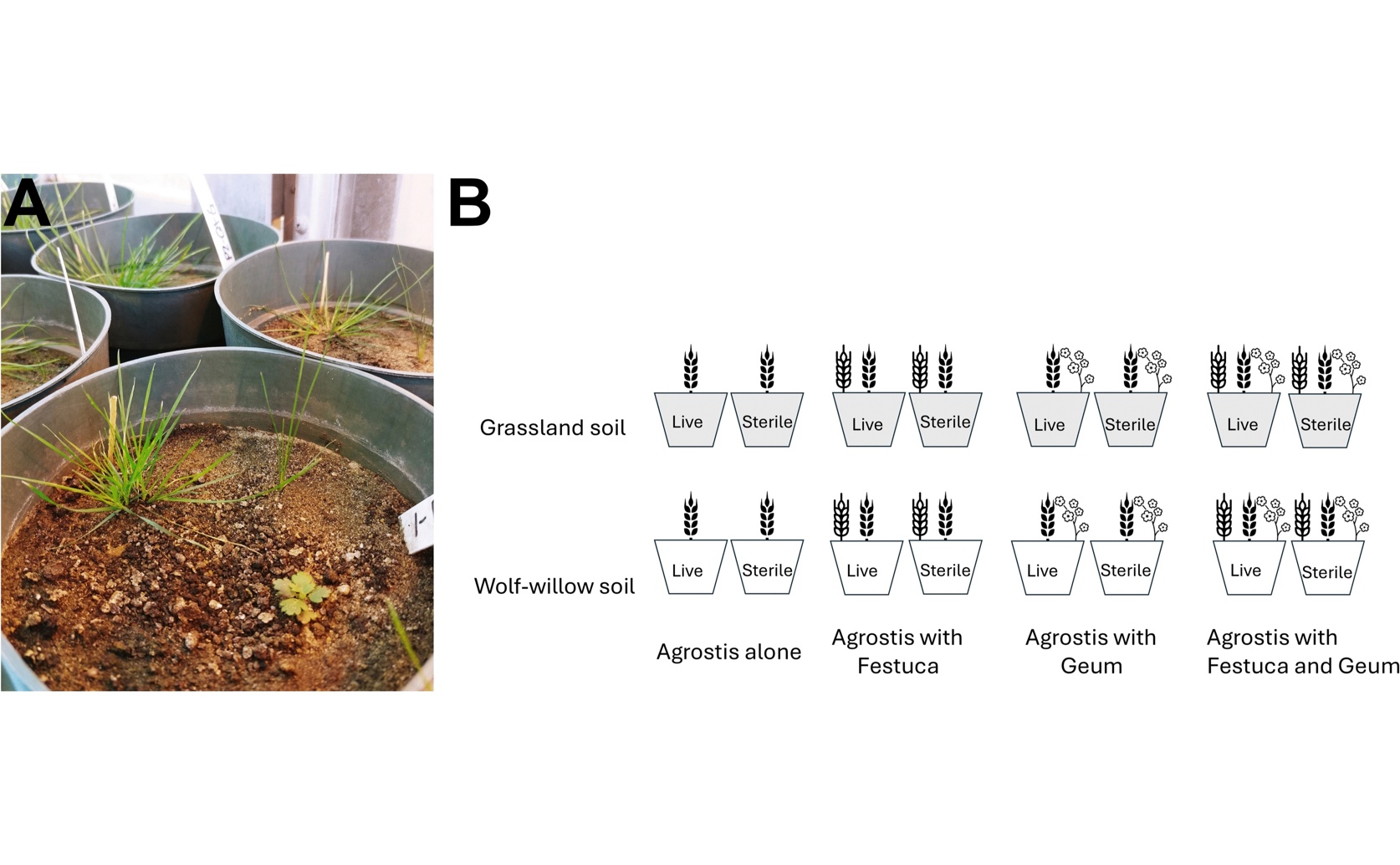
The experimental design, shown in a photograph (a) and diagram (b), revealed that the influence of soil biota on the grass Agrostis scabra is not a fixed property but changes depending on both the soil's origin and the identity of neighbouring plants.

Image adapted from: Oppon et al. / CC BY (Source)

Key Findings

  • In Alberta grasslands, soil from areas with wolf-willow shrubs initially slowed the growth of a grass species, suggesting the soil contains factors harmful to it
  • The negative impact of wolf-willow soil on grass growth disappeared when other plant species were nearby, but reappeared when both neighbour species grew alongside it
  • The effect of soil on plant growth isn't fixed; it depends on which plants are growing nearby, highlighting the importance of considering the whole plant community
Soil plays a critical role in determining which plants grow where, and how plant communities change over time. However, the influence of past vegetation on soil – known as soil legacies – and how these legacies impact current plant growth is a complex area of study. These legacies aren't simply about the soil's chemical composition; the communities of organisms living within the soil, collectively known as soil biota, are also key. Recent research from the University of Alberta and National Cheng Kung University[1] investigates how these soil biota effects change depending on the plants growing nearby. The study focused on a common ecological transition in northern prairies: the encroachment of wolf-willow shrubs ( Elaeagnus commutata ) into grasslands. Shrub encroachment is often linked to land degradation, but studies have shown this isn't always the case[2]. To understand how wolf-willow impacts the surrounding plant community, researchers examined the growth of Agrostis scabra (a grass species) when grown in soil collected from either a grassland or a wolf-willow shrubland. They then investigated how the presence of neighbouring plants – Festuca hallii (another grass) and Geum triflorum (a forb, or herbaceous flowering plant) – altered the effects of the soil. The initial results showed that A. scabra grew differently depending on the soil it was planted in. When grown alone, soil from the grassland had little effect on its growth, while soil from the wolf-willow shrubland significantly reduced growth. This suggests that the soil biota associated with wolf-willow has a negative impact on A. scabra. However, the most interesting finding was that the presence of neighbours changed this outcome. In the wolf-willow soil, the negative effect on A. scabra disappeared when either grass or forb neighbours were present individually. Surprisingly, this negative effect re-emerged when both neighbours were grown alongside A. scabra. This indicates that the interactions between the soil biota and the plants are not simply additive; the combined effect of the neighbours is different than the sum of their individual effects. In grassland soil, a similar pattern was observed: the forb neighbour alone reduced A. scabra growth, but this effect vanished when both neighbours were present. These findings highlight the context-dependent nature of soil legacies. The effect of soil biota on plant growth isn't fixed by the soil’s origin, but is instead dictated by the plant’s immediate surroundings. This builds on earlier work showing that plant-soil feedback can be positive, negative, or neutral depending on the successional stage of the ecosystem and the plant species involved[3]. The study from the University of Alberta and National Cheng Kung University takes this a step further, demonstrating that neighbour identity and density also play a crucial role. The researchers also investigated potential reasons for these interactions, finding differences in soil chemistry between the grassland and wolf-willow soils, particularly a lower pH in the wolf-willow soils. This lower pH likely influences the composition of the microbial communities within the soil, and therefore how they interact with plant roots. This is consistent with the idea that host-specific changes in soil community composition can generate feedback on plant growth, mediated by mechanisms such as rhizosphere bacteria, nematodes, and mycorrhizal fungi[4]. The study underscores the importance of considering the entire plant community and the complex interactions between plants, soil biota, and abiotic factors when trying to understand vegetation change and species coexistence.

AgricultureEcologyPlant Science

References

Main Study

1) Neighbourhood composition dictates expression of soil legacy effects on plant growth

Published 17th February, 2026

https://doi.org/10.1371/journal.pone.0342996


Related Studies

2) Shrub encroachment can reverse desertification in semi-arid Mediterranean grasslands.

https://doi.org/10.1111/j.1461-0248.2009.01352.x


3) Temporal variation in plant-soil feedback controls succession.

Journal: Ecology letters, Issue: Vol 9, Issue 9, Sep 2006


4) Soil community feedback and the coexistence of competitors: conceptual frameworks and empirical tests.

https://doi.org/10.1046/j.1469-8137.2003.00714.x


Related Articles

An unhandled error has occurred. Reload 🗙