Soil bacteria changes during drought don’t necessarily help plants grow

Jim Crocker
27th November, 2025

Soil bacteria changes during drought don’t necessarily help plants grow

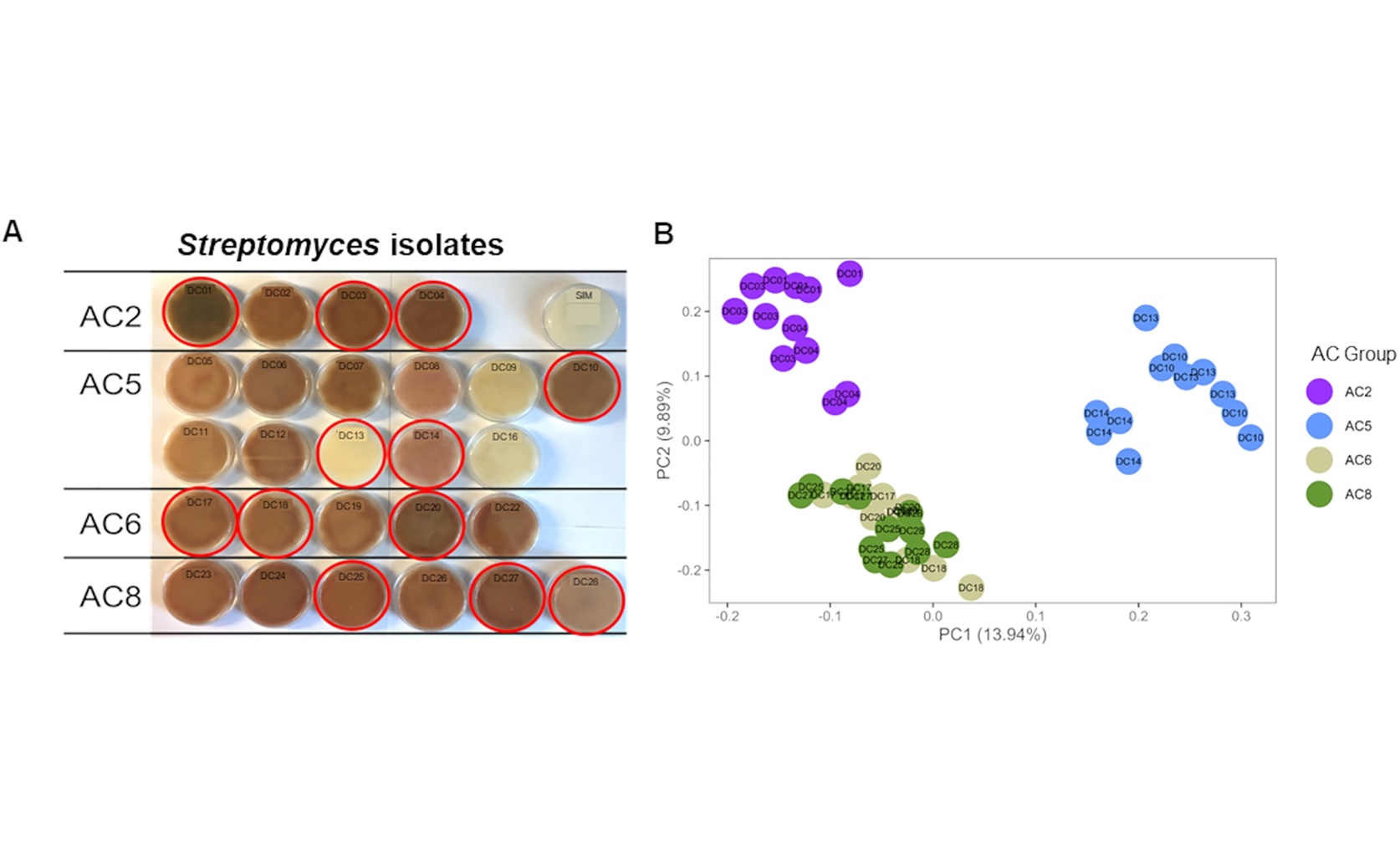
Streptomyces isolates that are indistinguishable by a common genetic marker (V3-V4 16S rRNA) actually exhibit significant underlying diversity, revealed through their varied physical appearance on growth media (A) and distinct metabolic outputs (B).

Image adapted from: Fonseca-Garcia et al. / CC BY (Source)

Key Findings

  • Researchers at multiple institutions found the Streptomyces genus consistently increases in sorghum root microbiomes during drought conditions
  • While Streptomyces becomes more abundant with drought, this enrichment doesn’t automatically mean it benefits the plant’s growth or survival
  • Specific genes related to water balance and cell membrane building are linked to Streptomyces drought enrichment, but these aren’t consistently tied to the bacteria’s evolutionary relationships
Drought poses a significant and growing threat to agriculture worldwide, impacting crop yields and food security. Plants aren’t isolated in their struggle against drought; they exist within a complex community of microorganisms, collectively known as the plant microbiome. This microbiome, encompassing bacteria, archaea, and fungi, plays a critical role in plant health, influencing growth, nutrient uptake, and stress tolerance[2][3]. Understanding how these microbial communities respond to, and potentially mitigate, drought stress is therefore crucial for developing strategies to improve crop resilience. Recent research has consistently shown that the genus Streptomyces becomes more abundant in the root microbiomes of plants experiencing drought, but the reasons behind this enrichment and whether it translates to actual benefits for the plant have remained unclear. Researchers at UC Berkeley, the USDA Plant Gene Expression Center, Lawrence Berkeley National Lab, UC Davis, and the University of Pittsburgh investigated this phenomenon, focusing on sorghum, a drought-tolerant crop[1]. They began by confirming the increased presence of Streptomyces in the roots of sorghum plants grown in field conditions experiencing drought, using two different DNA sequencing techniques to ensure accuracy in identifying the bacteria. These techniques, based on 16S rRNA gene sequencing, allow scientists to identify different bacterial groups by analyzing variations in their genetic material. The study identified five distinct variations, called amplicon sequence variants (ASVs), within the Streptomyces genus, each responding differently to drought conditions. To delve deeper, the researchers collected a library of Streptomyces isolates – essentially, pure cultures – from sorghum roots. They selected twelve isolates representing the five ASVs identified earlier and subjected them to detailed analysis. Whole-genome sequencing, which determines the complete DNA sequence of an organism, revealed significant genetic differences even between closely related isolates. This genetic variation was then linked to differences in the metabolites – small molecules involved in cellular processes – produced by the bacteria when grown in conditions mimicking drought versus well-watered environments, using a technique called exometabolomic profiling. The team then tested traits associated with drought survival, such as the ability to tolerate high salt concentrations (osmotic stress), produce siderophores (molecules that help acquire iron, a vital nutrient), and utilize different carbon sources. These traits varied considerably among the Streptomyces isolates and weren’t predictably linked to their genetic relationships. This suggests that the ability to cope with drought isn’t a universal characteristic of the Streptomyces genus, but rather a specific adaptation found in certain strains. Further experiments involved a larger panel of 48 Streptomyces isolates. The researchers used a ‘gnotobiotic’ system – plants grown in a sterile environment with only a single bacterial species present – to assess the ‘drought enrichment’ (DE) score of each isolate. This score indicates how much more abundant a particular Streptomyces strain becomes under drought conditions. Surprisingly, the DE scores varied greatly and didn’t correlate with the ability of the bacteria to promote plant growth. This finding challenges the assumption that increased abundance during drought automatically equates to a beneficial effect on the plant. Using a technique called pangenome-wide association, the researchers identified specific genes associated with drought enrichment. They found that genes involved in transporting osmolytes (molecules that help regulate water balance) and building cell membranes were more common in Streptomyces strains with higher DE scores. However, these associations weren’t consistently linked to the bacterial phylogeny – the evolutionary relationships between the strains. This reinforces the idea that drought enrichment is a complex trait driven by specific genes rather than inherited through common ancestry. These findings build upon earlier work highlighting the importance of the plant microbiome in overall plant health[2][3]. While previous studies established a link between microbial diversity and disease resistance, this research demonstrates that even within a single genus like Streptomyces, there’s substantial functional variation. The study also expands on research showing that root-associated bacteria can enhance plant growth under water stress[4], but crucially demonstrates that drought enrichment of Streptomyces doesn’t automatically translate to improved plant performance. The research underscores the need to move beyond simply identifying which microbes are present, and instead focus on understanding the specific functions of individual strains and how they interact with both the plant and the environment.

AgricultureEcologyPlant Science

References

Main Study

1) Enrichment of root-associated Streptomyces strains in response to drought is driven by diverse functional traits and does not predict beneficial effects on plant growth

Published 26th November, 2025

https://doi.org/10.1371/journal.pbio.3003526


Related Studies

2) Plant microbial diversity is suggested as the key to future biocontrol and health trends.

https://doi.org/10.1093/femsec/fix050


3) Plant-microbiome interactions: from community assembly to plant health.

https://doi.org/10.1038/s41579-020-0412-1


4) Improved plant resistance to drought is promoted by the root-associated microbiome as a water stress-dependent trait.

https://doi.org/10.1111/1462-2920.12439


Related Articles

An unhandled error has occurred. Reload 🗙