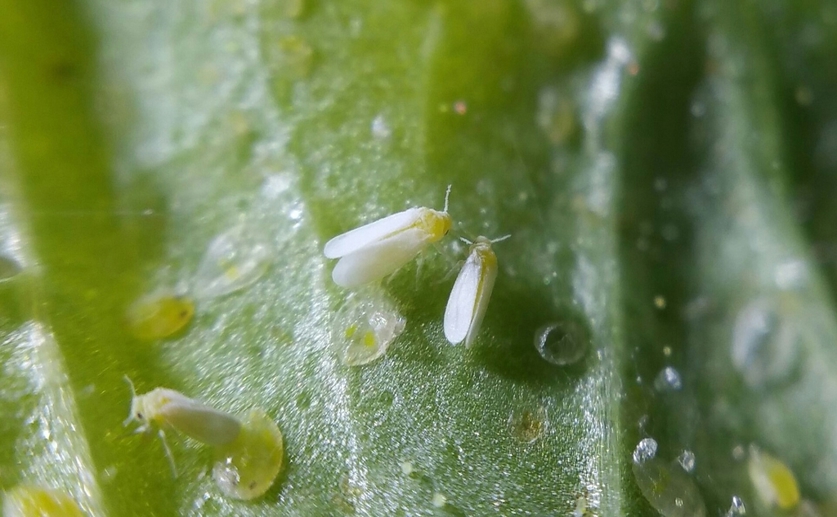
How nearby beneficial plants change how whiteflies feed on tomatoes

Greg Howard
8th October, 2025

How nearby beneficial plants change how whiteflies feed on tomatoes

These tiny whiteflies pose a major threat to tomato crops, but the strategic use of companion plants offers a promising, natural defense.

Photo adapted from: Mihajlo Tomić / CC BY (Source)

Key Findings

  • This study, conducted in a controlled environment, showed that Tagetes (marigold) and Crotalaria plants reduced whitefly settlement and egg-laying on tomato plants
  • Tagetes species appear to deter whiteflies through a combination of physical barrier effects and chemical repellence, while Crotalaria primarily acted as a trap, attracting the pests
  • The repellent effect of Tagetes wasn't linked to the overall intensity of volatile compounds released, but rather to the specific composition of these chemicals
Whiteflies are a major problem for tomato growers, causing significant crop damage and financial losses. Traditional pest control relies heavily on insecticides, but these can have negative environmental impacts and often lead to pest resistance[2]. This has driven research into alternative, more sustainable methods of pest management, such as using companion plants – growing specific plants alongside the main crop to deter pests or attract their natural enemies. A recent study by researchers at Sophia Agrobiotech Institute[1] investigated the potential of Tagetes (marigold) species and Crotalaria juncea (sunn hemp) as companion plants for controlling whiteflies (Bemisia tabaci) on tomato plants. The study began by confirming that whiteflies readily settle and lay eggs on tomato plants alone, establishing a baseline for comparison. When either Tagetes or Crotalaria was introduced alongside the tomatoes in a controlled environment, a significant reduction in both whitefly settlement and egg-laying was observed. This indicated that both plants had a deterrent effect. To understand how these plants were deterring the whiteflies, the researchers designed a follow-up experiment. They altered the arrangement of the plants to differentiate between two possible mechanisms: a physical barrier preventing whiteflies from reaching the tomatoes, or a chemical repellent effect that actively discouraged them. The results suggested a combination of both. Tagetes species appeared to act as a partial barrier, while also releasing chemicals that repelled the whiteflies. Interestingly, Crotalaria seemed to function more as a “sinkhole,” attracting and trapping the pests. The next step was to identify the chemicals responsible for the repellent effect. Using a technique called DHS-ATD-GC-MS, the researchers analyzed the volatile organic compounds (VOCs) released by the Tagetes plants. VOCs are essentially airborne chemicals that plants use to communicate and interact with their environment. The analysis confirmed the presence of known whitefly repellents, such as limonene, but also highlighted the importance of other, less-studied ketone compounds. The study found that the composition of the volatile blend, rather than its overall intensity, was more strongly associated with the repellent effect. This research builds upon earlier work demonstrating that companion plants can disrupt aphid host plant location through their volatile emissions[3]. While the previous study focused on aphids, the Sophia Agrobiotech Institute’s work shows a similar principle applies to whiteflies, with companion plant volatiles altering the ability of pests to find their host plants. Furthermore, the identification of specific repellent compounds in Tagetes provides a starting point for developing even more targeted pest control strategies. The study also connects with research on Crotalaria juncea’s properties as a green manure crop[4], which identified the presence of toxic alkaloids within the plant. While this study didn’t directly investigate the role of these alkaloids in whitefly control, it raises the possibility that they may contribute to the plant’s ability to trap and reduce pest populations. It’s important to note that the toxicity of these alkaloids and their potential impact on the tomato crop or the food chain would need to be carefully evaluated before widespread implementation. The researchers concluded that both Tagetes and Crotalaria species show promise as biocontrol agents for whitefly management in tomato production. They reduce pest pressure and offer a more sustainable alternative to chemical pesticides. Further research is needed to optimize field applications and fully understand the broader agroecological benefits of these companion plant strategies.

AgricultureEcologyPlant Science

References

Main Study

1) Altered Behavioural Response of Whitefly (Bemisia tabaci) on Tomato Associated with Biocontrol Plants

Published 6th October, 2025

https://doi.org/10.1007/s10886-025-01649-4


Related Studies

2) The global status of insect resistance to neonicotinoid insecticides.

https://doi.org/10.1016/j.pestbp.2015.04.004


3) Companion Plants for Aphid Pest Management.

https://doi.org/10.3390/insects8040112


4) Dehydropyrrolizidine alkaloids, including monoesters with an unusual esterifying acid, from cultivated Crotalaria juncea (Sunn Hemp cv.'Tropic Sun').

https://doi.org/10.1021/jf205296s


Related Articles

An unhandled error has occurred. Reload 🗙