How Location Affects Chickpea Blight Disease and What Causes Outbreaks

Jim Crocker
20th September, 2025

How Location Affects Chickpea Blight Disease and What Causes Outbreaks

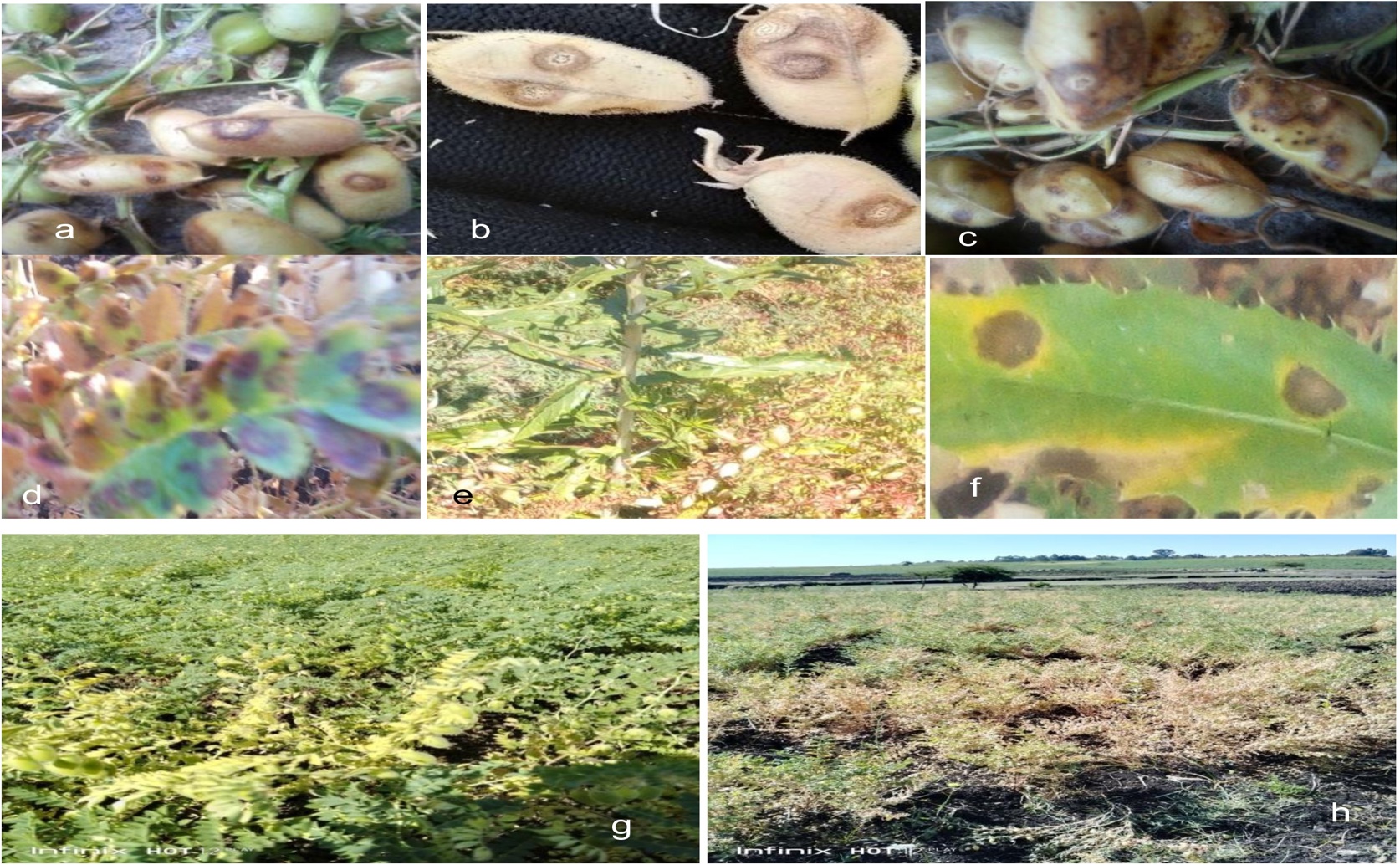
Visual evidence demonstrates characteristic necrotic lesions caused by Ascochyta rabiei on chickpea pods and leaves (a–d) and confirms safflower as a symptomatic alternative host (e–f) in fields assessed during the podding and physiological maturity growth stages (g–h).

Image adapted from: Mandefro et al. / CC BY (Source)

Key Findings

  • In northwestern Ethiopia, Ascochyta blight affected all chickpea fields surveyed during the 2022 growing season
  • Mixed cropping and less frequent land preparation (plowing less than two times) increased disease incidence and severity
  • Growing Kabuli chickpea varieties and preparing land more frequently were linked to lower disease levels, as were Nitisol soils compared to Vertisol soils
Chickpea, a vital legume crop in Ethiopia, faces significant threats from Ascochyta blight, a disease caused by the pathogen Ascochyta rabiei. This disease impacts both food security and the country’s export earnings. Recent research conducted by scientists at Debre Tabor University and Assam Agricultural University[1] investigated the extent of this disease and identified factors influencing its spread in northwestern Ethiopia. The study, carried out during the 2022 cropping season, revealed a concerning reality: Ascochyta blight was present in every chickpea field assessed across five districts. Disease incidence – the proportion of plants affected – and severity – the extent of damage on those plants – varied between locations, with Fogera district exhibiting the highest incidence (46.32%) and Gondar Zuria the highest severity (32.90%). To understand what drives the disease, researchers used statistical modelling to link disease levels with environmental and agricultural practices. The findings highlighted several key associations. Mixed cropping (growing chickpea alongside other plants) was strongly linked to higher disease incidence and severity. Conversely, growing chickpeas as a sole crop – dedicating land to chickpeas alone – was associated with lower disease levels. Land preparation practices also played a crucial role. Fields prepared less than two times were more prone to high disease incidence and severity, while more frequent preparation reduced the risk. Soil type was another important factor; Vertisol soils were associated with greater disease pressure, while Nitisol soils showed lower levels. The type of chickpea grown also had an impact. ‘Desi’ chickpea varieties were more susceptible to the disease than ‘Kabuli’ varieties. Finally, the presence of broadleaf weeds was linked to increased disease risk. These findings build upon earlier work demonstrating the importance of soil health in disease suppression[2]. That study showed that reduced and no-tillage farming, often combined with crop rotation, could improve the soil’s natural ability to resist pathogens by altering the distribution of carbon and increasing microbial biomass. While doesn’t directly examine tillage practices, the link between land preparation and disease incidence suggests a similar principle at play – more intensive preparation may disrupt the soil environment in ways that favor the pathogen. The research also aligns with the observation that the composition of the soil microbial community influences disease development[2]. The study found that the prevalence of Fusarium species (a related fungal genus) differed depending on tillage practice; saprophytic species were more common under non-inversion tillage, while pathogenic species were more common with conventional plowing. This suggests that agricultural practices can shift the balance of microbial communities, potentially increasing or decreasing disease risk. The results of offer practical recommendations for chickpea farmers in northwestern Ethiopia. By adopting sole cropping, increasing the frequency of land preparation, utilizing Nitisol soils where possible, and favoring Kabuli chickpea varieties, farmers can significantly reduce the impact of Ascochyta blight. These strategies, while not eliminating the disease entirely, represent important steps towards more sustainable and resilient chickpea production.

AgricultureEcologyPlant Science

References

Main Study

1) Spatial distribution of chickpea ascochyta blight (Ascochyta rabiei) and analyses of biophysical factors influencing disease epidemics in northwestern Ethiopia

Published 19th September, 2025

https://doi.org/10.1371/journal.pone.0333002


Related Studies

2) Tillage System and Crop Sequence Affect Soil Disease Suppressiveness and Carbon Status in Boreal Climate.

https://doi.org/10.3389/fmicb.2020.534786


Related Articles

An unhandled error has occurred. Reload 🗙