How Nearby Plants Affect a Plant’s Risk of Being Eaten by Herbivores

Greg Howard
24th August, 2025

How Nearby Plants Affect a Plant’s Risk of Being Eaten by Herbivores

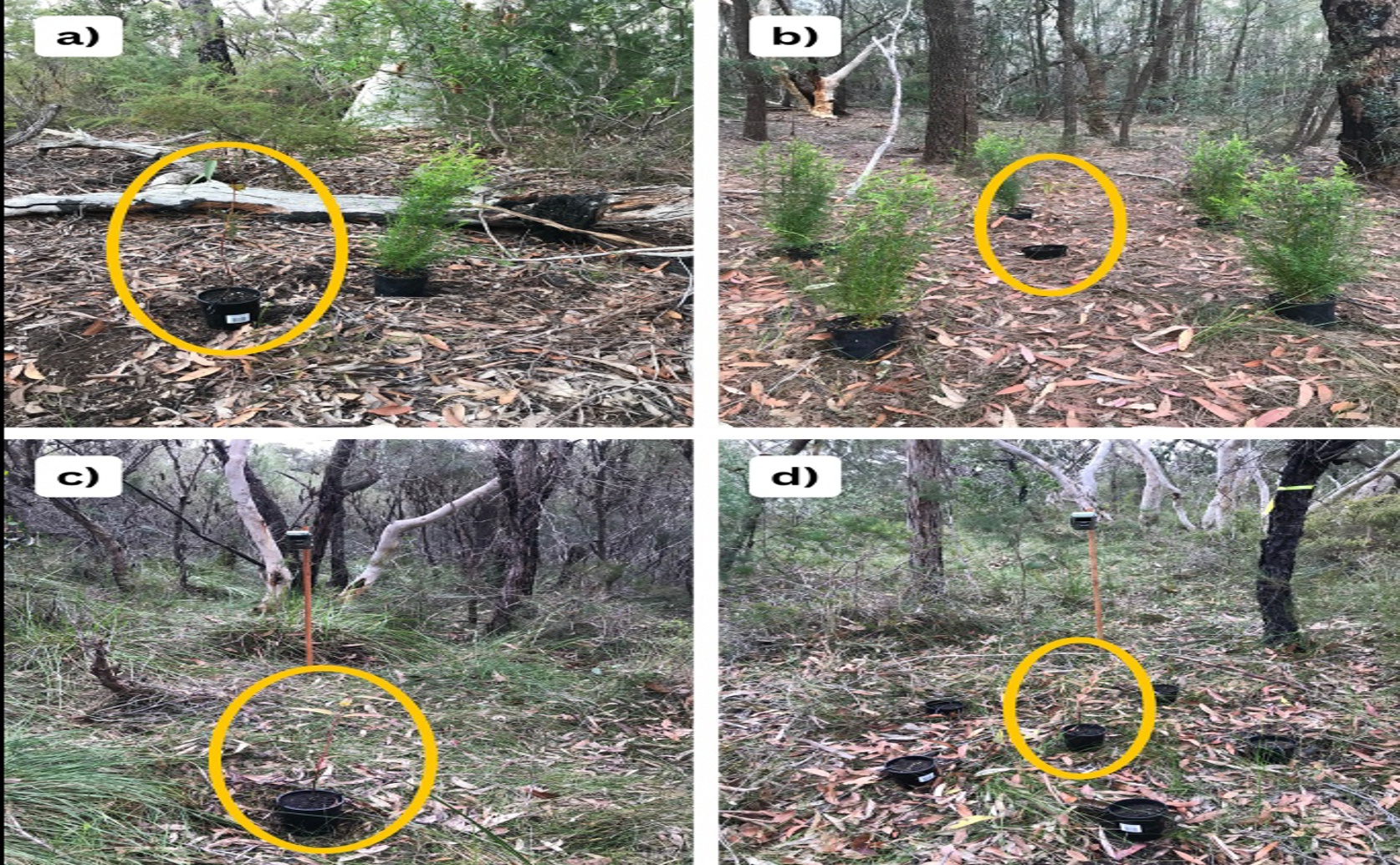
Experiments utilizing these configurations demonstrated that a single low-quality Boronia pinnata neighbour (a) provided high-quality grey gum (Eucalyptus punctata) seedlings with an associational refuge from swamp wallabies (Wallabia bicolor) that was equivalent in strength to a neighbourhood of five plants (b) when compared to the controls (c–d).

Image adapted from: Finnerty et al. / CC BY (Source)

Key Findings

  • In Australia’s eucalyptus woodlands, swamp wallabies delayed visiting and browsing plants when one low-quality shrub was nearby
  • A single low-quality shrub deterred wallabies as much as five shrubs, suggesting quantity isn’t key at this small scale
  • High-quality plants were almost always fully eaten regardless of the number of low-quality neighbours, indicating browsing severity may depend on plant quality
Plant communities are rarely simple, consisting of numerous species growing in close proximity. These interactions between plants can significantly impact how vulnerable individual plants are to being eaten by herbivores – a phenomenon known as an associational effect. Traditionally, these effects were thought to arise from the overall complexity of a plant patch, but whether a single neighbouring plant could influence herbivore behaviour remained unclear. Researchers at the University of Sydney, University of Pretoria and Royal Holloway University of London[1] investigated this question, focusing on whether even one neighbouring plant could alter the likelihood of a plant being visited and consumed by a browsing mammal, the swamp wallaby. The study centered around observing how swamp wallabies interacted with pairs of seedlings in their natural habitat. The seedlings were chosen based on their ‘quality’ – some were considered high-quality (more palatable and nutritious), and others low-quality (less appealing to the wallabies). The core experiment involved comparing three scenarios: pairs of high-quality seedlings, pairs consisting of one high-quality and one low-quality seedling, and isolated high-quality seedlings (no neighbours). The researchers meticulously tracked when wallabies first visited each plot and whether they browsed on the seedlings. The results demonstrated a clear associational effect from even a single neighbour. Seedling pairs with one high-quality and one low-quality plant were visited and browsed by wallabies later and less frequently than pairs of two high-quality seedlings. This suggests the presence of the low-quality plant acted as a deterrent, delaying herbivore feeding. Surprisingly, adding more low-quality neighbours didn’t amplify this effect; one or five neighbours had a similar impact on delaying wallaby visits. This finding challenges the traditional view of associational resistance, which often focuses on the complexity of entire plant communities[2]. Earlier research, such as that on flea beetles and cole crops, showed that diverse vegetation could reduce herbivore outbreaks by interfering with host-finding and feeding behaviour[2]. This was often attributed to the combined effect of multiple plant species creating a more confusing or less attractive environment for the pest. The current study suggests that even a single plant can contribute to this effect, potentially by disrupting the herbivore’s foraging process. The mechanism behind this single-neighbour effect likely stems from the herbivore’s foraging strategy. Animals often aim to maximize energy intake while minimizing energy expenditure. In the case of the bison studied in complex swards[3], their foraging decisions were based on maximizing digestible energy, leading them to avoid plants that required more handling time or offered lower nutritional value. The wallabies in this study may have similarly avoided high-quality seedlings paired with low-quality plants, perhaps because the presence of the less desirable plant reduced the overall profitability of the feeding patch. Importantly, the study highlights the importance of fine-scale interactions between plants. While previous work has examined the average neighborhood effects within whole plant communities[4], this research demonstrates that the immediate vicinity of a plant – even the presence of just one neighbour – can be crucial. This has significant ecological implications, suggesting that plant survival and community structure can be influenced by these subtle interactions. The researchers propose that the influence of neighbouring plants can range from the nearest individual to the entire plant neighbourhood, emphasizing the need to consider these intricate relationships when studying plant-herbivore dynamics.

AgricultureEcologyPlant Science

References

Main Study

1) Fine-scale associational effects: Single plant neighbours can alter susceptibility of focal plants to herbivores

Published 21st August, 2025

https://doi.org/10.1371/journal.pone.0330572


Related Studies

2) The influence of vegetational diversity on the population ecology of a specialized herbivore, Phyllotreta cruciferae (Coleoptera: Chrysomelidae).

https://doi.org/10.1007/BF00345736


3) Foraging decisions of bison for rapid energy gains can explain the relative risk to neighboring plants in complex swards.

Journal: Ecology, Issue: Vol 91, Issue 6, Jun 2010


4) Spatially complex neighboring relationships among grassland plant species as an effective mechanism of defense against herbivory.

https://doi.org/10.1007/s00442-010-1676-3


Related Articles

An unhandled error has occurred. Reload 🗙