Better Crop Mixes Help Fight Cassava Virus

Greg Howard
19th September, 2025

Better Crop Mixes Help Fight Cassava Virus
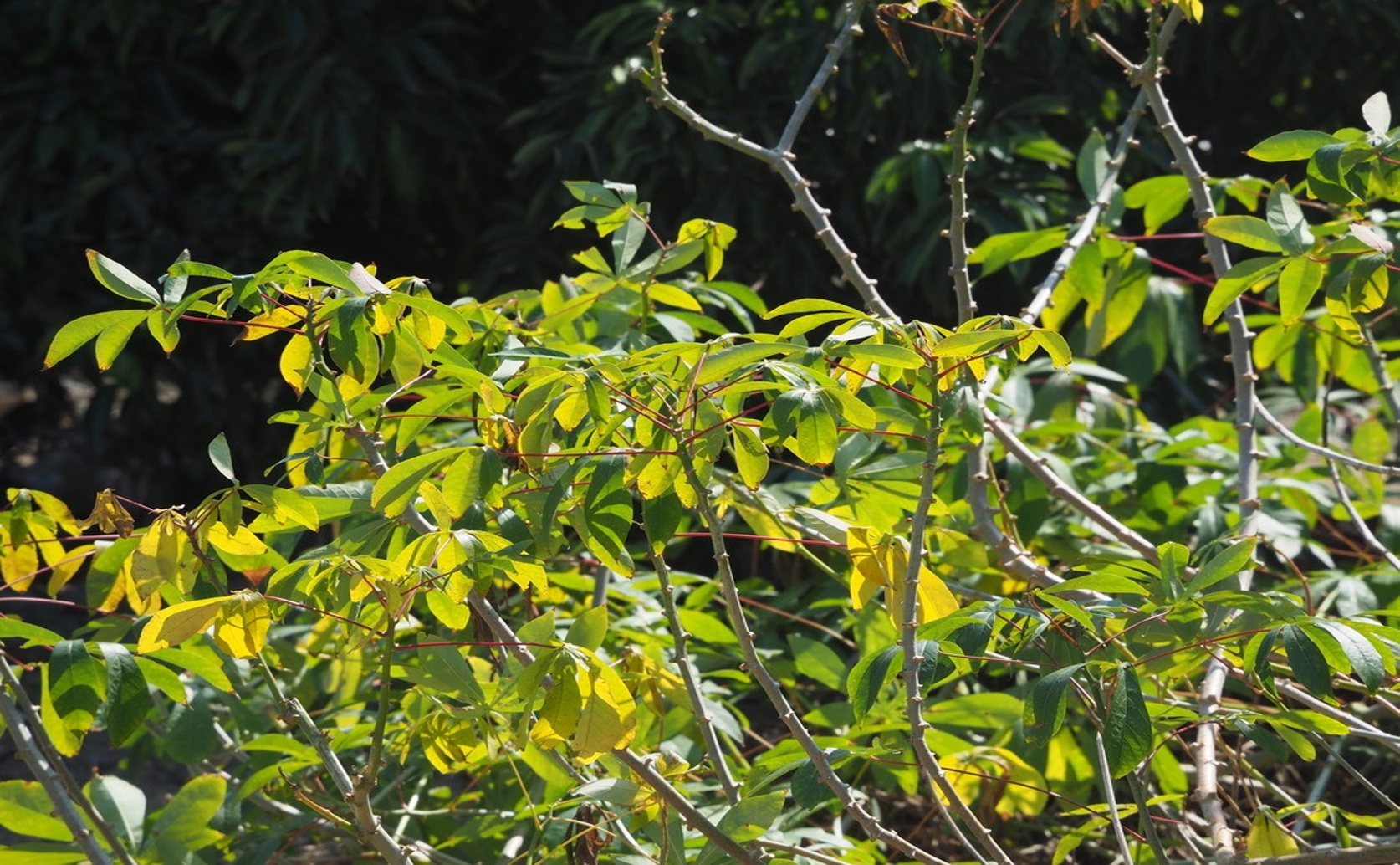
Cassava (Manihot esculenta)

Key Findings

  • This study, conducted on cassava crops, investigated how mixing different varieties could control two major viral diseases, Cassava Mosaic Disease (CMD) and Cassava Brown Streak Disease (CBSD)
  • For CMD, mixtures were ineffective due to the virus’s extremely rapid spread, making tolerant cassava varieties the best option
  • For CBSD, mixing resistant varieties with susceptible ones successfully reduced yield losses, especially with moderate insect pressure, offering a viable disease management strategy
Cassava is a vital food crop in Africa, Asia, and Latin America, but its production is constantly threatened by viral diseases like Cassava Mosaic Disease (CMD) and Cassava Brown Streak Disease (CBSD). These diseases can cause significant yield losses, impacting food security and livelihoods[2]. A key challenge in managing these diseases is that cassava is typically grown using vegetative propagation – meaning farmers replant stem cuttings from existing plants. This practice, while efficient, also means that viruses are easily passed down through generations, leading to accumulating infections and worsening outbreaks. Researchers at the Institut Agro, Univ Rennes, INRAE, University of Cambridge, and University of Melbourne Faculty of Science[1] have been investigating a potential solution: growing different cassava varieties together in the same field, known as varietal mixtures. The idea is that some varieties might be more resistant to viruses than others, and by planting them alongside susceptible varieties, the resistant ones could help protect the more vulnerable ones. To explore this concept, the team developed a web-based application called CropMix. CropMix uses a mathematical model to simulate how viruses spread between cassava plants under different conditions. The model considers factors like the rate of virus transmission by insects (specifically whiteflies for CMD and other insects for CBSD), the varying levels of resistance or tolerance in different varieties, and the presence of non-host crops – plants that viruses can’t infect. This allows researchers to predict which mixtures will perform best in terms of overall yield. Their findings revealed a crucial difference between CMD and CBSD. For CMD, the extremely high transmission rate of the cassava mosaic virus meant that mixtures weren’t very effective. Even with resistant varieties included, the virus spread so quickly that susceptible monocultures (fields planted with only one variety) often yielded more than mixtures containing susceptible and resistant varieties. This suggests that, in areas with high whitefly pressure, the virus simply overwhelms any protective effect offered by resistance. However, the situation was very different for CBSD. The study showed that varietal mixtures could provide substantial benefits in controlling CBSD. Resistant varieties were able to effectively shield susceptible varieties, significantly reducing yield losses, particularly under moderate to high insect pressure. This is because CBSD viruses are transmitted less efficiently than CMD viruses, allowing resistance to have a greater impact. The research also highlighted the importance of combining mixtures with other control measures. Integrating practices like ‘roguing’ – removing infected plants – and using non-host crops alongside varietal mixtures could further enhance disease management. This builds on earlier work demonstrating the importance of phytosanitation[2]. The development of CropMix is a significant step forward in understanding and managing cassava viral diseases. The application’s flexibility allows for tailoring recommendations to specific local conditions and diverse viral diseases, beyond just CMD and CBSD. The model’s simplicity is also an advantage, making it easier to implement and adapt in different agroecological contexts. The study also recognizes the need for real-world data and collaboration with farmers to refine these strategies and ensure they are both effective and acceptable to those who grow the crop. This is particularly important as the success of any disease management strategy relies on a balance between agronomic potential and farmer preferences.[3] noted that understanding pathogen evolution and host-pathogen interactions is key to mitigating future outbreaks, and CropMix provides a tool to explore these dynamics.

AgricultureEcologyPlant Science

References

Main Study

1) Optimizing crop varietal mixtures for viral disease management: A case study on cassava virus epidemics

Published 18th September, 2025

https://doi.org/10.1371/journal.pcbi.1012842


Related Studies

2) Cassava virus diseases: biology, epidemiology, and management.

https://doi.org/10.1016/bs.aivir.2014.10.001


3) Climate change impacts on plant pathogens, food security and paths forward.

https://doi.org/10.1038/s41579-023-00900-7


Related Articles

An unhandled error has occurred. Reload 🗙