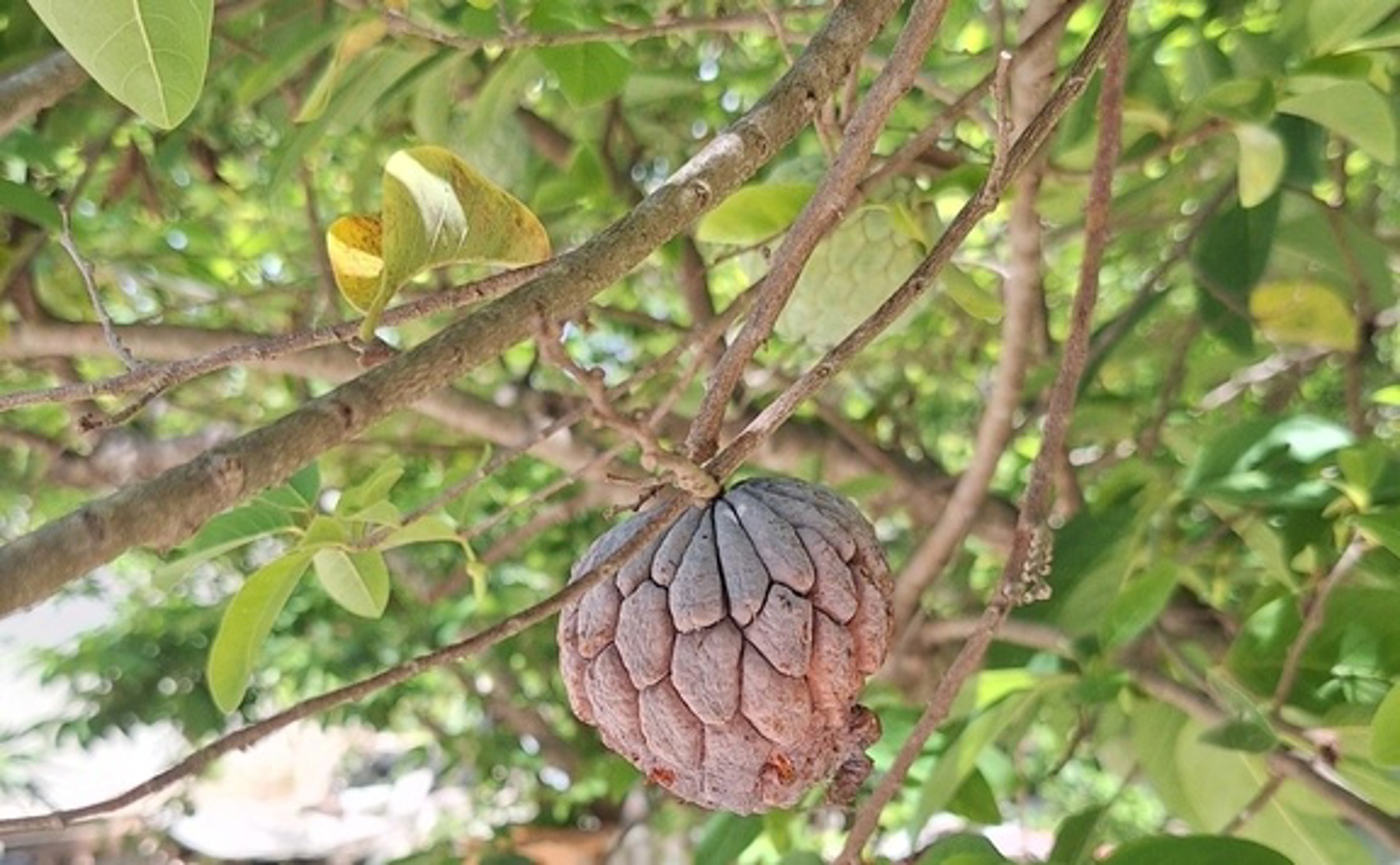
Better soil and feeding practices boost sugar apple fruit production and flavor

Greg Howard
15th December, 2025

Better soil and feeding practices boost sugar apple fruit production and flavor

Sugar apple (Annona squamosa)

Photo adapted from: Christine Loew / CC BY (Source)

Key Findings

  • In Yunnan Province, Annona squamosa yields are declining, prompting research into improving soil health through water, fertilizer, and mulching practices
  • Combining 75% field water holding capacity irrigation, 2083 kg·ha-1 fertilizer, and straw mulch (W2F2A3) significantly improved soil nutrient levels, enzyme activity, and microbial communities
  • The W2F2A3 treatment resulted in the highest fruit yield, single fruit weight, soluble solids, sugar content, vitamin C levels, and sugar-to-acid ratio, indicating optimal fruit quality and production
Annona squamosa, also known as sugar-apple, is an important fruit crop, but yields in Yunnan Province are declining due to irrigation issues and over-fertilization. Researchers from Kunming University of Science and Technology, Yuanjiang County Agricultural Machinery Management Service Center, and Dev Bhoomi Uttarakhand University recently investigated how water management, fertilizer levels, and mulching practices affect the soil around the roots of Annona squamosa trees – the rhizosphere – and ultimately, fruit production[1]. The goal was to find ways to improve soil health and create more sustainable farming methods. The study involved a field experiment where different combinations of irrigation, fertilizer, and mulching were tested. Irrigation levels were set to maintain soil water holding capacity at 55%, 75%, and 85%. Fertilizer application varied between 1666, 2083, and 2500 kg·ha-1. Mulching options included no mulch, grass mulch, and straw mulch. This setup allowed the researchers to observe how each factor, and combinations of factors, influenced the soil and the trees. The results showed that combining irrigation and fertilizer with mulching had a significant impact on the levels of essential nutrients in the soil. Specifically, a combination of 75% field water holding capacity (W2), 2083 kg·ha-1 of fertilizer (F3), and no mulching (A1) resulted in the highest nutrient content throughout the trees’ growth stages. However, the highest levels of soil enzyme activity – urease, phosphatase, and catalase – were found when using 75% field water holding capacity (W2), 2083 kg·ha-1 of fertilizer (F2), and straw mulch (A3). These enzymes are crucial for breaking down organic matter and releasing nutrients that plants can use. The study also examined the microbial communities within the soil. Different treatments led to changes in the number and diversity of these microorganisms, with the highest abundance observed using 85% field water holding capacity (W3), 2500 kg·ha-1 of fertilizer (F3), and grass mulch (A2). Microorganisms play a vital role in nutrient cycling and overall soil health. Interestingly, the highest single fruit weight and overall yield, along with improved fruit quality characteristics like soluble solids, sugar content, vitamin C levels, and sugar-to-acid ratio, were achieved with 75% field water holding capacity (W2), 2083 kg·ha-1 of fertilizer (F2), and straw mulch (A3). These findings highlight the complex interplay between water, nutrients, and the soil’s biological environment. The researchers found a strong connection between soil nutrient levels, enzyme activity, microbial community structure, and the quality of the Annona squamosa fruit. This suggests that optimizing these factors can directly improve fruit production. Soil erosion, for example, significantly reduces total nitrogen, ammonium nitrogen, and nitrate nitrogen levels[2], which this study addresses by optimizing fertilizer and water levels. To determine the best combination of these factors, the researchers used a water-fertilizer-mulching evaluation algorithm based on PCA-GRA (Principal Component Analysis – Grey Relational Analysis). This algorithm confirmed that the combination of 75% field water holding capacity, 2083 kg·ha-1 of fertilizer, and straw mulch (W2F2A3) was the most effective solution. This combination appears to synergistically improve the rhizosphere microecology, enhancing nutrient cycling through regulated enzyme activity and microbial functions. The use of straw mulch, in particular, was shown to be key in this process. The benefits of mulching align with previous research showing it can create a more favorable microclimate and balance the carbon balance of the soil-plant system[3]. The study provides a practical model for ecological restoration and economic benefits in green fruit tree cultivation, offering a targeted approach to improve soil health and fruit yield.

AgricultureEcologyPlant Science

References

Main Study

1) Optimizing soil quality and rhizosphere ecology to enhance Annona squamosa yield and quality through water-fertilizer-mulching synergy

Published 12th December, 2025

https://doi.org/10.1371/journal.pone.0338781


Related Studies

2) Soil Erosion Thickness and Seasonal Variations Together Drive Soil Nitrogen Dynamics at the Early Stage of Vegetation Restoration in the Dry-Hot Valley.

https://doi.org/10.3390/microorganisms12081546


3) Long-Term Changes in Organic Matter Content and Soil Moisture Determine the Degree of Root and Soil Respiration.

https://doi.org/10.3390/plants12020251


Related Articles

An unhandled error has occurred. Reload 🗙