New planter design improves seed spacing and placement for better crop growth

Greg Howard
23rd December, 2025

New planter design improves seed spacing and placement for better crop growth

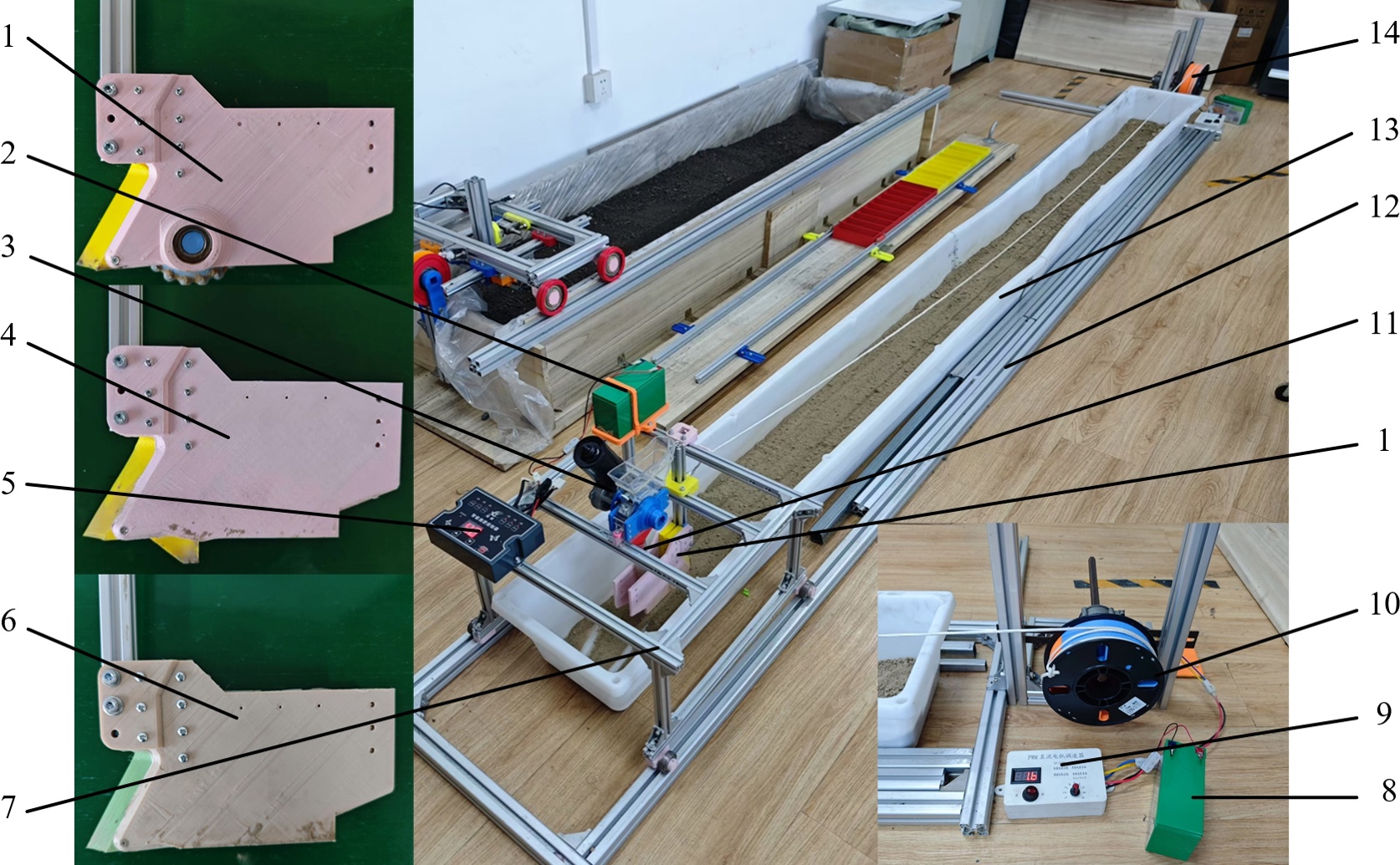
Using a custom-built soil bin test rig, the performance of the novel sharp-angle spherical roller furrow opener (1) was physically compared against traditional sharp-angle pointed-bottom (4) and flat-bottom (6) designs to validate its effect on seeding uniformity.

Image adapted from: Dun et al. / CC BY (Source)

Key Findings

  • A new furrow opener design, featuring spherical rollers, was developed to improve seed placement accuracy in soybean plot breeding tests
  • Simulations and physical tests showed this roller opener reduced seed spacing inconsistencies and sideways drift compared to traditional designs
  • The roller opener’s V-shaped grooves and ridges limit seed movement, resulting in more uniform sowing and reliable breeding trial results
Improving crop breeding relies heavily on precise sowing, where consistent seed placement is crucial for accurate genetic evaluations. Traditional furrow openers, the tools that create the trenches for seeds, often struggle with uneven spacing and seeds drifting sideways, reducing the reliability of breeding trials. Researchers at Harbin Cambridge University, Northeast Forestry University, and China Construction Fourth Engineering Division Corp. Ltd.[1] have addressed this problem with a novel furrow opener design, significantly improving sowing uniformity. The core issue with existing openers stems from their structural limitations. They tend to cause seeds to bounce or shift laterally during planting, leading to inconsistent spacing. To overcome this, the team developed a sharp-angle roller furrow opener featuring independently rotating V-shaped ball rollers. This design builds upon the concept of traditional sharp-angle flat-bottom openers, but introduces a dynamic element to control seed placement. The rollers create V-shaped grooves and small spherical pits in the soil, forming ridges that physically restrain the seeds, limiting both their forward and sideways movement. The effectiveness of this design was first investigated using computer simulations. The researchers built a detailed model within the EDEM software, simulating the interaction between soybean seeds, soil, and the new opener, comparing it to both sharp-angle and flat-bottom openers. They used three key metrics to evaluate performance: spacing fluctuation coefficients (measuring the consistency of seed spacing), lateral offset dispersion (how much seeds deviate from a straight line), and average lateral offset (the average distance seeds move sideways). The simulation results demonstrated a clear advantage for the roller opener, showing reduced spacing fluctuations and lateral offsets compared to the traditional designs. To validate the simulation results, the team 3D-printed prototypes of all three opener types and conducted physical tests using a custom-built soil trench bench. These bench tests confirmed the simulation findings. Under identical conditions, the roller opener consistently outperformed the others in sowing uniformity, minimizing both spacing inconsistencies and lateral seed drift. This study isn't entirely new ground; previous research has highlighted the challenges of soil adhesion to furrow openers, particularly in the sticky black soils of Northeast China[2]. That study focused on biomimetic designs – mimicking natural structures – to reduce drag and adhesion on disc furrow openers, achieving a 15.36% reduction in resistance with optimized convex hull and wedge structures. While the study doesn’t directly address adhesion in the same way, the improved control over seed placement and reduced bouncing could indirectly lessen the build-up of soil on the opener, as less force is required to maintain a consistent furrow. The innovation presented in moves beyond simply reducing resistance; it actively manages seed movement within the furrow. The V-shaped rollers and resulting soil structure create a more stable environment for the seeds, enhancing the precision of the sowing process. This design framework, combining structural innovation with both computational modeling and physical testing, offers a sustainable approach to agricultural equipment development, integrating mechanical performance with resource efficiency.

AgricultureEcologyPlant Science

References

Main Study

1) Simulation and test of a V-shaped seed-guiding surface and concave pit furrow opener for seed displacement restriction: Verification on seeding uniformity and post-soil-contact seed motion limitation

Published 19th December, 2025

https://doi.org/10.1371/journal.pone.0337695


Related Studies

2) The mechanism of resistance-reducing/anti-adhesion and its application on biomimetic disc furrow opener.

https://doi.org/10.3934/mbe.2020256


Related Articles

An unhandled error has occurred. Reload 🗙