New nanoparticle treatment shows promise against a deadly fungal brain infection

Greg Howard
19th January, 2026

New nanoparticle treatment shows promise against a deadly fungal brain infection

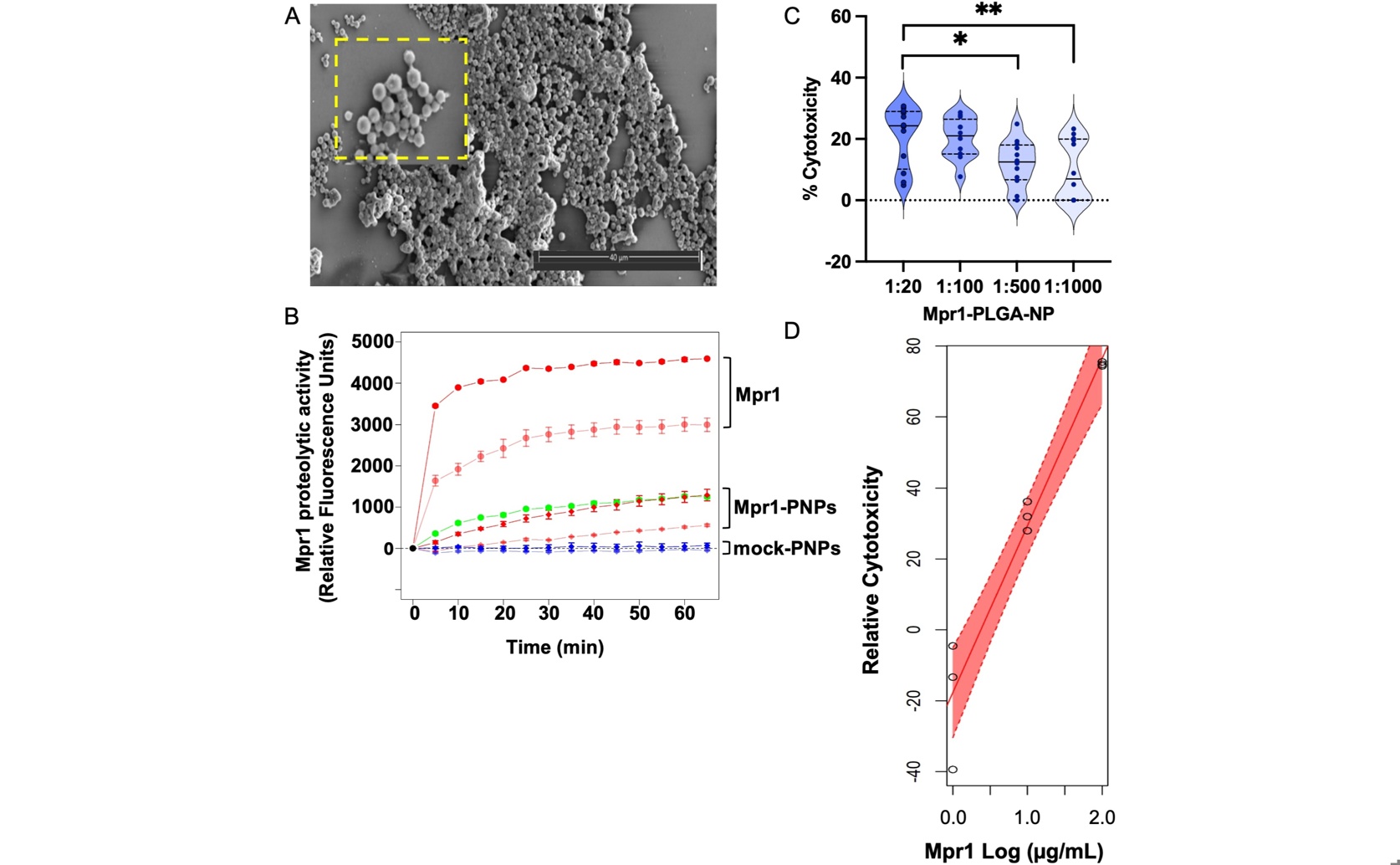
After confirming the nanoparticles' spherical shape (a), experiments showed they are promising for drug delivery because the attached Mpr1 enzyme retained its key protein-degrading function (b) while the particles themselves exhibited only low, dose-dependent toxicity to brain cells (c, d).

Image adapted from: Lanser et al. / CC BY (Source)

Key Findings

  • Researchers engineered nanoparticles to carry an antifungal drug across the blood-brain barrier, a challenge in treating brain infections
  • Coating the nanoparticles with an enzyme from the Cryptococcus neoformans fungus, called Mpr1, significantly improved their ability to penetrate a lab-grown blood-brain barrier model
  • These Mpr1-coated nanoparticles reduced fungal growth in the lab model, requiring eight times less antifungal drug to achieve the same effect as without the nanoparticles
Treating diseases affecting the brain is often severely limited by the blood-brain barrier (BBB), a highly selective membrane protecting the central nervous system (CNS) from harmful substances circulating in the bloodstream. This barrier, however, also prevents many potentially life-saving drugs from reaching their target within the brain. Researchers at U California Davis and U Florida have been working on novel ways to overcome this challenge, specifically focusing on a pathway used by the fungal pathogen Cryptococcus neoformans to invade the brain[1]. The BBB isn’t simply a static wall; it’s a dynamic and complex structure composed of specialized cells, primarily endothelial cells, that tightly control what passes in and out of the brain[2]. These cells form a barrier through tight junctions, but also actively transport molecules and respond to signals from the CNS. This communication aspect is crucial for healthy brain function, but also represents potential vulnerabilities that pathogens can exploit. Historically, the difficulty of getting drugs across this barrier was demonstrated as early as 1914 with salvarsan, a syphilis treatment, failing to penetrate the brain[3]. This led to a reliance on lipid-soluble drugs, as these could passively diffuse across the BBB, but many effective drugs lack this property. Cryptococcus neoformans causes a severe brain infection called cryptococcal meningoencephalitis, and it achieves this by crossing the BBB. Previous research has identified that the fungus utilizes a process involving direct invasion of the endothelial cells[4]. This invasion doesn’t simply damage the barrier, but rather involves the fungus triggering changes within the endothelial cells themselves, allowing it to pass through without disrupting the overall integrity of the BBB. The study focused on a specific enzyme produced by Cryptococcus neoformans called Mpr1, a metalloprotease. This enzyme plays a key role in the fungus’s ability to penetrate the BBB. Researchers engineered nanoparticles – extremely small particles – made of a biocompatible material, poly(D,L-lactide-co-glycolide), and coated them with the Mpr1 enzyme. These nanoparticles were designed to carry amphotericin B, a powerful antifungal drug often used to treat cryptococcal infections. The nanoparticles were carefully characterized to ensure they were the right size and shape, had a stable surface charge (zeta potential), and efficiently encapsulated the amphotericin B drug. Importantly, they also tested for toxicity to brain endothelial cells, confirming the nanoparticles themselves weren't harmful. The researchers then tested the nanoparticles’ ability to cross an in vitro model of the BBB – essentially a lab-grown version of the barrier using brain endothelial cells. The results showed that nanoparticles coated with Mpr1 penetrated the barrier significantly more effectively than those without the enzyme. This suggests that mimicking the fungus’s strategy of using Mpr1 to interact with the BBB can enhance drug delivery. Further testing in another in vitro model, this time simulating a neural cryptococcal infection, demonstrated that the Mpr1-functionalized nanoparticles carrying amphotericin B reduced the fungal burden. Furthermore, the drug was far more potent when delivered within the nanoparticles, requiring eight times less amphotericin B to achieve the same level of fungal inhibition compared to unencapsulated drug. This highlights the potential of the nanoparticle delivery system to improve drug efficacy and reduce the dosage needed, potentially minimizing side effects. These findings build upon previous understanding of the BBB as a dynamic structure with specific transport pathways[2]. By utilizing a naturally occurring pathway exploited by Cryptococcus neoformans, the researchers were able to enhance drug delivery. The study demonstrates that engineering nanoparticles with Mpr1 offers a promising strategy for overcoming the challenges of brain drug delivery and improving the treatment of CNS diseases.

MedicineBiochemMycology

References

Main Study

1) Conjugation of a Cryptococcus neoformans-derived metalloprotease to antifungal-loaded PLGA nanoparticles treats neural cryptococcosis in an in vitro model

Published 16th January, 2026

https://doi.org/10.1371/journal.pone.0340202


Related Studies

2) The dynamic blood-brain barrier.

https://doi.org/10.1111/febs.13412


3) A Historical Review of Brain Drug Delivery.

https://doi.org/10.3390/pharmaceutics14061283


4) Cryptococcal yeast cells invade the central nervous system via transcellular penetration of the blood-brain barrier.

Journal: Infection and immunity, Issue: Vol 72, Issue 9, Sep 2004


Related Articles

An unhandled error has occurred. Reload 🗙