Protein Controls Gene Activity and Disease Factors in Meningitis Fungus

Greg Howard
15th May, 2025

Protein Controls Gene Activity and Disease Factors in Meningitis Fungus

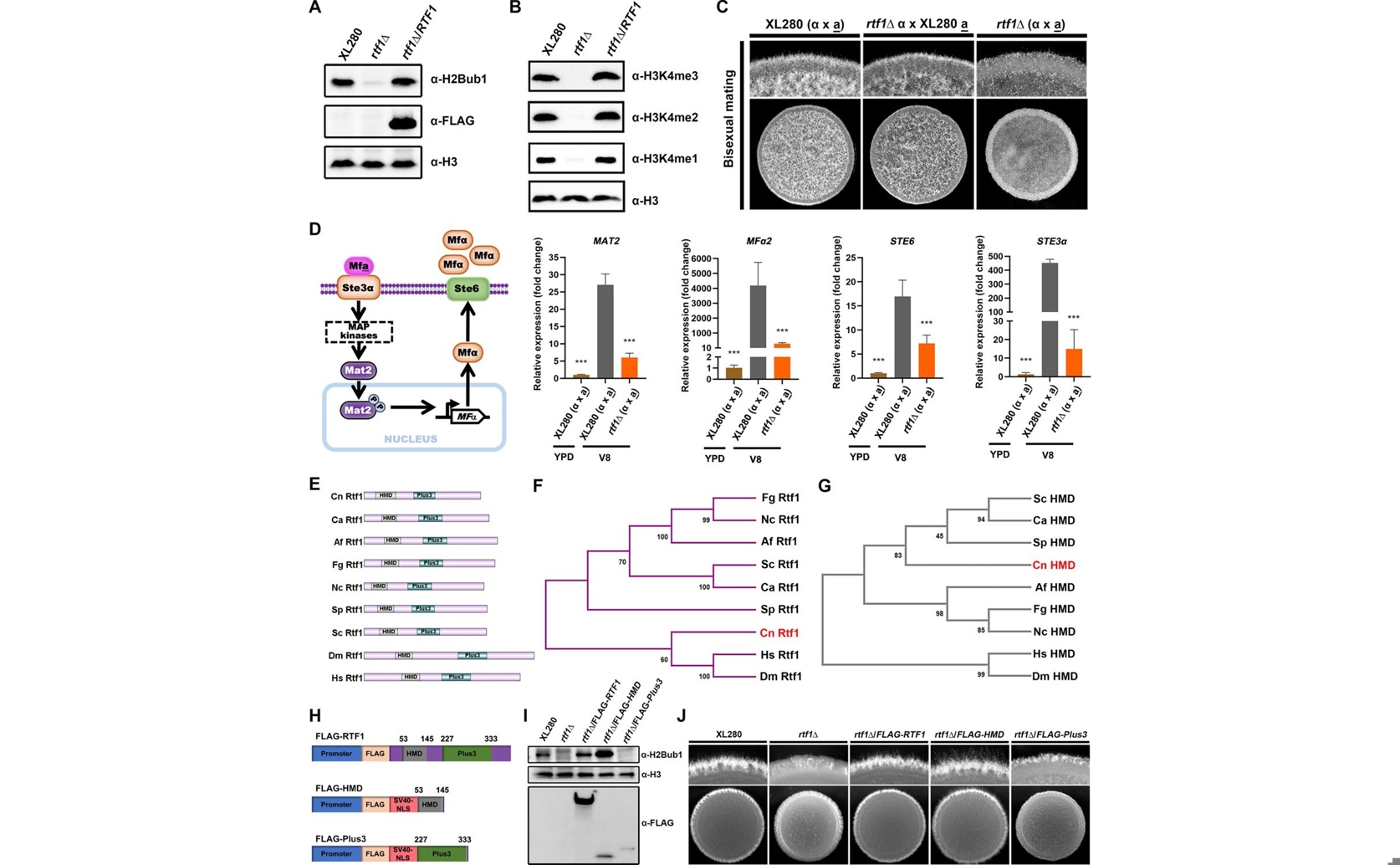
Experiments in Cryptococcus deneoformans reveal that Rtf1 is essential for histone H2B monoubiquitination (H2Bub1) and mating-related morphogenesis (a–d), and that the histone modification domain (HMD) alone is sufficient to restore H2Bub1 levels and filamentous growth (i, j).

Image adapted from: Jiang et al. / CC BY (Source)

Key Findings

  • *Researchers at Henan Agricultural University found that the protein Rtf1 helps the fungus Cryptococcus neoformans cause serious brain infections.*
  • *They discovered that Rtf1 can control gene activity on its own, enabling the fungus to change shape and become more harmful.*
  • **These insights suggest that targeting Rtf1 could lead to new treatments to prevent fungal infections
Recent research from Henan Agricultural University has uncovered new insights into how the fungal pathogen Cryptococcus neoformans causes meningitis, a serious infection of the brain and spinal cord. The study focuses on a protein called Rtf1, which plays a critical role in regulating gene expression and the ability of the fungus to change its shape and cause disease[1]. Rtf1 is part of a larger protein complex known as Paf1C, which is involved in modifying histones—proteins around which DNA is wrapped. These modifications can influence how genes are turned on or off. In Saccharomyces cerevisiae, a species of yeast, Rtf1 is a stable component of Paf1C and is important for adding a small molecule called ubiquitin to a specific histone, H2B. This process, known as H2B monoubiquitination (H2Bub1), affects how tightly DNA is packaged and how accessible it is for gene expression[2]. The new study found that in Cryptococcus neoformans, Rtf1 operates differently. Unlike in yeast, Rtf1 in this pathogenic fungus is not tightly bound to the Paf1C complex. Instead, a particular part of Rtf1, called the histone modification domain (HMD), is sufficient to promote H2Bub1 and activate genes involved in the fungus’s mating and filamentation processes—key factors for its ability to cause disease. This indicates that Rtf1 can regulate gene expression independently of Paf1C in Cryptococcus neoformans. Understanding how Rtf1 functions in this pathogen is important because it highlights potential targets for antifungal therapies. By disrupting the ability of Rtf1 to modify histones, it may be possible to prevent the fungus from changing its shape and becoming more virulent, thereby reducing its capacity to cause infection. The researchers employed several advanced techniques to arrive at their conclusions. They used genetic manipulation to remove the Rtf1 gene and observed the resulting effects on the fungus’s ability to grow and cause disease. They also introduced the HMD alone into the mutant strains and found that it could restore some of the lost functions, such as morphogenesis and pathogenicity, but not others like thermal tolerance and melanin production. This selective restoration underscores the specific role of the HMD in regulating certain aspects of the fungus’s biology. These findings build on earlier research that showed how H2Bub1 influences nucleosome organization and gene expression[2]. The current study extends this knowledge by demonstrating that Rtf1-mediated H2Bub1 has distinct effects depending on its location within the genome. In regions that are usually inactive, H2Bub1 acts to suppress the assembly of the transcription machinery, thereby keeping genes turned off. Conversely, in highly active gene regions, H2Bub1 facilitates the process of transcription elongation, helping genes to be expressed more effectively[2]. The new research shows that in Cryptococcus neoformans, Rtf1 leverages this mechanism to control critical processes related to the fungus’s ability to cause disease. Moreover, the study reveals that the regulation by Rtf1 does not involve certain histone marks previously thought to be important, specifically H3K4, K36, and K79. This suggests that Rtf1 and H2Bub1 may have unique roles in Cryptococcus neoformans that differ from those in other organisms, highlighting the complexity of gene regulation in different species[2]. The implications of this research are significant for developing new strategies to combat fungal infections. By targeting the specific functions of Rtf1 and its role in H2Bub1, it may be possible to design drugs that interfere with the pathogen’s ability to regulate gene expression and adapt to hostile environments, such as the human body. This could lead to more effective treatments for infections caused by Cryptococcus neoformans, which are particularly dangerous for individuals with weakened immune systems. In summary, the study from Henan Agricultural University advances our understanding of the molecular mechanisms underlying fungal pathogenicity. It highlights the versatile role of Rtf1 in regulating gene expression through histone modification, independent of the Paf1 complex, and underscores the importance of H2Bub1 in controlling the fungus’s ability to cause disease. These insights not only deepen our knowledge of gene regulation in fungal pathogens but also pave the way for the development of novel antifungal therapies.

MedicineBiochemMycology

References

Main Study

1) Rtf1 HMD domain facilitates global histone H2B monoubiquitination and regulates morphogenesis and virulence in the meningitis-causing pathogen Cryptococcus neoformans

Published 12th May, 2025

https://doi.org/10.7554/eLife.99229


Related Studies

2) Genome-wide function of H2B ubiquitylation in promoter and genic regions.

https://doi.org/10.1101/gad.177238.111


Related Articles

An unhandled error has occurred. Reload 🗙