How sugar breakdown fuels changes in fungal shape and disease-causing ability

Jenn Hoskins
9th February, 2026

How sugar breakdown fuels changes in fungal shape and disease-causing ability

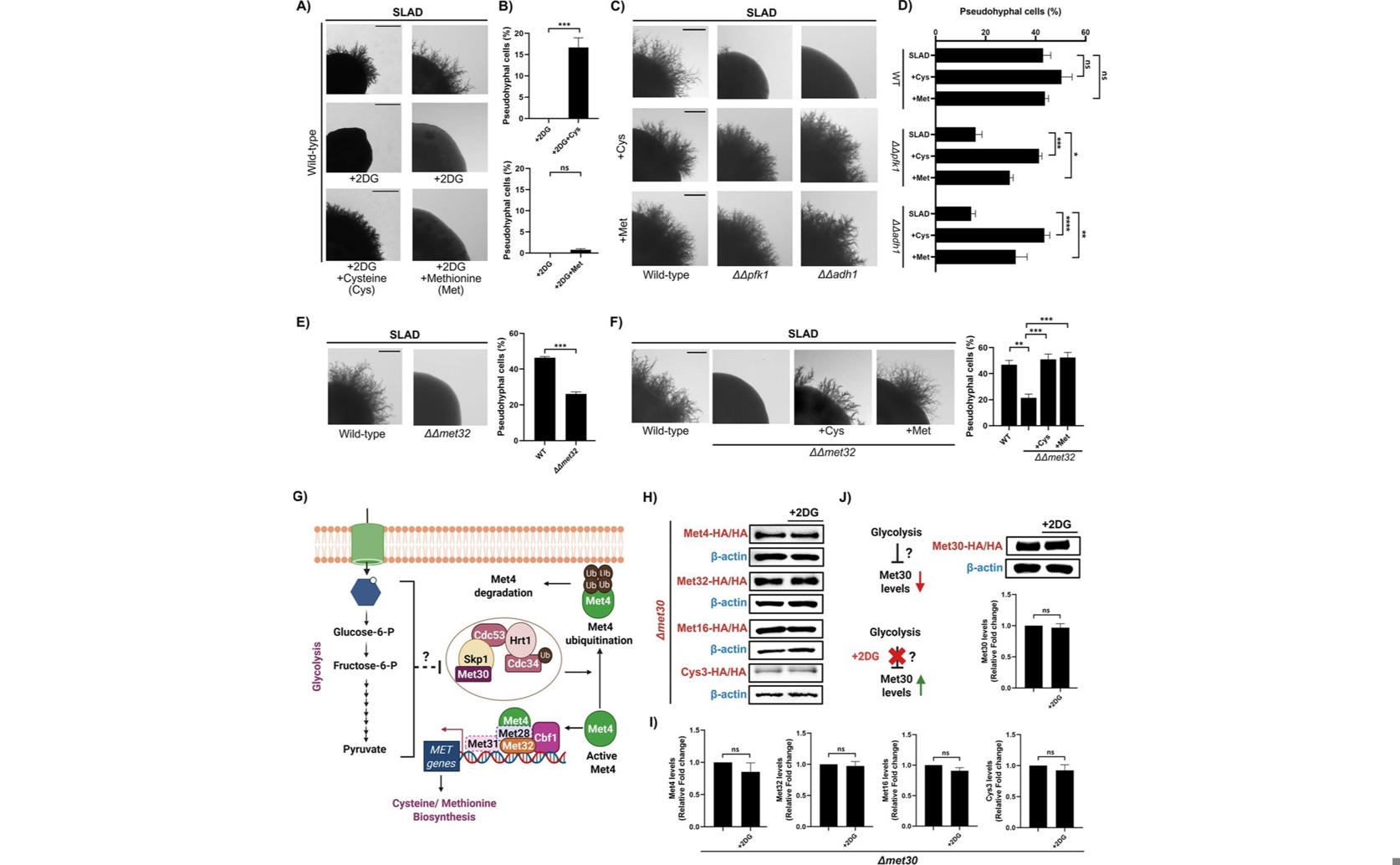
In Saccharomyces cerevisiae, the block on filamentous pseudohyphal growth caused by inhibiting glycolysis (a-d) or deleting a key sulfur metabolism gene (e) is reversed by supplying external sulfur compounds (a, c, f), demonstrating that glycolysis controls this critical shape change by regulating sulfur metabolism.

Image adapted from: Shah et al. / CC BY (Source)

Key Findings

  • Glycolysis is essential for fungal morphogenesis in both baker’s yeast and the human pathogen Candida albicans under nitrogen-limiting conditions
  • Glycolysis regulates morphogenesis independently of the well-known cAMP-PKA signaling pathway
  • Active glycolysis drives the production of sulfur-containing amino acids, which are critical for fungal morphogenesis and virulence
Fungi exhibit a remarkable ability to change shape in response to their environment, a process called fungal morphogenesis that is crucial for survival and infection. While the genetic components driving this process are becoming clearer, the underlying metabolic factors have remained largely unknown. A recent study by Shah et al. from CSIR-CCMB, AcSIR[1] has uncovered a critical link between central carbon metabolism and the production of sulfur-containing amino acids, demonstrating that glycolysis is essential for this shape-shifting ability in both baker’s yeast and the human pathogen Candida albicans. The study began with the observation that blocking glycolysis – the pathway that breaks down glucose for energy – prevented both yeast species from undergoing morphogenesis when grown in nitrogen-limited conditions. This suggested that glycolysis isn't simply providing energy for the process, but is actively required for it. Further investigation revealed that glycolysis fuels the de novo biosynthesis, or creation, of sulfur-containing amino acids. When these amino acids were supplied directly to the yeast, the fungi were able to resume morphogenesis despite the blocked glycolysis, confirming their central role. This finding builds upon earlier work demonstrating the importance of carbohydrate metabolism in Candida albicans pathogenicity[2]. That study identified key transcriptional regulators, Tye7p and Gal4p, that control the expression of glycolytic genes, and showed that disrupting their function severely impaired growth and virulence. The current study complements these findings by identifying glycolysis itself as a key driver of morphogenesis, a process directly linked to virulence. It suggests that Tye7p and Gal4p are acting upstream, ensuring sufficient glycolytic capacity to support the downstream production of sulfur-containing amino acids. The importance of nutrient sensing in regulating fungal growth and development is also well-established[3]. Signaling pathways respond to the availability of sugars, amino acids, and nitrogen, influencing gene expression and metabolic profiles. The new research highlights a specific connection between carbon sensing (via glycolysis) and sulfur metabolism, demonstrating that it’s not just the presence of nutrients, but their utilization that dictates morphogenesis. Interestingly, the study also revealed a connection to oxidative stress responses in Candida albicans[4]. While not directly examined in this study, the role of sulfur metabolism in responding to sulfite stress suggests a potential interplay between these pathways. The production of sulfur-containing amino acids may not only support morphogenesis but also contribute to the cell’s ability to cope with oxidative damage. To test the clinical relevance of these findings, the researchers created a Candida albicans mutant lacking phosphofructokinase-1 (Pfk1), a key enzyme in glycolysis. This mutant exhibited significantly reduced survival within murine macrophages – immune cells that engulf and destroy pathogens – and attenuated virulence in a mouse model of systemic candidiasis. This demonstrates that disrupting glycolysis compromises the pathogen's ability to cause disease in vivo. Overall, the research from CSIR-CCMB, AcSIR elucidates a previously uncharacterized coupling between glycolysis and sulfur metabolism that is critical for driving fungal morphogenesis, contributing to our understanding of this conserved phenomenon. The findings suggest that targeting glycolysis could represent a novel therapeutic strategy for combating fungal infections, potentially disarming pathogens and increasing their susceptibility to existing antifungals.

BiochemMycologyEvolution

References

Main Study

1) Glycolysis-dependent sulfur metabolism orchestrates morphological plasticity and virulence in fungi

Published 6th February, 2026

https://doi.org/10.7554/eLife.109075


Related Studies

2) Transcriptional regulation of carbohydrate metabolism in the human pathogen Candida albicans.

https://doi.org/10.1371/journal.ppat.1000612


3) Nutritional control of growth and development in yeast.

https://doi.org/10.1534/genetics.111.135731


4) Adaptation of Candida albicans to Reactive Sulfur Species.

https://doi.org/10.1534/genetics.116.199679


Related Articles

An unhandled error has occurred. Reload 🗙