Computer models and genetics link vitamin A to longer lifespans in C. elegans

Jim Crocker
26th December, 2025

Computer models and genetics link vitamin A to longer lifespans in C. elegans

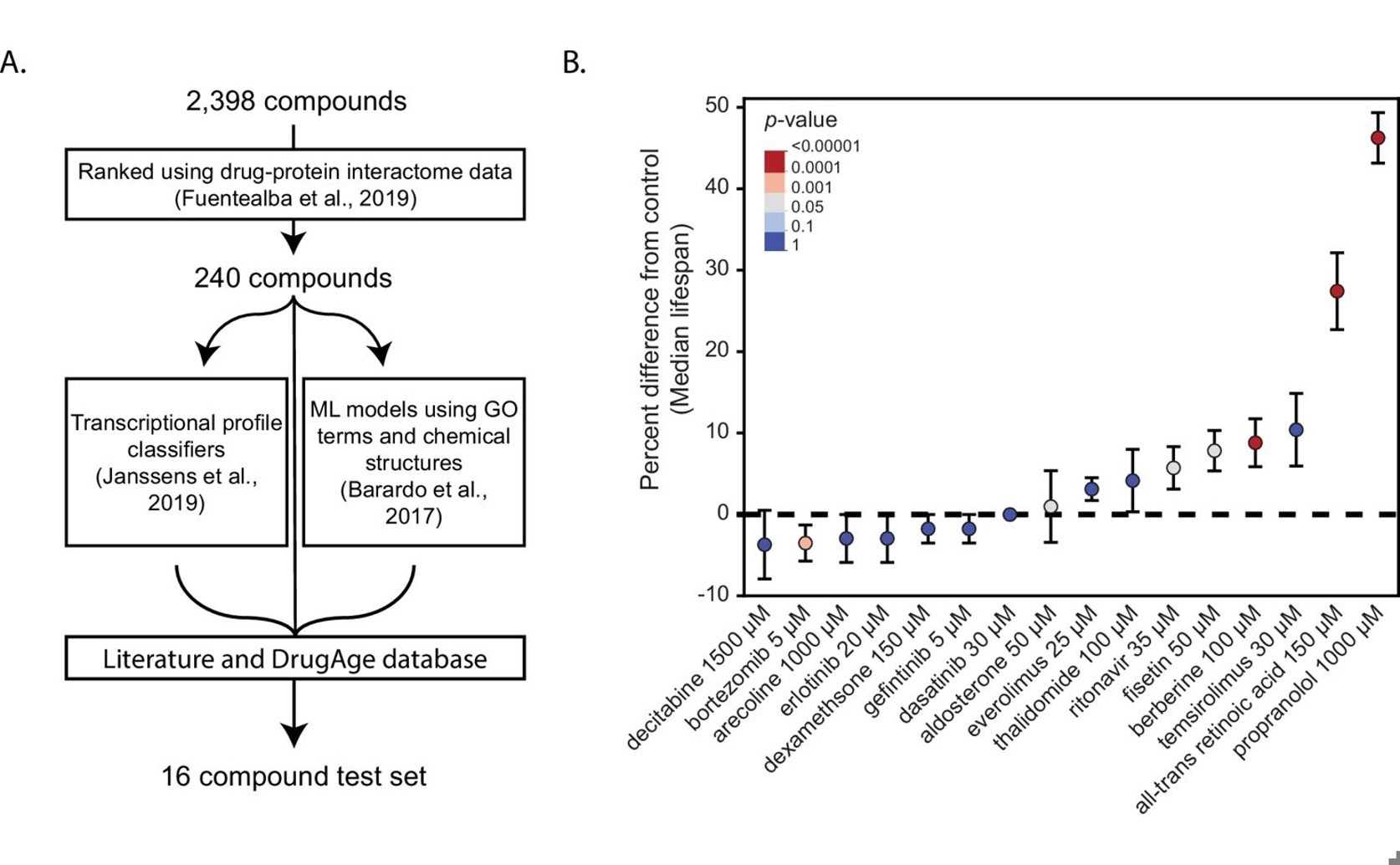
A computational screening of 16 compounds (a) identified the vitamin A derivative all-trans retinoic acid (atRA) as a key candidate that robustly extends the lifespan of Caenorhabditis elegans (b).

Image adapted from: Banse et al. / CC BY (Source)

Key Findings

  • Researchers identified five compounds out of sixteen tested that extended C. elegans lifespan, suggesting computational prediction can efficiently prioritize anti-aging candidates
  • All-trans retinoic acid (atRA) significantly increased lifespan in C. elegans, requiring the AKT-1 and AKT-2 kinases for this effect
  • atRA’s lifespan extension depends on the Nrf2/SKN-1 and HSF1/HSF-1 pathways, indicating it modulates conserved stress response and protein maintenance mechanisms
Discovering ways to combat the negative health effects of aging is a major goal of modern medical research. Identifying potential anti-aging compounds from the vast number of possibilities is a significant challenge. Researchers at the University of Oregon have recently taken a step forward in this area by using computer modeling to predict which compounds are most likely to extend lifespan, then testing these predictions in a living organism[1]. The study focused on 16 compounds identified through computational analysis as having potential anti-aging properties. These compounds were then evaluated using the Caenorhabditis elegans ( C. elegans) model organism, a tiny worm frequently used in aging research. C. elegans has a short lifespan, making it ideal for quickly assessing the effects of interventions. Traditionally, these lifespan assays involved manually tracking individual worms, a time-consuming process[2]. However, advancements in technology, such as the lifespan machine developed by Stroustrup et al.[2], have automated much of this process, allowing for larger-scale studies. Of the 16 compounds tested, five showed promising results by extending the lifespan of C. elegans: all-trans retinoic acid (atRA), berberine, fisetin, propranolol, and ritonavir. This represents a 30% success rate, a surprisingly high outcome given the initial pool of candidates. The researchers then focused on atRA, also known as tretinoin in medical applications, for further investigation. To understand how atRA was extending lifespan, the team delved into the genetic mechanisms involved. They discovered that atRA’s effects required two specific regulatory kinases, AKT-1 and AKT-2. Kinases are enzymes that activate other proteins, essentially acting as signaling switches within cells. While the well-known target of Akt, FOXO/DAF-16, wasn’t crucial for the lifespan extension, other targets were. Specifically, Nrf2/SKN-1 and HSF1/HSF-1 were found to be necessary. These proteins are involved in cellular stress resistance and protein maintenance. Interestingly, AAK-2, the catalytic subunit of AMPK, another conserved metabolic regulator, was also required. This finding is particularly noteworthy as it builds upon previous research demonstrating the importance of protein homeostasis in longevity[3]. The accumulation of misfolded proteins is a hallmark of aging, and compounds that can promote proper protein folding and prevent aggregation can extend lifespan. The involvement of HSF-1 in the atRA-mediated lifespan extension suggests that atRA is, at least in part, acting by bolstering the protein homeostasis network. Furthermore, the study highlights the potential of manipulating endogenous signaling molecules – those naturally produced by the body – to improve healthspan. atRA is a naturally occurring signaling ligand, meaning it binds to receptors and triggers cellular responses. By co-opting this existing signaling pathway, researchers may be able to achieve more effective and targeted anti-aging interventions. The research also adds to the growing body of knowledge regarding the retinoic acid system in invertebrates[4], demonstrating a conserved role for this genetic machinery in neuronal differentiation and potentially broader physiological processes.

GeneticsBiochemEvolution

References

Main Study

1) Computer prediction and genetic analysis identifies retinoic acid modulation as a driver of conserved longevity pathways in genetically diverse Caenorhabditis nematodes

Published 23rd December, 2025

https://doi.org/10.7554/eLife.104375


Related Studies

2) A simplified design for the C. elegans lifespan machine.

https://doi.org/10.14440/jbm.2020.332


3) Amyloid-binding compounds maintain protein homeostasis during ageing and extend lifespan.

https://doi.org/10.1038/nature09873


4) The retinoic acid machinery in invertebrates: ancestral elements and vertebrate innovations.

https://doi.org/10.1016/j.mce.2009.08.029


Related Articles

An unhandled error has occurred. Reload 🗙