XDH-1 Loss Leads to Kidney Stones, Reversed by SULP-4 Transport

Jim Crocker
25th September, 2025

XDH-1 Loss Leads to Kidney Stones, Reversed by SULP-4 Transport

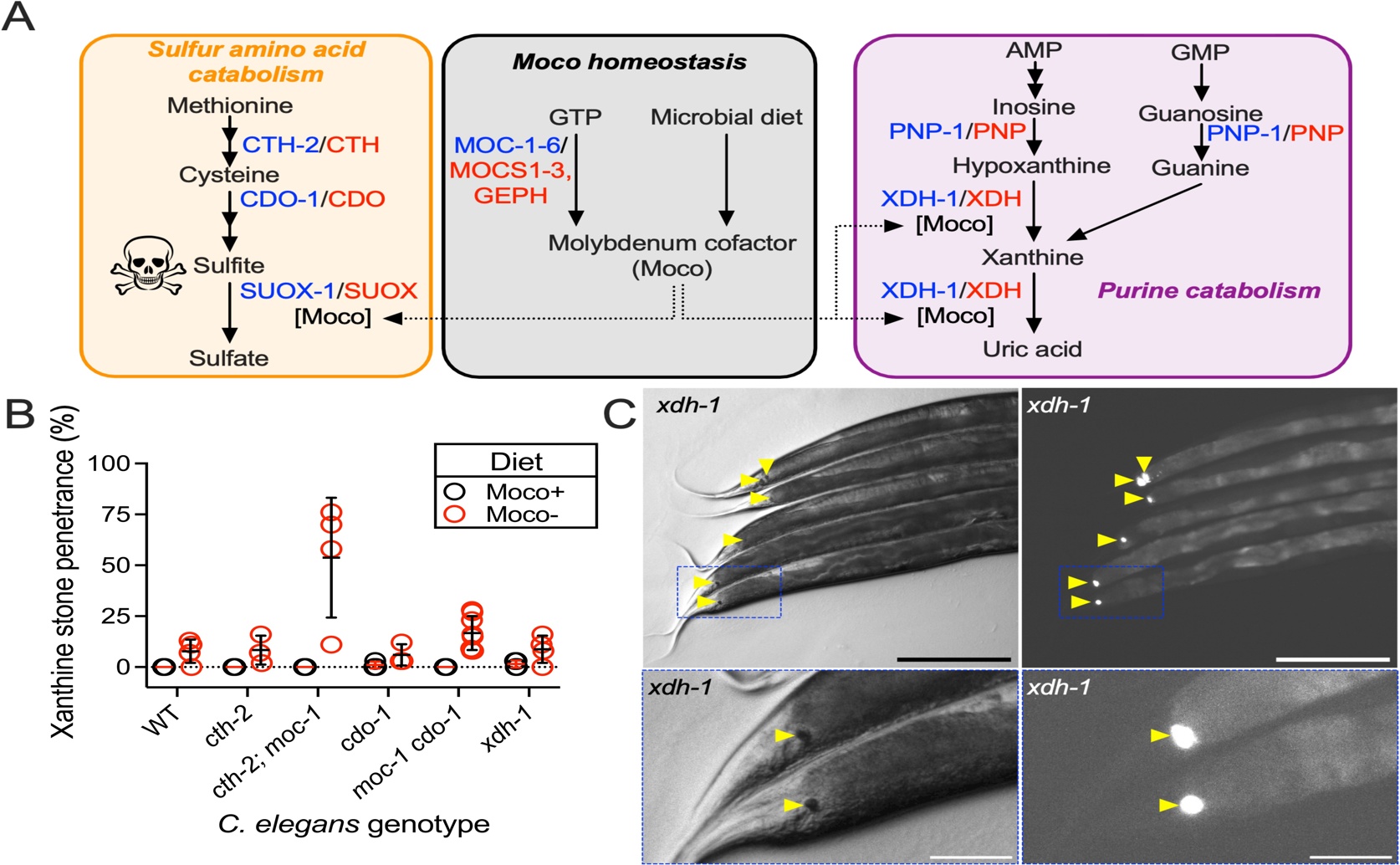
An overview of metabolic pathways (a) and phenotypic characterization demonstrate that Molybdenum cofactor (Moco) deficiency or loss of the xdh-1 gene causes the accumulation of autofluorescent xanthine stones in Caenorhabditis elegans (b, c).

Image adapted from: Snoozy et al. / CC BY (Source)

Key Findings

  • In a worm model, disrupting a gene called xdh-1, similar to a human gene, causes xanthine stones to form, mimicking a rare disease called xanthinuria
  • Loss of another gene, sulp-4, significantly increases the frequency of xanthine stone formation in the xdh-1 mutant worms, suggesting it plays a protective role
  • The sulp-4 gene functions in excretory cells and impacts sulfate levels, with altered sulfate balance potentially leading to osmotic stress and increased stone formation
Human health relies on efficient processing of waste products, and disruptions to this process can lead to serious illness. One such disruption occurs in a metabolic pathway involving purines – compounds found in our DNA and many foods. The final steps of purine breakdown are catalyzed by an enzyme called xanthine dehydrogenase (XDH). Mutations in XDH cause a condition called xanthinuria, leading to the build-up of xanthine which forms stones in the kidneys, causing infections and potentially kidney failure[1]. Currently, there are no effective treatments for this condition, highlighting the need to understand how the body maintains proper purine levels. Researchers at Sanford Research & University of South Dakota, Oregon Health & Science University, and UMass Chan Medical School investigated this problem using the nematode worm, Caenorhabditis elegans as a model organism. C. elegans has a gene, xdh-1, which functions similarly to human XDH. The team created worms with defects in either Moco – a crucial molecule required for XDH function – or in the xdh-1 gene itself, mimicking human XDH deficiency. Both scenarios resulted in the formation of xanthine stones in the worms, confirming the model’s relevance. Interestingly, only a small percentage of worms with a completely non-functional xdh-1 gene developed these stones. This suggested that other, yet unknown, mechanisms were involved in regulating xanthine accumulation. To identify these mechanisms, the researchers conducted a genetic screen: they induced further mutations in the xdh-1 mutant worms, looking for those that dramatically increased the frequency of stone formation. This screen revealed a key gene, sulp-4, which encodes a protein that transports sulfate ions. Loss of sulp-4 function significantly increased xanthine stone formation in the xdh-1 mutant worms. Further investigation showed that sulp-4 doesn’t act directly in the cells where stones form, but instead functions in excretory cells, suggesting a systemic role in regulating xanthine levels. The connection between sulfate and xanthine stones was further strengthened by the observation that suppressing sulp-4’s function with mutations in genes involved in sulfur amino acid metabolism – specifically cth-2 and cdo-1 – rescued the stone formation phenotype. These genes are responsible for producing sulfate, a substrate of SULP-4, implying that excessive sulfate accumulation contributes to the problem. The researchers proposed that increased sulfate levels create an osmotic imbalance in the worm’s gut, making it easier for xanthine to crystallize and form stones. This was supported by findings that activating an osmotic stress response pathway also promoted xanthine stone formation in the xdh-1 mutant background. This study builds on previous understanding of how the body manages uric acid levels. It’s known that serum uric acid concentrations are determined by a balance between production and excretion, and that genetic factors can disrupt this balance[2]. The research highlights the importance of inter-kingdom Moco transfer in maintaining sulfur homeostasis, as demonstrated in C. elegans[3], and the essential role of molybdenum in enzymes like sulfite oxidase[4]. The current findings extend this understanding by identifying a specific transporter, SULP-4, as a critical regulator of xanthine stone formation, linking purine metabolism to sulfate transport and osmotic balance. By establishing C. elegans as a model for human XDH deficiency, this research opens new avenues for identifying therapeutic targets to treat this debilitating condition.

GeneticsBiochemEvolution

References

Main Study

1) XDH-1 inactivation causes xanthine stone formation in Caenorhabditis elegans which is inhibited by SULP-4-mediated anion exchange in the excretory cell

Published 24th September, 2025

https://doi.org/10.1371/journal.pbio.3003410


Related Studies

2) Genetic disorders resulting in hyper- or hypouricemia.

https://doi.org/10.1053/j.ackd.2012.06.002


3) Molybdenum cofactor transfer from bacteria to nematode mediates sulfite detoxification.

https://doi.org/10.1038/s41589-019-0249-y


4) Molybdenum cofactors, enzymes and pathways.

https://doi.org/10.1038/nature08302


Related Articles

An unhandled error has occurred. Reload 🗙