Fungal compounds show promise as potential new cancer therapies

Greg Howard
24th December, 2025

Fungal compounds show promise as potential new cancer therapies

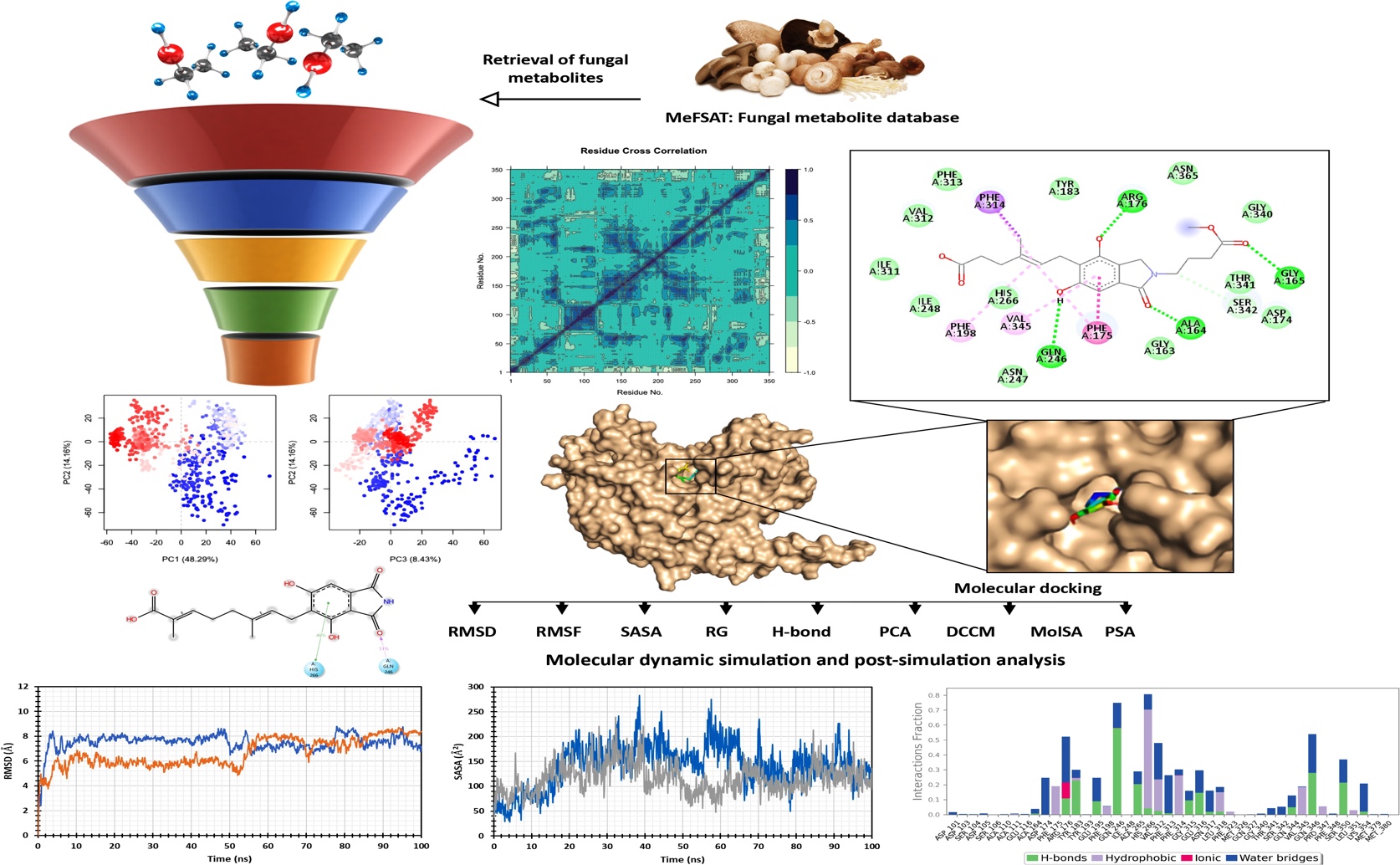
The overview of the entire study.

Image adapted from: Masum et al. / CC BY (Source)

Key Findings

  • This study, conducted at multiple universities including those in Bangladesh and the US, investigated fungal compounds as potential cancer-fighting agents by targeting the SIRT2 protein
  • Two fungal metabolites, MSID001658 and MSID000672, showed strong binding to SIRT2 in computer simulations, suggesting they could effectively block the protein’s function
  • Molecular dynamics simulations indicated MSID001658 formed a more stable connection with SIRT2, while MSID000672 exhibited greater flexibility, both showing promise for further drug development
Cancer remains a leading cause of death globally, with nearly 20 million new cases diagnosed in 2022 alone[2]. Understanding the underlying mechanisms driving cancer development is crucial for creating effective treatments. One protein increasingly implicated in cancer progression is Sirtuin 2 (SIRT2). SIRT2 belongs to a family of proteins called sirtuins, which regulate various biological processes and depend on a molecule called NAD+ to function. Research has shown that SIRT2 activity is often disrupted in different types of cancer[3]. This disruption suggests that controlling SIRT2 activity could be a promising strategy for fighting cancer. Specifically, identifying molecules that can inhibit SIRT2 – effectively blocking its function – has become a significant focus for drug development. A recent study conducted by researchers at Chattogram Veterinary & Animal Sciences University, Asian University for Women (AUW), Noakhali Science & Technology University, Lovely Professional University, Chattogram Veterinary & Animal Sciences University, University of Rajshahi, and University of Texas Southwestern[1] investigated fungal metabolites as potential SIRT2 inhibitors. The team used a technique called computer-aided drug design (CADD) to screen a large number of naturally occurring compounds from fungi. CADD involves using computer simulations to predict how well different molecules bind to a target protein – in this case, SIRT2. The initial screening identified several promising candidates. Further analysis focused on two metabolites, MSID001658 and MSID000672. Both showed strong binding affinities to SIRT2, meaning they were predicted to attach well to the protein. MSID001658 had a slightly higher predicted binding score (-10.9 kcal/mol) than MSID000672 (-10.2 kcal/mol). To confirm these findings, the researchers performed molecular dynamics simulations. These simulations tracked the movement and interactions of SIRT2 with each metabolite over time, providing a more detailed understanding of the stability of the complexes formed. The simulations revealed that both complexes were generally stable, but MSID001658 formed a more consistently structured association with SIRT2. MSID000672 showed greater flexibility and increased exposure to the surrounding solvent. This difference suggests that MSID001658 might bind more tightly and predictably to SIRT2, while MSID000672 could have a more dynamic interaction. Beyond binding affinity and stability, the researchers also assessed the drug-like properties of the metabolites. These properties, known as ADMET (absorption, distribution, metabolism, excretion, and toxicity), are critical for determining whether a compound can be developed into a viable drug. Importantly, both metabolites exhibited good oral bioavailability, meaning they were likely to be absorbed effectively when taken by mouth. They also had favorable ADMET profiles and showed no signs of being toxic to cells, carcinogenic (cancer-causing), or mutagenic (causing genetic mutations). Interestingly, previous studies have highlighted the role of SIRT2 in regulating tubulin, a protein essential for cell structure and division[4]. SIRT2 deacetylates tubulin, impacting microtubule dynamics. This connection between SIRT2 and tubulin suggests a broader role for SIRT2 in cancer cell behavior, and inhibiting it could disrupt cell division and tumor growth. The findings of build upon this understanding by identifying potential inhibitors that could target SIRT2 and ultimately impact these processes. The researchers concluded that MSID001658 and MSID000672 are promising candidates for further investigation as anticancer agents. While MSID001658 appears to form a more stable complex with SIRT2, MSID000672’s increased flexibility might also offer therapeutic advantages, and warrants further study. Additional in vitro (laboratory) and in vivo (animal) experiments are needed to confirm these findings and evaluate the effectiveness of these metabolites in treating cancer.

MedicineBiochemMycology

References

Main Study

1) Bioactive fungal metabolites as SIRT2 antagonists: A computational quest for cancer treatment

Published 22nd December, 2025

https://doi.org/10.1371/journal.pone.0339474


Related Studies

2) Global cancer statistics 2022: GLOBOCAN estimates of incidence and mortality worldwide for 36 cancers in 185 countries.

https://doi.org/10.3322/caac.21834


3) In silico drug discovery of SIRT2 inhibitors from natural source as anticancer agents.

https://doi.org/10.1038/s41598-023-28226-7


4) The human Sir2 ortholog, SIRT2, is an NAD+-dependent tubulin deacetylase.

Journal: Molecular cell, Issue: Vol 11, Issue 2, Feb 2003


Related Articles

An unhandled error has occurred. Reload 🗙