New fungus discovered infecting persimmon trees

Jim Crocker
29th December, 2025

New fungus discovered infecting persimmon trees

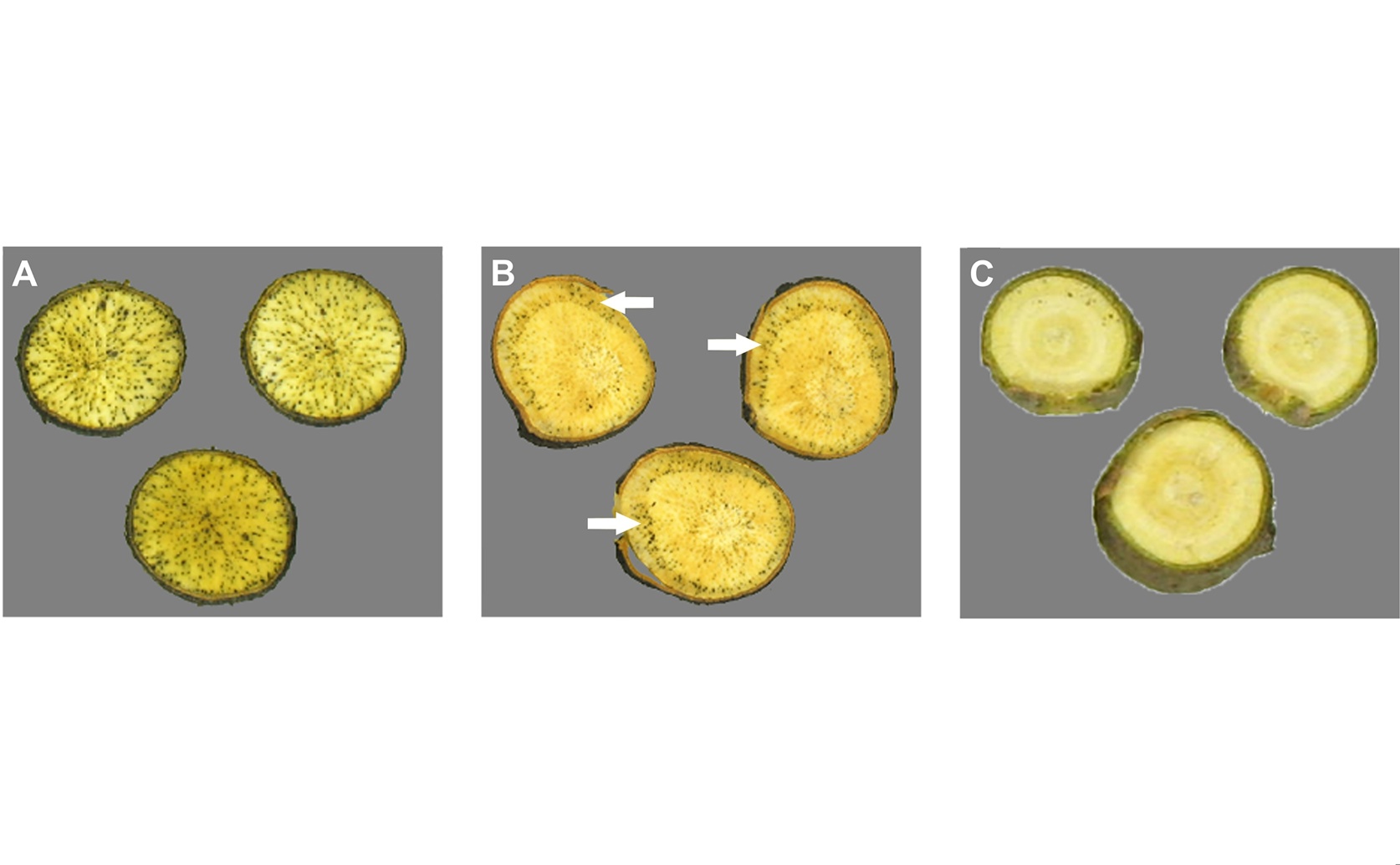
The taproots of naturally infected Diospyros virginiana plants displayed key disease symptoms as either evenly distributed (A) or circular (B) patterns of necrosis, in contrast to asymptomatic roots (C), which led to the first identification of Ilyonectria liriodendri as a pathogen for this host.

Image adapted from: Molnár et al. / CC BY (Source)

Key Findings

  • In Hungary, researchers identified Ilyonectria liriodendri fungus infecting persimmon trees, a new host for this pathogen
  • Genetic analysis confirmed the fungus causes disease, fulfilling Koch’s postulates by re-isolating it from infected plants
  • I. liriodendri isolates showed some variation in traits, suggesting a diverse population capable of adapting to new hosts
Black foot disease poses a significant threat to various woody plants, including grapevines and walnuts, primarily attacking roots and the base of the stem. The disease is caused by several fungal species within the genus Ilyonectria, and identifying the specific pathogens involved is crucial for developing effective management strategies. Recently, researchers from Eszterházy Károly Catholic University and Benemerita Universidad Autonoma de Puebla[1] identified Ilyonectria liriodendri as a cause of disease in persimmon trees (Diospyros virginiana) in Hungary – a previously unreported host for this fungus. The study began with the isolation of four Ilyonectria liriodendri isolates from the decaying roots of diseased persimmon plants in Eger, Hungary, in 2021. To confirm their identity, the researchers examined specific sections of their DNA – the ITS region, β-tubulin gene, and partial histone H3 gene. These genetic markers act like fingerprints, allowing scientists to accurately identify fungal species. Phylogenetic analysis, a method comparing the genetic relationships between organisms, confirmed all four isolates belonged to Ilyonectria liriodendri. While genetically similar, the isolates showed some variation in their physical characteristics (macro- and micromorphology) and the enzymes they produced (exoenzyme production). This suggests a degree of diversity within the I. liriodendri population, which is important to consider when studying the fungus’s overall behavior and potential for adaptation. To definitively prove that I. liriodendri was responsible for the disease symptoms observed in persimmon, the researchers performed a controlled experiment based on Koch’s postulates. This involves infecting healthy plants with the fungus and then re-isolating it from the newly diseased tissue. One-year-old persimmon plants were inoculated with conidial suspensions – essentially, a solution containing fungal spores – of the I. liriodendri isolates. After 90 days in a greenhouse environment, 16 out of 20 inoculated plants developed necrosis (tissue death) in their taproots, while the control plants (those not inoculated) remained healthy. Importantly, the researchers were able to re-isolate the I. liriodendri fungus from the roots of the infected plants, confirming its role as the causative agent of the disease. This finding expands our understanding of the host range of I. liriodendri. Previous research has documented a wide range of Ilyonectria species associated with black foot disease in grapevines[2][3], and these studies identified several species within the Dactylonectria, Neonectria, and Thelonectria genera alongside Ilyonectria. The work in California[3] specifically highlighted the diversity of cylindrocarpon-like fungi causing root diseases in various fruit and nut crops, including ten previously described species and two new ones. The ability to accurately identify these species, often relying on genetic markers such as ITS, β-tubulin, and TEF1, is critical for understanding disease epidemiology and developing targeted control measures. Similar genetic markers were also used in a study of grapevine black foot disease in Northern Spain[2], which identified eleven species and two newly described ones, emphasizing the complex fungal community involved in the disease. The Spanish study also investigated the virulence – the degree of disease-causing ability – of different isolates, finding significant variation even within the same species. The discovery of I. liriodendri causing disease in persimmon adds to this growing body of knowledge, suggesting that this fungus may be a more widespread pathogen than previously recognized. Furthermore, research into esca and Petri disease in British Columbia[4] demonstrates the importance of identifying new species and their pathogenic potential, as well as the usefulness of genetic markers like EF1-α for delineating Phaeomoniella species. The identification of I. liriodendri as a persimmon pathogen is significant because it represents a new host association for this fungus. This information is valuable for growers and researchers alike, as it broadens the scope of potential disease risks and informs future investigations into the fungus’s biology and control.

AgriculturePlant ScienceMycology

References

Main Study

1) Isolation and characterization of the phytopathogenic fungus Ilyonectria liriodendri from persimmon as a new susceptible host

Published 26th December, 2025

https://doi.org/10.1371/journal.pone.0339616


Related Studies

2) Occurrence and Diversity of Black-Foot Disease Fungi in Symptomless Grapevine Nursery Stock in Spain.

https://doi.org/10.1094/PDIS-03-19-0484-RE


3) Taxonomy and multi-locus phylogeny of cylindrocarpon-like species associated with diseased roots of grapevine and other fruit and nut crops in California.

https://doi.org/10.3114/fuse.2019.04.06


4) Grapevine Trunk Diseases in British Columbia: Incidence and Characterization of the Fungal Pathogens Associated with Esca and Petri Diseases of Grapevine.

https://doi.org/10.1094/PDIS-05-13-0523-RE


Related Articles

An unhandled error has occurred. Reload 🗙