Study identifies bee pollen types based on where they come from using AI

Greg Howard
22nd October, 2025

Study identifies bee pollen types based on where they come from using AI

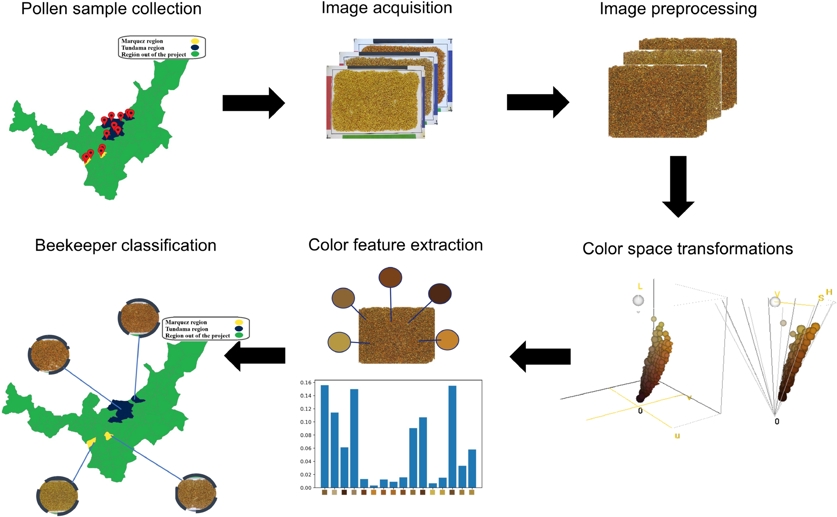
Flowchart from study of the geographic origin classification process.

Image adapted from: Campuzano et al. / CC BY (Source)

Key Findings

  • In Colombia’s Boyacá region, researchers developed a method to identify the origin of pollen samples using images and machine learning
  • The machine learning model accurately predicted the pollen producer in 85% of the cases, showing color characteristics can reveal its source
  • This image-based approach offers a simpler, faster, and more affordable way to verify pollen origin compared to traditional, complex analyses
Bee pollen is gaining popularity as a health food, and consumers are increasingly interested in knowing where their pollen comes from. Knowing the origin and producer of pollen can increase its value and build trust with buyers. Researchers at AGROSAVIA (Colombia), Escuela Tecnológica Instituto Técnico Central (Colombia), Universidad Nacional de Colombia (Colombia), and Universidad Nacional de Colombia (Colombia) have developed a new method to identify pollen producers using digital images and machine learning[1]. The challenge lies in verifying the source of pollen. Pollen’s nutritional benefits are well-established[2], with studies highlighting its potential as a dietary supplement and its positive effects on animal health. However, the digestibility of pollen can be a limiting factor, prompting the development of various pollen-based products to improve nutrient absorption[2]. This increased focus on product quality and bioavailability naturally leads to a demand for traceability – knowing exactly where the pollen originated. The study focused on pollen samples collected from different beekeepers in the Boyacá region of Colombia. The researchers used a consistent process to take standardized images of the pollen. These images weren’t analyzed visually by people; instead, the team used machine learning – a type of artificial intelligence – to analyze the color information within the images. The core idea is that subtle differences in color might indicate the specific beekeeper the pollen came from, potentially due to variations in the local flora the bees forage on. Machine learning models are essentially algorithms trained to recognize patterns in data. In this case, the “data” was the color information from the pollen images, and the “pattern” was the association between specific color characteristics and the beekeeper who produced the pollen. The models learned to predict the producer based on these color features. The results were promising. The model accurately identified the producer of the pollen samples 85% of the time. This demonstrates that it's possible to determine the origin of pollen based on its color characteristics alone. This research builds on existing knowledge of bee product properties[3]. While studies have long recognized the pharmacological benefits of bee products like honey and royal jelly due to their flavonoid content, this study shifts the focus to a practical application of pollen identification. Furthermore, work done at the Institute of Apicultural Research (CHINA) has already shown the feasibility of predicting the physicochemical composition of bee pollen based on its botanical origin[4], using neural networks and fuzzy models. This study takes a different approach, utilizing image analysis and machine learning to focus on producer identification rather than plant genus. Crucially, the method developed by the research team offers a cost-effective and accessible way to verify pollen origin. Traditional methods of origin authentication often rely on complex elemental analysis[5], which can be expensive and time-consuming. Using digital images and machine learning provides a simpler, faster, and more affordable alternative.

AgriculturePlant ScienceMycology

References

Main Study

1) Classification of images of bee pollen according to their producers

Published 21st October, 2025

https://doi.org/10.1371/journal.pone.0334615


Related Studies

2) The Application of Pollen as a Functional Food and Feed Ingredient-The Present and Perspectives.

https://doi.org/10.3390/biom10010084


3) Bee Products in Dermatology and Skin Care.

https://doi.org/10.3390/molecules25030556


4) Computational intelligence applied to discriminate bee pollen quality and botanical origin.

https://doi.org/10.1016/j.foodchem.2017.06.014


5) Geographical Origin Authentication of Agri-Food Products: Α Review.

https://doi.org/10.3390/foods9040489


Related Articles

An unhandled error has occurred. Reload 🗙