Using sugar baits to attract and trap sand flies that spread leishmaniasis

Jenn Hoskins
29th December, 2025

Using sugar baits to attract and trap sand flies that spread leishmaniasis

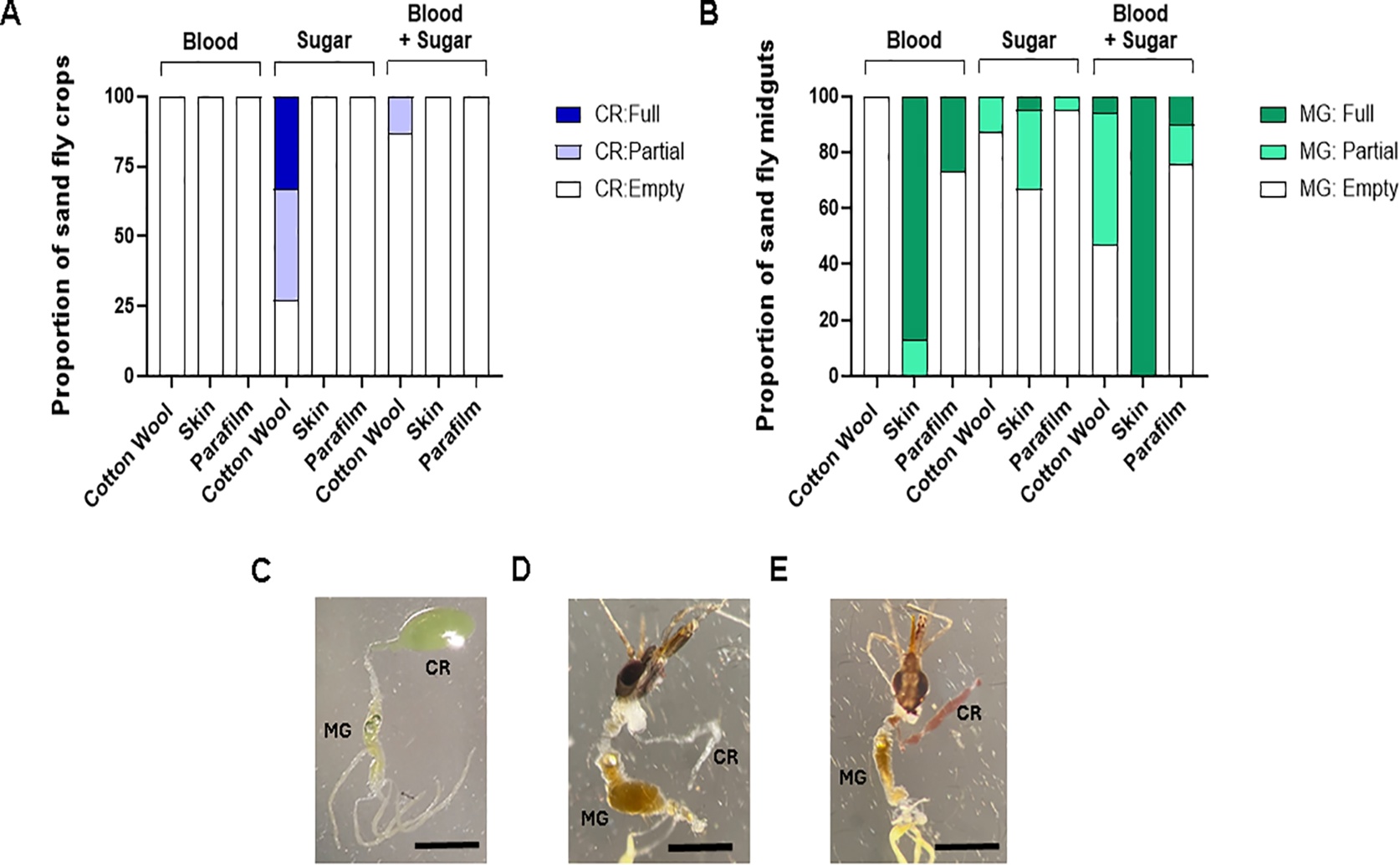
The feeding programs of sand flies (Lutzomyia longipalpis) are distinct but manipulable, as adding blood to a sugar solution overrides the physical feeding method to direct the meal into both the midgut and the crop (a–e), demonstrating a key principle this study exploits to enhance the delivery of sugar-based insecticides.

Image adapted from: Castro et al. / CC BY (Source)

Key Findings

  • Sand flies need sugar for energy and survival, making sugar baits a potential control method
  • Combining 10% sucrose and 10% fructose in baits significantly increased sugar intake by sand flies
  • Adding BSA and ATP to sugar baits dramatically enhanced insecticide potency, reducing the lethal dose needed to kill sand flies
Leishmaniasis, a disease transmitted by sand flies, affects millions globally, particularly in impoverished regions. Current control methods often struggle with sustainability and adaptation to local sand fly behaviours. A key challenge is managing the sand fly population effectively, as traditional insecticide-based strategies face increasing resistance and logistical hurdles. Researchers at the Instituto Oswaldo Cruz (IOC), the London School of Hygiene & Tropical Medicine, and the International Atomic Energy Agency[1] have been investigating a novel approach: Attractive Targeted Sugar Baits (ATSBs). These baits exploit the sand fly’s need for sugar to supplement blood meals, offering a potentially more targeted and efficient control method. The core idea behind ATSBs is to attract sand flies with sugar, then deliver a lethal dose of insecticide. However, simply providing sugar isn’t always enough. Sand flies are selective feeders, and the efficiency of the bait depends on attracting them to consume enough of the insecticide-laced sugar. Previous research into mosquito control has highlighted the potential of ATSBs, with studies exploring their use against malaria vectors[2]. These studies, while showing promise, haven't always resulted in statistically significant reductions in disease incidence, suggesting that optimising bait attractiveness and insecticide delivery is crucial. To improve ATSB efficacy against sand flies, the IOC team focused on understanding the factors that influence their sugar-feeding behaviour. They developed a fluorescent assay – a technique using fluorescent markers to track sugar intake – to precisely measure how much sugar sand flies consumed. Their experiments revealed that sand flies prefer certain sugar combinations over others. Specifically, a mix of 10% sucrose and 10% fructose proved most effective at encouraging sugar meal uptake. However, simply finding the preferred sugar blend wasn't the whole story. The researchers discovered that adding bovine serum albumin (BSA), a protein source, and adenosine triphosphate (ATP), a phagostimulant – a substance that encourages feeding – dramatically increased sugar meal size and deposition into both the crop (a storage organ) and midgut (the digestive tract). This is significant because getting the insecticide into both areas increases its effectiveness. The most important finding was that incorporating BSA and ATP into the ATSB significantly enhanced the potency of the insecticide fipronil. The concentration of fipronil needed to kill 50% of the sand flies (the LC50) was reduced from 584 µM to just 1.65 µM when delivered within a sugarmeal containing BSA and ATP. This represents a substantial improvement in killing efficiency. This research builds on the broader understanding of vector control strategies, acknowledging the challenges presented by insecticide resistance[3]. By focusing on the behavioural aspects of sand fly feeding, the IOC team has identified a way to overcome some of the limitations of traditional insecticide-based approaches. The addition of blood feeding phagostimulants to ATSBs doesn't just attract sand flies; it encourages them to ingest a lethal dose of insecticide more readily, improving the overall effectiveness of the bait. This demonstrates a new approach to target these disease vectors.

AgricultureHealthEcology

References

Main Study

1) Exploiting nectar and blood feeding cues and phagostimulants to optimise Attractive Targeted Sugar Baits against a sand fly vector of leishmaniasis

Published 26th December, 2025

https://doi.org/10.1371/journal.pntd.0013888


Related Studies

2) Efficacy of attractive targeted sugar bait stations against malaria in Western Province Zambia: epidemiological findings from a two-arm cluster randomized phase III trial.

https://doi.org/10.1186/s12936-024-05175-8


3) Maximizing the Potential of Attractive Targeted Sugar Baits (ATSBs) for Integrated Vector Management.

https://doi.org/10.3390/insects14070585


Related Articles

An unhandled error has occurred. Reload 🗙