How bacteria produce digestive enzymes may offer new industrial applications

Jim Crocker
21st December, 2025

How bacteria produce digestive enzymes may offer new industrial applications

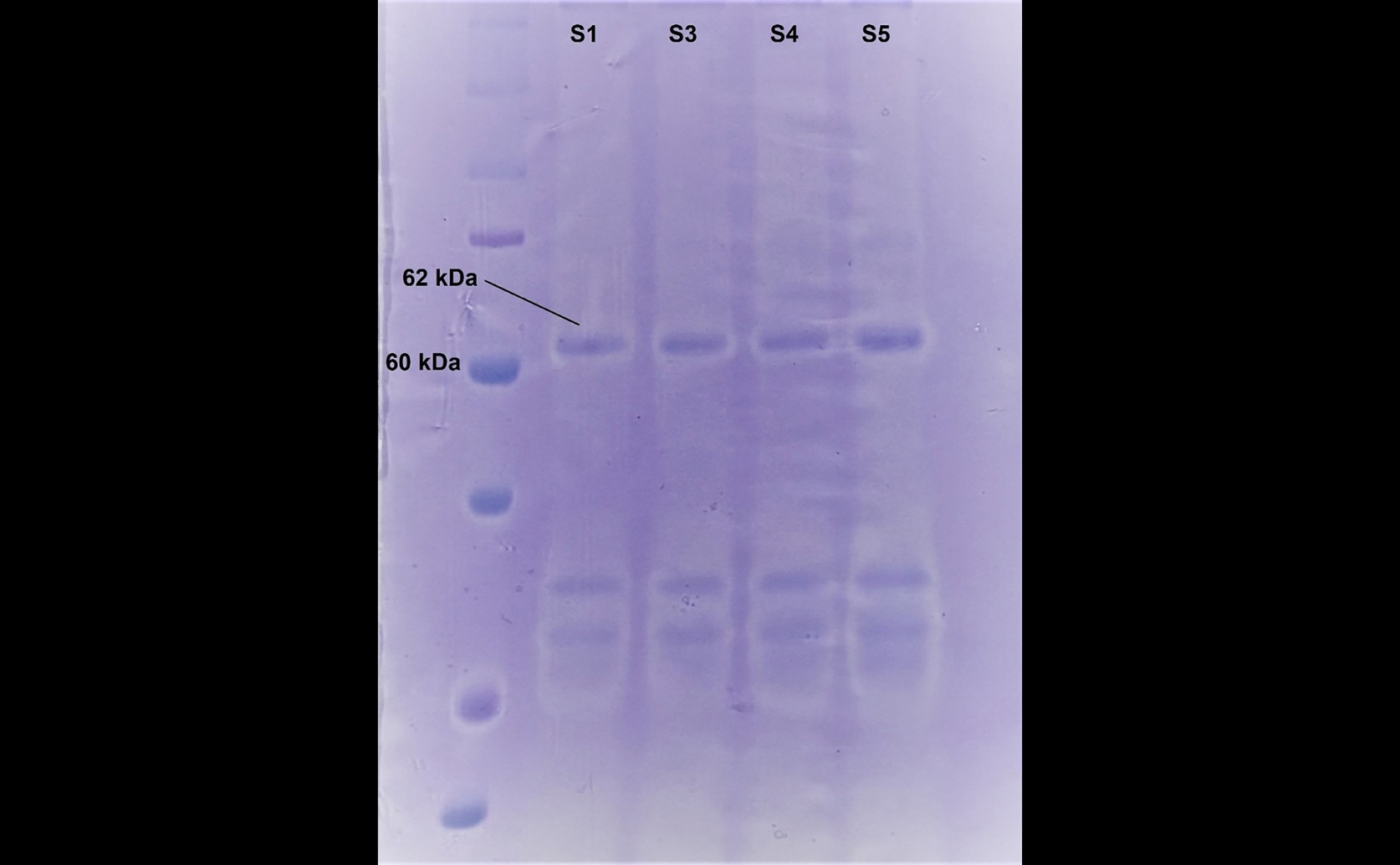
SDS-PAGE analysis of the purified α-amylase from the most potent Bacillus spizizenii isolates revealed a distinct protein band at approximately 62 kDa (lanes 2 and 3), confirming the molecular weight predicted from the genomic analysis.

Image adapted from: Sharif et al. / CC BY (Source)

Key Findings

  • Researchers in Iran identified two new bacterial strains, S1 and S3, from soil and water samples that produce high levels of the α-amylase enzyme
  • These strains (S1 and S3) demonstrated exceptional stability, maintaining enzyme activity across a wide pH range (4-9) and high temperatures (30-80°C), making them suitable for industrial use
  • Genomic analysis confirmed S1 and S3 are novel variants of Bacillus spizizenii, with a specific gene identified that codes for a highly efficient α-amylase enzyme with strong binding to starch
α-Amylase enzymes are vital in many industries, including food production, animal feed, and biotechnology[2]. These enzymes break down starch into simpler sugars, a process called hydrolysis, and are particularly useful in making ingredients like maltodextrin and glucose syrups. While bacteria, especially those from the Bacillus genus, are commonly used to produce these enzymes due to their efficiency, there’s a continuous search for new strains with even better performance. A recent study conducted by researchers at Isfahan University of Technology & Islamic Azad University, Iran[1], focused on finding these improved α-amylase producers in various environments across Iran. The research team collected samples from soil, water, and industrial waste across five Iranian provinces – Golestan, Mazandaran, Gilan, Kurdistan, and Isfahan. They then isolated sixty bacterial strains and screened them for their ability to break down starch. Four strains stood out, showing high levels of α-amylase production, indicated by a “productivity index” greater than 1.8. Of these, strains S1 and S3, found in the Kuhrang water source and Gavkhouni Wetland in Isfahan province, respectively, were particularly promising. These strains produced exceptionally high amounts of α-amylase – up to 34,121 units per gram of culture – and remained stable across a wide range of pH levels (4 to 9) and temperatures (30 to 80°C). The stability of enzymes is a critical factor for industrial use[2]. Enzymes often lose their effectiveness when exposed to harsh conditions like extreme temperatures or pH levels. The broad tolerance of strains S1 and S3 addresses this challenge, making them potentially valuable for large-scale applications. To understand these strains better, the researchers performed detailed genetic analysis, including sequencing their entire genomes. This revealed that strains S1 and S3 are novel variants of Bacillus spizizenii. This is significant because this is the first documented report of α-amylase production potential from this species within Iranian ecosystems, and specifically from Isfahan province. Further investigation pinpointed a specific gene, 1980 base pairs long, belonging to the GH13 family, which codes for the α-amylase enzyme. This gene produces a 62 kDa enzyme with a high degree of similarity (93.6%) to an α-amylase enzyme called AmyE found in Bacillus subtilis. To understand how well this enzyme functions, the researchers used computer modeling (molecular docking) to simulate its interaction with maltotetraose, a sugar molecule formed during starch breakdown. This simulation showed a strong binding affinity between the enzyme and the sugar, indicating efficient catalysis. The enzyme’s ability to bind effectively is crucial for its function, and the modeling highlighted key interactions with specific amino acids in the enzyme’s active site. The study builds upon previous knowledge of α-amylase production in Bacillus species[3]. While Bacillus subtilis has been extensively studied for its amylase-producing capabilities, exploring other Bacillus species like B. spizizenii can lead to the discovery of enzymes with improved properties. Furthermore, research has shown that different Bacillus subtilis subspecies produce unique secondary metabolites[4], suggesting genetic diversity within the genus can translate to functional differences. This research aligns with this concept, demonstrating that even within a single species, variations can exist that impact enzyme production and stability. The discovery of these high-performing strains from diverse environments emphasizes the importance of exploring underexplored ecosystems for novel biotechnological resources. The improved stability and activity of the α-amylase produced by these B. spizizenii strains, combined with their genetic characteristics, makes them strong candidates for use in industrial applications, particularly in animal feed. Indeed, supplementing animal diets with α-amylase can improve nutrient digestibility and overall performance[5].

BiotechGeneticsBiochem

References

Main Study

1) Genomic and enzymatic insights into α-amylase-producing Bacillus spizizenii strains isolated from Isfahan province, Iran

Published 18th December, 2025

https://doi.org/10.1371/journal.pone.0333668


Related Studies

2) Structure-based modification of a-amylase by conventional and emerging technologies: Comparative study on the secondary structure, activity, thermal stability and amylolysis efficiency.

https://doi.org/10.1016/j.foodchem.2023.137903


3) Application of microbial α-amylase in industry - A review.

https://doi.org/10.1590/S1517-83822010000400004


4) Promotion of Bacillus subtilis subsp. inaquosorum, Bacillus subtilis subsp. spizizenii and Bacillus subtilis subsp. stercoris to species status.

https://doi.org/10.1007/s10482-019-01354-9


5) Alpha-amylase supplementation of broiler diets based on corn.

Journal: Poultry science, Issue: Vol 82, Issue 3, Mar 2003


Related Articles

An unhandled error has occurred. Reload 🗙