Simple setups can boost reptile research and offer useful design tips

Jim Crocker
28th November, 2025

Simple setups can boost reptile research and offer useful design tips

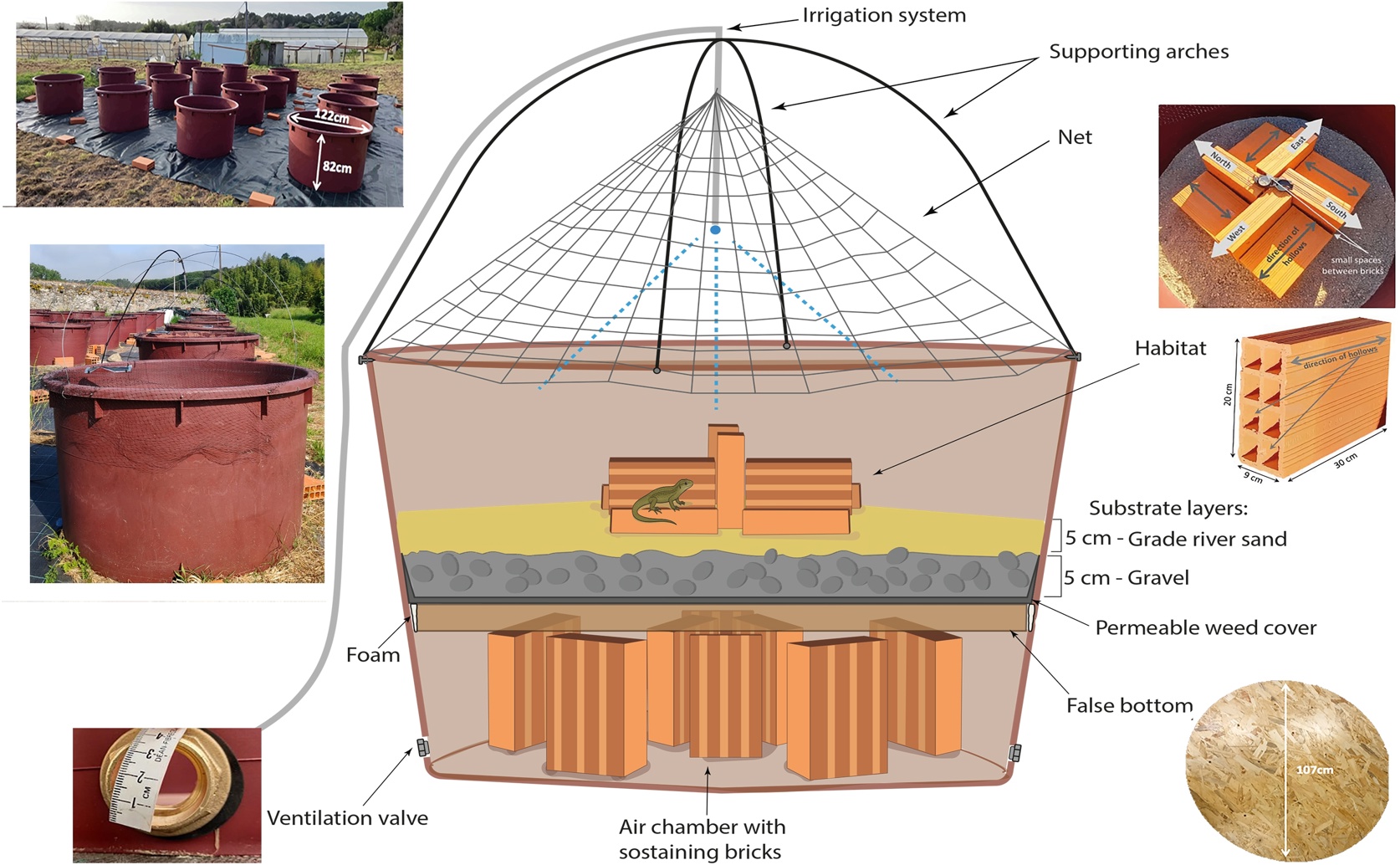
Mesocosm design diagram from study.

Image adapted from: Simbula et al. / CC BY (Source)

Key Findings

  • Researchers in Portugal developed a new, affordable mesocosm system for studying reptiles in a semi-natural environment
  • The mesocosm system successfully housed lizards for seven months, with most maintaining or gaining weight and exhibiting natural behaviors
  • This modular system, costing around 215€ per unit, is easily expandable and suitable for individual-level reptile research with limited resources
Ecological research often faces a challenge: how to study natural systems without disrupting them, and how to do so affordably. Traditional methods involve either highly controlled laboratory experiments, which may not reflect real-world complexity, or large-scale field studies, which can be expensive and logistically difficult. Mesocosms – essentially controlled ecosystems – offer a middle ground, allowing researchers to observe ecological processes in a more natural setting while still maintaining experimental control[2]. However, even building and maintaining mesocosms can be resource-intensive. Researchers at CIBIO-InBIO (Porto), BIOPOLIS (Porto), University of Porto, University of Tirana, Ovidius University, Chelonia Romania, and HUN-REN Ecological Research addressed this issue by developing a new, medium-sized mesocosm system (MS)[1]. This system is designed for studying individual animals and how they interact with their environment, specifically focusing on small, ground-dwelling reptiles. The goal was to create a practical and affordable alternative to larger, more complex mesocosm facilities. The study recognized that while large mesocosms are useful for understanding how entire communities interact, they are often beyond the reach of researchers with limited funding or space. The new MS prioritizes replicated experimental units – meaning multiple identical setups – which is crucial for reliable scientific results. This approach aligns with the principles outlined in earlier work evaluating ecological risk assessment, which emphasized the importance of experimental models like microcosms and mesocosms for understanding environmental impacts[3]. The MS units were constructed using readily available, inexpensive materials and included a programmable irrigation system to mimic natural rainfall patterns. To test the system, the researchers used Podarcis bocagei lizards, a common reptile species, over a seven-month period. They captured wild lizards and housed them in the mesocosms, carefully monitoring their health and behavior. The results were encouraging. The mesocosms proved to be durable and required only minor maintenance. Importantly, most lizards maintained or even gained weight during the active season, indicating the system provided adequate resources. The lizards also exhibited natural behaviors, such as basking in the sun and searching for food, suggesting the mesocosms provided a reasonably realistic environment. The modular design of the MS is a key feature. It can be easily expanded or modified to suit different research questions. The researchers successfully expanded the system to 32 units after the initial pilot test, demonstrating its scalability. This adaptability is important because mesocosm designs have evolved over time, with increasing consideration given to factors like nutrient cycling and interactions between different parts of the ecosystem[2]. This new mesocosm system offers a valuable tool for ecological research, particularly for studies focusing on individual-level responses to environmental factors and basic interactions between members of the same species. It provides a practical solution for researchers facing resource constraints, allowing them to conduct rigorous experiments in a semi-natural setting.

EnvironmentEcologyAnimal Science

References

Main Study

1) A cost-effective mesocosm framework for reptile research: Design, validation, and practical insights

Published 26th November, 2025

https://doi.org/10.1371/journal.pone.0337616


Related Studies

2) A review of mesocosm experiments on heavy metals in marine environment and related issues of emerging concerns.

https://doi.org/10.1007/s11356-020-11121-3


3) The use of terrestrial and aquatic microcosms and mesocosms for the ecological risk assessment of veterinary medicinal products.

Journal: Environmental toxicology and chemistry, Issue: Vol 24, Issue 4, Apr 2005


Related Articles

An unhandled error has occurred. Reload 🗙