How farming impacts small creatures living in ponds and ditches

Jenn Hoskins
25th November, 2025

How farming impacts small creatures living in ponds and ditches

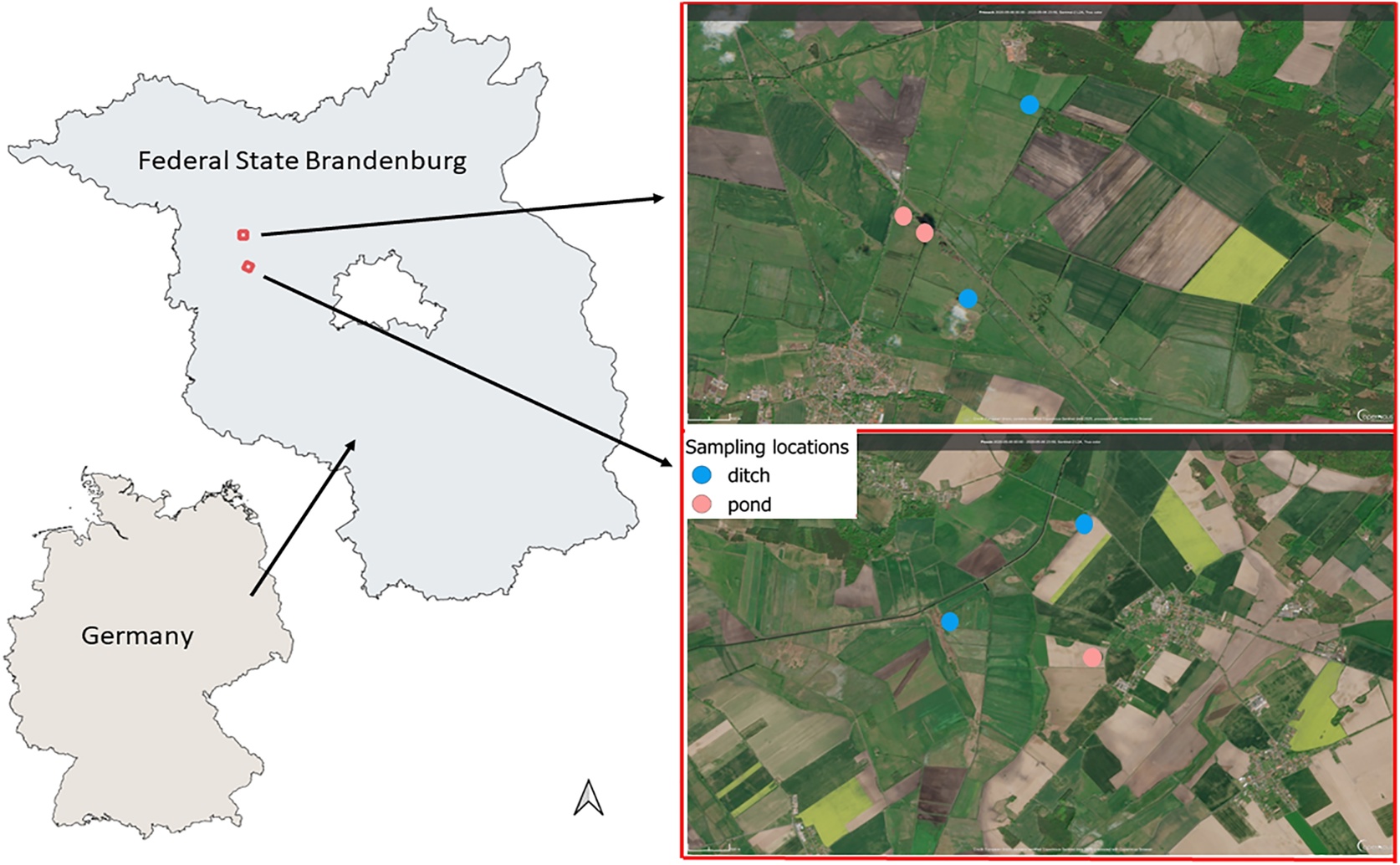
Map of sampling sites, ditches in blue and ponds in red. Map data: European Union contains modified Copernicus Sentinel data 2025 processed with Copernicus Browser, Sentinel 2-L2A (from study).

Image adapted from: Trau et al. / CC BY (Source)

Key Findings

  • This study, conducted in Germany, investigated how agricultural practices impact invertebrate life in small ponds and ditches
  • While ponds showed greater resource diversity reflected in varied invertebrate diets, ditches surprisingly hosted more predator species
  • Agricultural stressors like pesticides and nutrients didn't clearly simplify food webs as expected, suggesting complex ecosystem responses
Agriculture significantly alters landscapes and impacts the biodiversity within them. While the negative consequences of agricultural practices on larger ecosystems are well-documented, the effects on smaller, often overlooked habitats like ponds and ditches are less understood. These smaller water bodies, despite their vulnerability, provide crucial habitat for benthic invertebrates – insects and other small creatures living on the bottom of these water bodies – and contribute to overall ecosystem health. A recent study by researchers at the Julius Kühn-Institute & University of Zagreb[1] investigated how agricultural stressors affect these invertebrate communities, focusing on their feeding habits and resource use rather than simply counting the number of different species present. Traditional methods of assessing biodiversity rely on taxonomic diversity – essentially, how many different species are present. However, these methods can sometimes miss subtle but important changes in how ecosystems function. This is because different species can fulfill similar roles, meaning a loss of one species doesn’t necessarily equate to a loss of function. The study addressed this by employing a ‘functional’ approach, examining the functional feeding groups (FFGs) of invertebrates. FFGs categorize invertebrates based on how they obtain their food – for example, predators, shredders (those that break down leaf litter), or collectors. This provides a more nuanced understanding of the ecosystem’s processes. The researchers collected benthic invertebrates and water samples from three ponds and four ditches within an agricultural landscape in Brandenburg, Germany. They then analyzed the stable isotope ratios of carbon and nitrogen within the invertebrates. Stable isotopes are different forms of these elements that are incorporated into an organism’s tissues as they consume food. By analyzing these ratios, scientists can determine what the invertebrates are eating and their position in the food web. Water samples were also analyzed for pesticide and nutrient residues, identifying the specific agricultural stressors present. The study utilized a Bayesian approach – a statistical method that incorporates prior knowledge and uncertainty – to estimate community metrics for each water body type and FFGs. This allowed for a more robust assessment of the data, accounting for the inherent variability in natural systems. A statistical technique called distance-based Redundancy Analysis was then used to identify which environmental variables (like pesticide levels or nutrient concentrations) were most strongly correlated with changes in the invertebrate communities. The results showed that invertebrate communities in ponds were more spread out in terms of their isotopic signatures than those in ditches. This suggests that ponds offer a greater diversity of resources and habitats, allowing invertebrates to utilize a wider range of food sources. While no clear patterns emerged when comparing FFGs between ponds and ditches overall, some differences were observed. For example, predator FFGs were more diverse in ditches, with a greater number of different species fulfilling that role. The researchers noted that the fluctuating conditions in these small water bodies led to significant differences between them. This research builds upon earlier work highlighting the broad impacts of agricultural land use on ecosystems[2][3]. Previous studies have shown that agricultural intensification can lead to habitat loss, water contamination, and a decline in biodiversity. The findings of[3] specifically noted that despite policy changes aimed at environmental protection, agricultural intensification and abandonment continue to threaten the ecology of agro-ecosystems across Europe. The current study adds to this understanding by demonstrating how these stressors affect the functional structure of invertebrate communities in small water bodies. Interestingly, the study’s findings align with research on freshwater food webs[4], which suggests that warming and nutrient enrichment can simplify food web structure. While this study didn’t directly examine the effects of warming, the observed simplification of resource use in ditches – where conditions are often more unstable – suggests a similar trend. The study also echoes the concerns raised in[2] regarding the need to balance increasing food production with minimizing agriculture’s environmental footprint. The researchers acknowledge that larger datasets are needed to confirm these patterns and to more definitively link agricultural practices to changes in stable isotope composition. However, the study demonstrates the importance of using functional approaches to assess biodiversity and ecosystem health, particularly in vulnerable habitats like ponds and ditches. Traditional taxonomic measures may not always capture the subtle but significant changes occurring in these communities, while a focus on how organisms function provides a more comprehensive understanding of the impacts of agricultural stressors.

AgricultureEnvironmentEcology

References

Main Study

1) Assessing agricultural effects on benthic invertebrate communities in ponds and ditches using δ¹⁵N and δ¹³C isotope niches

Published 24th November, 2025

https://doi.org/10.1371/journal.pone.0336486


Related Studies

2) Solutions for a cultivated planet.

https://doi.org/10.1038/nature10452


3) Ecological impacts of early 21st century agricultural change in Europe--a review.

https://doi.org/10.1016/j.jenvman.2009.07.005


4) The interaction between warming and enrichment accelerates food-web simplification in freshwater systems.

https://doi.org/10.1111/ele.14480


Related Articles

An unhandled error has occurred. Reload 🗙