Season, Wind, and Rain Influence Sediment Transport Models

Jenn Hoskins
30th September, 2025

Season, Wind, and Rain Influence Sediment Transport Models

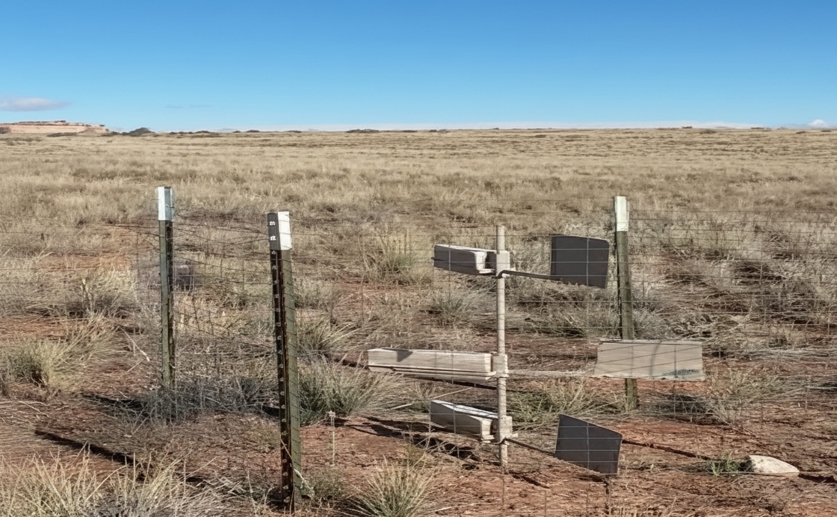
A sediment collector on the Colorado Plateau, measuring the amount of dust the wind moves.

Image adapted from: Kulmatiski et al. / CC BY (Source)

Key Findings

  • This study, conducted on the Colorado Plateau in the USA, significantly improved sediment transport prediction models
  • A random forest statistical approach explained 91% of the variation in sediment transport, a substantial increase from 58% using previous methods
  • Wind speed, season, and precipitation were the primary drivers of sediment transport, with soil moisture having limited additional predictive power at a broad landscape scale
Wind erosion is a growing global problem, impacting soil health, accelerating snowmelt, contributing to respiratory issues, and even causing hazardous conditions like reduced visibility during dust storms and traffic accidents. While scientists understand the mechanics of how wind moves small amounts of sediment – millimeters to meters – predicting sediment transport over larger areas – kilometers and beyond – remains a challenge. Researchers at Utah State University, the U.S. Geological Survey, and Universidade de Sao Paulo tackled this issue in a recent study[1], aiming to improve the accuracy of sediment transport predictions across a large landscape. The core of the study involved analyzing data from a network of 52 sediment flux collectors deployed on the Colorado Plateau in the USA. These devices measure the amount of sediment moved by the wind. Initial analyses using a ‘regression tree’ method explained 58% of the variation in sediment transport. However, the team found that switching to a more sophisticated statistical approach called ‘random forest’ dramatically improved this, explaining 91% of the variation. This represents a significant leap in predictive capability. A key finding was the surprisingly limited impact of factors often assumed to be crucial. While soil moisture alone explained a substantial 52% of the variation, adding it to a model already incorporating season, wind speed, and seasonal precipitation didn’t significantly improve accuracy. Similarly, expanding the dataset with four additional years of measurements, or including data on soil roughness and the presence of grazing animals, yielded no noticeable gains. This suggests that these factors, while important at smaller scales, are less critical when considering sediment transport across a broader landscape. These results build upon earlier work highlighting the localized nature of wind erosion. Studies[2] have demonstrated that wind erosion often occurs in ‘hotspots’ – specific areas where conditions are particularly conducive to sediment lifting – while the surrounding landscape remains relatively stable. The current study reinforces this idea, suggesting that the primary drivers of sediment transport are more broadly related to large-scale factors like season and wind speed, rather than highly localized conditions. The importance of wind speed is consistent with the physics of wind-blown sand and dust[3], which details how increasing wind velocity directly correlates with greater sediment entrainment. However, the study emphasizes that wind speed isn’t acting in isolation; it’s the interplay with seasonal changes and precipitation patterns that dictates sediment movement. The research also touches upon the importance of sufficient data for accurate modeling. The team suggests that establishing similar dust flux networks in new regions would require collecting at least 300-500 samples to achieve a comparable level of predictive accuracy using random forest analyses. This is because the random forest method requires a large amount of data to identify complex relationships between variables. Furthermore, the study provides a ‘baseline model’ for understanding sediment transport on a landscape scale. This model, explaining 91% of the observed variance, can be used as a starting point for future research and as a benchmark for evaluating the effectiveness of different mitigation strategies. The findings from Central Asia[4], which identified key dust source areas and the importance of vegetation dynamics, further demonstrates the need for regional specificity in modeling sediment transport. The Utah State University team’s work provides a framework for understanding sediment transport that can be adapted and refined for different environments.

AgricultureEnvironmentEcology

References

Main Study

1) Season, wind speed, and seasonal rain are major drivers of a regional aeolian sediment transport model

Published 26th September, 2025

https://doi.org/10.1371/journal.pone.0333166


Related Studies

2) Blowing dust and highway safety in the southwestern United States: Characteristics of dust emission "hotspots" and management implications.

https://doi.org/10.1016/j.scitotenv.2017.10.124


3) The physics of wind-blown sand and dust.

https://doi.org/10.1088/0034-4885/75/10/106901


4) Seasonal dynamics of threshold friction velocity and dust emission in Central Asia.

Journal: Journal of geophysical research. Atmospheres : JGR, Issue: Vol 120, Issue 4, Feb 2015


Related Articles

An unhandled error has occurred. Reload 🗙