Scientists develop a digital tool to manage saltwater in island aquifers

Jenn Hoskins
29th September, 2025

Scientists develop a digital tool to manage saltwater in island aquifers

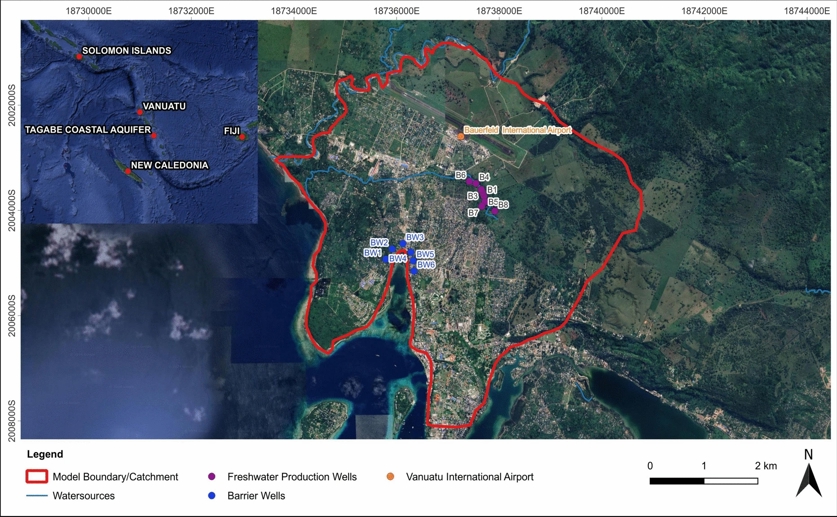
This map from the study shows the vital coastal freshwater supply (outlined in red) that is threatened by saltwater seeping in from the ocean.

Image adapted from: Sharan et al. / CC BY (Source)

Key Findings

  • This study developed a novel digital twin (DT) framework to manage saltwater intrusion (SWI) in the Tagabe coastal aquifer of Port Vila, Vanuatu
  • The DT combines a 3D groundwater model, machine learning surrogates, and optimisation techniques to predict optimal pumping rates for freshwater production and barrier wells
  • Scenario analysis using the DT showed that pumping 17,317 m3/d from production wells with 202 m3/d from barrier wells maximised freshwater output at a salt concentration of 0.75 kg/m3
Saltwater intrusion (SWI) is a growing problem for islands and coastal communities worldwide, threatening freshwater supplies essential for drinking, agriculture, and overall sustainability. Pacific Island nations are particularly vulnerable, and Port Vila, Vanuatu, is no exception. The increasing demand for freshwater coupled with rising sea levels and changing climate patterns exacerbate the issue, making effective management strategies critical. Researchers at James Cook University recently developed a novel approach to tackle SWI in the Tagabe coastal aquifer of Port Vila[1]. Their study focused on predicting and managing SWI using a sophisticated “digital twin” (DT) framework. A digital twin, in this context, is a virtual representation of a real-world system – in this case, the Tagabe aquifer – that can be used to simulate its behavior under various conditions. The core of this DT is a three-dimensional numerical model representing the aquifer’s physical characteristics and how water flows through it. This model simulates the movement of both freshwater and saltwater, taking into account factors like pumping rates and salt concentrations. To optimize water management, the researchers employed machine learning techniques to create “surrogate ensemble models.” These models act as faster, simplified versions of the complex numerical model, allowing for rapid testing of different pumping strategies. These strategies were then fed into a “simulation-optimisation” (S–O) model, identifying the best possible pumping patterns to minimize SWI. The team then created five scenarios, each representing different levels of salt concentration within the aquifer (ranging from 0.45 to 1.15 kg/m3). By running these scenarios through the DT, they were able to predict the optimal pumping rates for both production wells (extracting freshwater) and barrier wells (injecting freshwater to create a protective barrier against saltwater). The results showed that scenario 3, with a salt concentration of 0.75 kg/m3, yielded the most efficient outcome – maximizing freshwater production (17,317 m3/d) while minimizing the need for barrier well pumping (202 m3/d). Conversely, scenario 5, with the highest salt concentration (1.15 kg/m3), required significantly higher pumping rates from both production (31,676 m3/d) and barrier wells (5000 m3/d). This study builds upon earlier research demonstrating the effectiveness of numerical modeling for understanding SWI[2]. The SEAWAT code, used in that previous work, provides the foundation for the flow and transport equations utilized in the current study’s 3D numerical model. However, the James Cook University team goes further by incorporating machine learning and optimization techniques, creating a dynamic and predictive DT framework. Interestingly, the concept of long-term natural source zone depletion (NSZD) of contaminants, including LNAPLs, shares similarities with the principles applied in this SWI management approach[3]. While NSZD focuses on the natural breakdown and removal of pollutants, both concepts involve understanding complex subsurface processes and predicting long-term trends. The digital twin approach used in this study could potentially be adapted to model NSZD processes, creating a more comprehensive understanding of contaminant fate and transport in subsurface environments. The accuracy of the S–O model was validated against the full numerical model, with a relative error of less than 10%, confirming its reliability. Importantly, the researchers emphasize that this is the first application of a DT framework specifically for managing SWI in coastal aquifers. The methodology developed is globally relevant and offers a valuable tool for water resource managers facing similar challenges in coastal regions. The DT’s ability to predict future scenarios and adapt to changing conditions makes it a powerful asset in ensuring sustainable water supplies.

AgricultureEnvironmentEcology

References

Main Study

1) Conceptual development and implementation of a digital twin model for managing saltwater intrusion of an island coastal aquifer

Published 26th September, 2025

https://doi.org/10.1007/s10661-025-14553-x


Related Studies

2) Management of saltwater intrusion using 3D numerical modelling: a first for Pacific Island country of Vanuatu.

https://doi.org/10.1007/s10661-023-12245-y


3) Towards a digital twin for characterising natural source zone depletion: A feasibility study based on the Bemidji site.

https://doi.org/10.1016/j.watres.2021.117853


Related Articles

An unhandled error has occurred. Reload 🗙