How Soil Structure Affects Strength of Plateau Loess Deposits

Jim Crocker
30th September, 2025

How Soil Structure Affects Strength of Plateau Loess Deposits

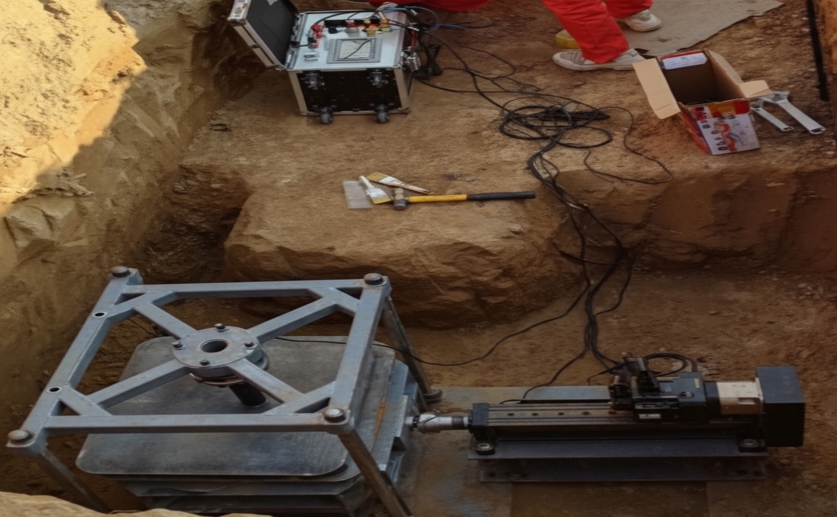
A custom-built testing machine is installed directly onto the soil of China's Loess Plateau to measure its natural structural strength.

Photo adapted from: Cheng et al. / CC BY (Source)

Key Findings

  • Loess on the Shaanxi Plateau in China, studied across three sites, shows varying strength due to its internal structure
  • Higher clay content (1-10%) in loess increases its cohesion, making it “stickier”, while decreasing its internal friction angle
  • Particle flow modeling confirms that changes in clay content alter how stress is distributed within loess, impacting its overall strength
The Loess Plateau in northern China presents significant challenges for engineering projects due to the unique properties of loess – a wind-blown sediment known for its susceptibility to erosion and landslides. Understanding the strength characteristics of loess is crucial for safe and effective construction. Traditionally, loess has been treated as a relatively homogenous material, but recent research indicates considerable variability in its strength across different locations, even within the same region. This variability is thought to be linked to the internal structure of the loess, specifically the arrangement and composition of its particles. Researchers at 1PowerChina Northwest Engineering, Chengdu University of Technology, and Chang’an University, along with the Institute of Disaster Prevention, CHINA, conducted a study[1] to investigate this relationship in three representative areas of the Shaanxi Loess Plateau. The focus was on Malan loess, a common type found in the region, and the goal was to determine how its structural properties influence its strength when subjected to shear forces – forces that cause layers of material to slide past each other. The study employed a multi-faceted approach. First, in-situ direct shear tests were performed. These tests involve applying a force to a sample of loess and measuring its resistance to sliding, effectively simulating the conditions encountered during a landslide or the stress on a foundation. Alongside these physical tests, the researchers utilized particle flow modeling – a computational technique that simulates the behavior of individual particles within the loess. This allowed them to examine the microscopic processes occurring during shear deformation, which are difficult to observe directly in the lab. Finally, theoretical analysis was used to interpret the results and develop a more comprehensive understanding of the underlying mechanisms. A key finding was the significant geographical heterogeneity in loess strength. This means that loess samples taken from different locations exhibited markedly different resistance to shear stress, despite being the same general type of loess. The researchers attributed this variability primarily to differences in the loess’s structure. Specifically, they found a strong correlation between clay content and strength parameters. As the clay particle content increased (within a range of 1% to 10%), the cohesion of the loess increased, while the internal friction angle decreased. Cohesion refers to the internal attraction between particles, essentially how “sticky” the loess is. Internal friction angle describes the resistance to sliding between particles – a higher angle means greater resistance. The study highlighted that changes in cohesion were more pronounced than changes in the internal friction angle, suggesting that clay content has a disproportionately large impact on the overall strength of loess. These findings build upon earlier work investigating the mechanical behavior of root-soil composites[2]. That study demonstrated that the strength of soil is significantly influenced by the presence of plant roots, and that the failure of root-soil systems occurs in distinct stages, including coordinated deformation, stress redistribution, and root fracture. The researchers in[2] observed an “inverted cone shape” of failure, and a correlation between root morphology and the stress state of the soil. While focusing on a different system (soil without roots), the current study shares a similar emphasis on the importance of internal structure and the complex interplay between particle properties and overall strength. The concept of stress redistribution identified in[2] aligns with the observation in that changes in clay content alter the way stress is distributed within the loess during shear deformation. Furthermore, the “oblique root” hypothesis proposed in[2], suggesting that shear stress is transformed into tensile stress within roots, highlights the importance of understanding stress states within a composite material. This principle is relevant to as the alteration of clay content directly affects the stress state of the loess particles themselves. The particle flow modeling used in the current study allowed researchers to visualize these processes at a granular level, providing insights into how changes in clay content affect the distribution of stress and the movement of particles during shear. This is a significant advancement, as it moves beyond simply correlating clay content with strength parameters to explaining the underlying mechanisms driving these changes. The results of this research contribute to a more nuanced understanding of loess strength and provide a theoretical foundation for regional variations in engineering design. By accounting for the structural properties of loess, engineers can develop more accurate models and safer construction practices in the challenging environment of the Loess Plateau.

AgricultureEnvironmentEcology

References

Main Study

1) Comprehensive analysis of the influence of loess structure on strength on the Loess Plateau, China

Published 29th September, 2025

https://doi.org/10.1371/journal.pone.0333204


Related Studies

2) Mechanical mechanism of soil consolidation by plant roots in loess area of northern Shaanxi.

https://doi.org/10.1038/s41598-025-92179-2


Related Articles

An unhandled error has occurred. Reload 🗙