Silkworm protein creates new hydrogel for potential biomedical uses

Greg Howard
10th November, 2025

Silkworm protein creates new hydrogel for potential biomedical uses

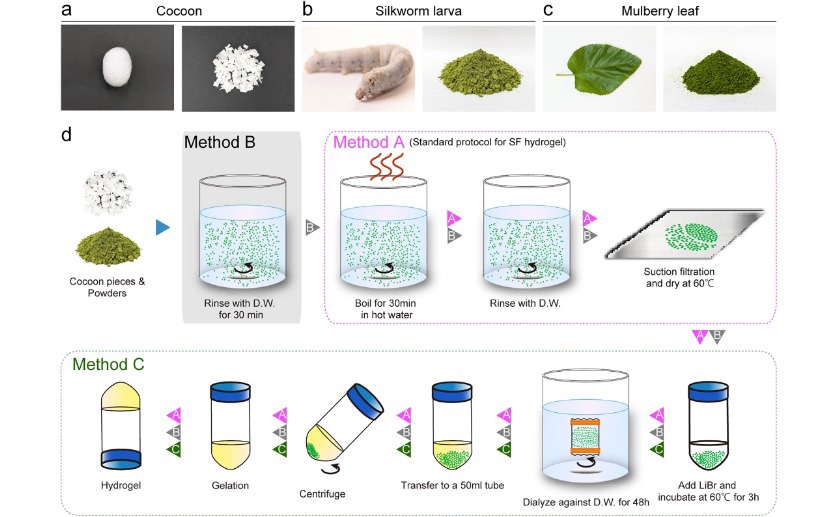
Illustration from the study of the preparation of hydrogels from Bombyx mori silkworm larval powder, cocoon pieces, and mulberry leaf powder using three distinct extraction methods involving lithium bromide (LiBr) solubilization and varying purification steps.

Image adapted from: Yamazaki et al. / CC BY (Source)

Key Findings

  • Researchers created a gel using whole silkworm larvae powder, finding it formed a gel effectively and surprisingly outperformed gels made from purified silk
  • The gel formation relies on a silk protein called FibH, as demonstrated by the inability of modified larvae lacking FibH to create a gel
  • The new gel has a unique structure with lower crystallinity due to other insect components like sericin, chitin, and cellulose, contributing to its improved gelling properties
Insect-derived materials are gaining attention for use in various fields, including medicine and food science, due to their strength, compatibility with the body, and sustainable production[2]. Traditionally, silk fibroin – a protein produced by silkworms – has been the primary insect-derived material used for these applications[3][4]. However, a recent study from researchers at Shinshu University and the Baba Kinaram Research Foundation[1] explores a new approach: creating a hydrogel – a water-based gel – directly from whole silkworm larvae powder, without needing additional gelling agents. Hydrogels are useful in biomedical engineering because they mimic the natural environment of cells, making them suitable for tissue repair and drug delivery. Existing hydrogels often require synthetic chemicals to form, which can be problematic for medical use. The aim of this research was to determine if a hydrogel could be created solely from processed silkworm larvae, and to understand how its properties compared to those made from purified silk fibroin. The study involved grinding whole silkworm larvae into a powder (designated B100rw) and mixing it with water. The resulting mixture was then observed to see how it solidified, or ‘gelled’, at low temperatures. Researchers measured how much pressure the gel could withstand (compressive stress), how well it stuck to surfaces (adhesiveness), and how long it took to form. They also used techniques like Fourier-transform infrared spectroscopy and wide-angle X-ray scattering to examine the internal structure of the gel, specifically looking at the arrangement of protein molecules. The results showed that the B100rw powder formed a gel effectively, and surprisingly, it performed better than hydrogels made from purified silk fibroin. It was stronger, stuck to surfaces more readily, and gelled faster, particularly at lower temperatures. Further investigation revealed that the gelation process was primarily driven by a component of silk fibroin called the heavy chain (FibH). When the researchers prevented the larvae from producing FibH, the powder failed to form a gel. Interestingly, the B100rw hydrogel had a slightly different internal structure than those made from purified silk fibroin. While both contained β-sheets – a common structural element in proteins that contributes to strength – the B100rw gel had lower crystallinity, meaning the molecules were less rigidly ordered. This difference is likely due to the presence of other components in the whole-larvae powder, such as sericin, chitin, and cellulose[2][5]. These additional insect-derived polymers appear to contribute to the enhanced gelation properties observed. The findings build upon previous knowledge of insect-derived materials. For example, the importance of chitin and chitosan – found in insect cuticles – for creating strong and sustainable materials has been previously demonstrated[5]. This study expands on that by showing how a combination of different insect polymers, present in whole larvae, can create a unique hydrogel with improved properties. Similarly, the detailed understanding of silk fibroin’s structure, including the roles of its heavy and light chains and associated proteins[3], provided a foundation for understanding the role of FibH in the gelation process. The researchers suggest that this new hydrogel could be used in a variety of applications, including food production and medical treatments. The fact that it’s made from the whole larva, rather than just purified silk, could also make it a more cost-effective and sustainable option. Further research will focus on refining the gelation process and exploring the potential of hydrogels derived from other insect species.

BiotechGenetics

References

Main Study

1) Insect-derived polymer hydrogel based on fibroin matrix from whole silkworm larvae

Published 7th November, 2025

https://doi.org/10.1371/journal.pone.0335864


Related Studies

2) Drug Discovery Potential of Insect-derived Compounds: A Review.

https://doi.org/10.2174/0115701638294753240422134722


3) Silk fibroin of Bombyx mori is secreted, assembling a high molecular mass elementary unit consisting of H-chain, L-chain, and P25, with a 6:6:1 molar ratio.

Journal: The Journal of biological chemistry, Issue: Vol 275, Issue 51, Dec 2000


4) Materials fabrication from Bombyx mori silk fibroin.

https://doi.org/10.1038/nprot.2011.379


5) Insect cuticle-inspired design of sustainably sourced composite bioplastics with enhanced strength, toughness and stretch-strengthening behavior.

https://doi.org/10.1016/j.carbpol.2024.121970


Related Articles

An unhandled error has occurred. Reload 🗙