How growing chickpeas with dragon's head impacts seed quality

Jenn Hoskins
1st November, 2025

How growing chickpeas with dragon's head impacts seed quality

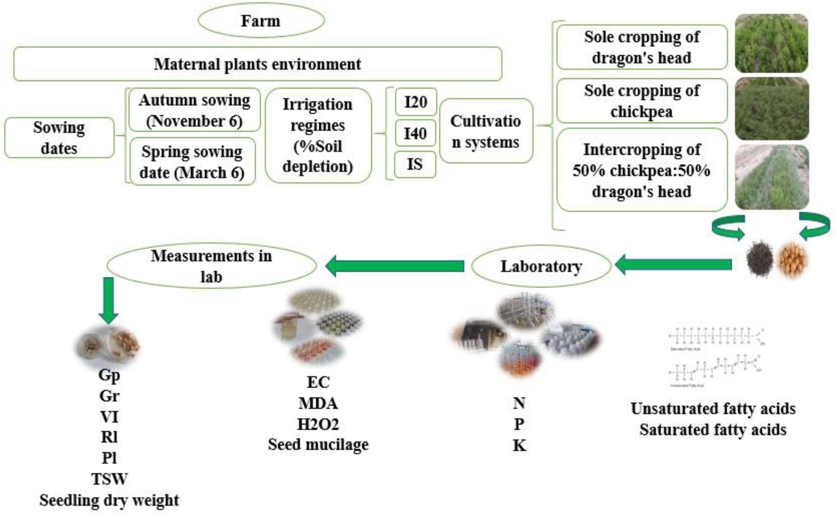
A recent study on dragon's head and chickpea investigates how the combination of intercropping, different irrigation schedules, and seasonal planting times impacts the resulting seed quality and crop resilience.

Image adapted from: Mirdoraghi et al. / CC BY (Source)

Key Findings

  • This study, conducted in Iran, found that growing chickpeas and dragon’s head together (intercropping) can improve seed quality, but the benefits depend on watering and planting time
  • Intercropping with short or medium watering, and autumn planting, led to better seed germination and increased nutrient content in both chickpea and dragon’s head seeds
  • While intercropping generally improved seed nutritional value, excessive water stress during intercropping still caused signs of cellular damage, but less than in crops grown alone
Seed quality is a critical factor in successful agriculture, directly impacting crop yields and stability. The environment experienced by a plant during seed production can have lasting effects on the seeds it produces. Recent research from Shahed University in Tehran, Iran, and Huazhong University of Science and Technology, investigated how growing crops together – a practice called intercropping – affects seed quality in dragon’s head ( Lallemantia iberica ) and chickpea (Cicer arietinum)[1]. The study focused on how different watering schedules and planting times influence the outcome. The researchers tested various conditions. They grew the crops either alone (sole system) or together (intercropping, with a 50/50 mix of chickpea and dragon’s head). They also varied the irrigation – providing water when the soil was 20% depleted of available water (short interval), 40% depleted (medium interval), or only at sowing and before flowering (long interval). Finally, they compared autumn planting (November) with spring planting (March) over two years, 2021-22 and 2022-23. The results showed that intercropping didn’t always improve seed quality; it depended on the specific conditions. When intercropped under short or medium irrigation intervals and autumn sowing (Ic (I20S1) and Ic (I40S1)), both chickpea and dragon’s head seeds showed improved germination. This suggests that certain combinations of intercropping and watering can create favorable conditions for seed development. However, when intercropped with long irrigation intervals and either autumn or spring sowing (Ic (ISS2) and Ic (ISS1)), the seeds showed signs of stress. These signs included higher levels of hydrogen peroxide (H2O2), malondialdehyde (MDA), and electrical conductivity (EC). Malondialdehyde (MDA) is a key indicator of lipid peroxidation, a process where fats in cell membranes are damaged by oxidative stress[2]. Increased MDA levels suggest that the seeds experienced cellular damage during development. Electrical conductivity measures the integrity of cell membranes; higher levels indicate damage and leakage of cellular contents. Hydrogen peroxide is a reactive oxygen species, and its accumulation also signals stress. Interestingly, intercropping consistently increased the nutrient content (nitrogen, phosphorus, potassium) and fatty acid levels in the seeds, and these increases were linked to better germination. This suggests that even under stressful conditions, intercropping can enhance the nutritional value of seeds. The study builds on earlier work showing that the maternal environment – the conditions experienced by the mother plant – significantly impacts seed and seedling traits[3]. Like the tomato study, this research demonstrates that factors like water availability can alter seed composition and performance. The findings also relate to research on soybean, where shading during seed development altered fatty acid composition and hormone levels, ultimately improving germination[4]. While this study didn’t directly examine shading, the intercropping system likely created a more complex light environment compared to the sole system, potentially influencing seed development in a similar way. The soybean study showed that changes in fatty acid profiles could affect germination, and the current research supports this by showing a positive correlation between fatty acid levels and germination indexs. The most effective strategy identified in the study was intercropping with short or medium irrigation intervals and autumn sowing. This combination appears to create a beneficial environment for seed development, leading to improved germination and enhanced seed quality. This research highlights the potential of intercropping as a sustainable agricultural practice, offering a way to improve seed quality and resilience, particularly in regions facing water stress.

AgricultureGeneticsPlant Science

References

Main Study

1) Seed quality as affected by intercropping of Chickpea and L. iberica

Published 30th October, 2025

https://doi.org/10.1371/journal.pone.0332264


Related Studies

2) Lipid peroxidation: production, metabolism, and signaling mechanisms of malondialdehyde and 4-hydroxy-2-nonenal.

https://doi.org/10.1155/2014/360438


3) The interaction between genotype and maternal nutritional environments affects tomato seed and seedling quality.

https://doi.org/10.1093/jxb/erz101


4) Shading of the mother plant during seed development promotes subsequent seed germination in soybean.

https://doi.org/10.1093/jxb/erz553


Related Articles

An unhandled error has occurred. Reload 🗙