Adding a wheat chromosome boosts drought resistance during flowering

Jenn Hoskins
21st October, 2025

Adding a wheat chromosome boosts drought resistance during flowering

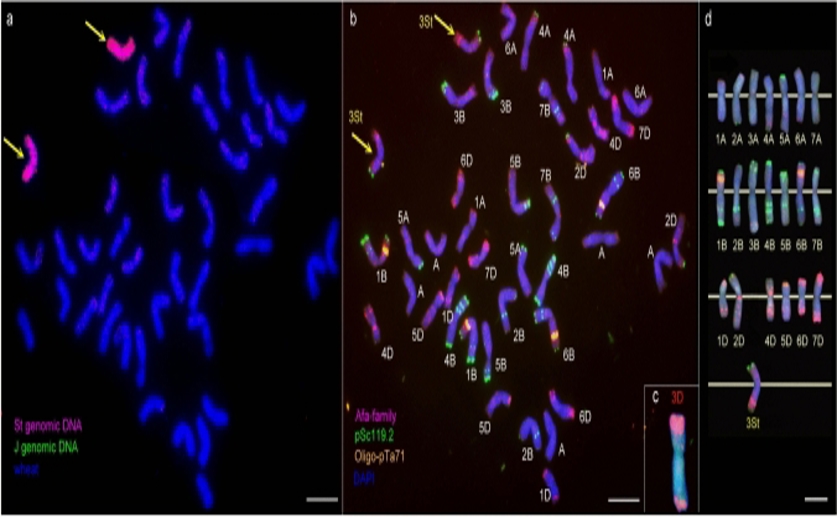
Fluorescent probes highlight the replacement of a wheat chromosome pair with a drought-tolerance-conferring chromosome pair from its wild relative Thinopyrum (red).

Image adapted from: Türkösi et al. / CC BY (Source)

Key Findings

  • Researchers in Hungary developed a new wheat line, GLA8, by adding a chromosome from a related grass species, Thinopyrum intermedium, to improve drought tolerance
  • GLA8 wheat maintains similar grain yield and fertility to standard wheat varieties, indicating successful integration of the new chromosome without negative impacts
  • During drought stress, GLA8 preserved water more efficiently, showed less leaf damage, and had a smaller reduction in yield compared to its wheat parents
Wheat production faces increasing challenges from drought, particularly during the flowering stage, leading to significant yield reductions worldwide. A key limitation in developing drought-resistant wheat varieties is the relatively limited genetic diversity within commonly cultivated wheat[2]. To address this, researchers at the Hungarian Research Network (HUN-REN) have investigated a novel approach to introduce beneficial genetic material from a related grass species, Thinopyrum intermedium, into wheat, resulting in a new wheat line with improved drought tolerance[1]. The core of this research involved a “chromosome substitution line”, where a specific chromosome pair from Thinopyrum intermedium replaced a corresponding pair in wheat. Chromosomes carry genes, and by substituting wheat chromosomes with those from a different species, scientists can introduce new traits. In this case, chromosome 3D from wheat was replaced with a group 3 chromosome pair from a Thinopyrum intermedium hybrid. This process was confirmed using techniques like in situ hybridization (visualizing chromosomes directly) and genotyping-by-sequencing (analyzing the wheat’s genetic makeup). A significant hurdle in chromosome substitution is ensuring the resulting plant remains fertile and productive. Previous work has focused on utilizing wild wheat relatives to broaden the genetic base of bread wheat[3], but maintaining yield and fertility during these introductions is often difficult. The HUN-REN team found that this particular substitution, designated 3St(3D), showed “good functional compensation,” meaning the plant performed similarly to its wheat parent lines, ‘Mv9kr1’ and ‘Mv Karizma’, in terms of grain yield and fertility across both field and greenhouse experiments. This is a crucial finding, as it demonstrates the potential for stable inheritance of the desired traits. Further investigation revealed the substitution line also exhibited a semidwarf phenotype – a shorter plant stature – due to the presence of Rht8 and Rht2 dwarfing alleles. These alleles are already commonly used in wheat breeding to improve yield by increasing stem strength and preventing lodging (bending or breaking of stems). To understand how the substitution line improves drought tolerance, the researchers subjected the plants to a 10-day water withdrawal period during flowering. Using automated shoot phenotyping – the detailed measurement of plant characteristics – they observed that the substitution line preserved water more efficiently than the parent lines. This was reflected in sustained photosynthetic activity, meaning the plant continued to produce energy even under drought stress. They measured this using the Normalized Difference Vegetation Index (NDVI) and modified Normalized Difference Index (mND705), indicators of plant health and chlorophyll content. Chlorophyll is essential for photosynthesis, and less degradation indicates better stress tolerance. The study also examined the expression of stress-related genes, finding a moderate level of protective functions were activated in the substitution line during drought. This suggests the introduced chromosome pair contains genes that help the plant cope with water scarcity at a molecular level. Interestingly, the substitution line developed thicker roots with increased volume compared to the wheat parents under drought conditions. This is significant because a larger root system with a lower surface-to-volume ratio can enhance water storage efficiency. The principle here is that a greater volume allows for more water uptake and retention, while a lower surface area reduces water loss through evaporation. Recent advancements in genome sequencing have provided tools to efficiently analyze complex genomes, enabling techniques like skim-sequencing[4] which allows for rapid genotyping of large populations. While not directly used in this study, these technologies could be employed to further characterize the genetic basis of drought tolerance in the 3St(3D) line and accelerate the breeding process. This research builds upon previous efforts to incorporate genetic diversity into wheat, offering a promising avenue for developing climate-resilient cultivars and enhancing global wheat production.

AgricultureGeneticsPlant Science

References

Main Study

1) Replacement of chromosome 3D with Thinopyrum chromosome 3St led to increased drought tolerance during the flowering stage in wheat

Published 18th October, 2025

https://doi.org/10.1007/s00299-025-03632-5


Related Studies

2) Emerging Trends in Wheat (Triticum spp.) Breeding: Implications for the Future.

https://doi.org/10.31083/j.fbe1601002


3) Chromosome-scale assembly of the wild wheat relative Aegilops umbellulata.

https://doi.org/10.1038/s41597-023-02658-2


4) A high-throughput skim-sequencing approach for genotyping, dosage estimation and identifying translocations.

https://doi.org/10.1038/s41598-022-19858-2


Related Articles

An unhandled error has occurred. Reload 🗙