Finding genes linked to drought resistance in soybean using remote sensing

Jenn Hoskins
18th October, 2025

Finding genes linked to drought resistance in soybean using remote sensing

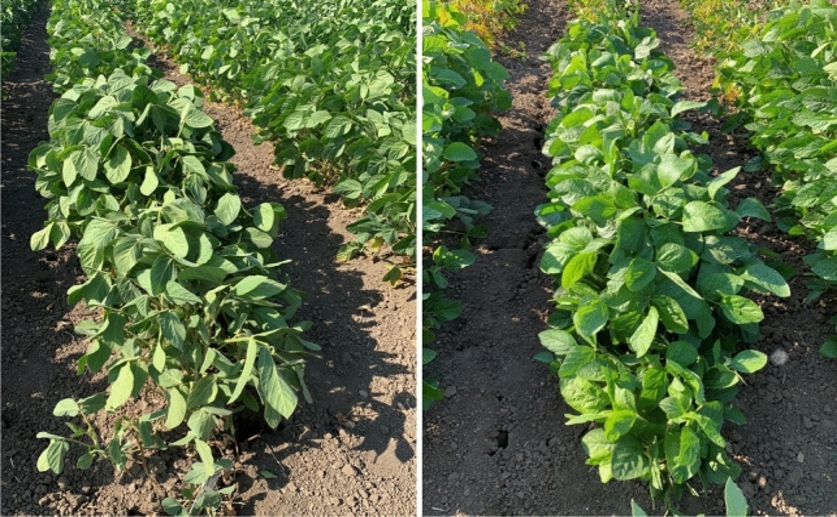
Fast wilting parent Benning (left) and slow wilting parent (right)

Image adapted from: Burner et al. / CC BY (Source)

Key Findings

  • This study, conducted in Wyoming, identified genetic regions controlling ultra-slow canopy wilting (CW) in soybean line PI 603535, a trait linked to drought tolerance
  • Seven key genetic markers (QTLs) were found to influence CW, with the PI 603535 line contributing beneficial genes for slower wilting in most cases
  • Multispectral imagery (NDVI and GNDVI) accurately reflected drought stress levels in soybean, showing potential as a faster method for evaluating drought tolerance compared to visual assessments
Drought poses a significant threat to soybean production, consistently ranking as the most damaging environmental stress impacting yield. Developing soybean cultivars better equipped to withstand drought conditions is crucial for maintaining and increasing crop output. Researchers at Univ. of Georgia recently investigated the genetic basis of a promising drought-tolerant trait: ultra-slow canopy wilting (CW) in a soybean line designated PI 603535[1]. Previous research has identified specific soybean lines, like PI 416937, exhibiting inherent drought resistance[2][3]. These lines often demonstrate slower wilting rates under water-deficit conditions and have been utilized in breeding programs aimed at improving soybean productivity. However, pinpointing the specific genes responsible for these traits has remained a challenge. A key aspect of this is understanding the quantitative trait loci (QTLs) – specific locations on the chromosomes associated with particular traits – that control drought tolerance. Initial studies focused on canopy wilting as a measurable characteristic, identifying seven QTLs in PI 416937 that collectively explained 75% of the variation in this trait[2]. Interestingly, these QTLs weren't exclusively inherited from the drought-tolerant parent, suggesting a complex genetic architecture. The Univ. of Georgia study aimed to identify the QTLs underlying the CW phenotype in PI 603535. Researchers created a recombinant inbred line (RIL) population by crossing Benning soybean plants with PI 603535. RILs are essentially genetically uniform lines created through multiple generations of controlled breeding, allowing scientists to isolate and study the effects of different gene combinations. These RILs were then grown in rain-fed field conditions over three years, and their CW response was carefully monitored during periods of drought. To enhance the efficiency and objectivity of drought evaluation, the researchers incorporated aerial multispectral and thermal imagery. These technologies allowed them to remotely assess plant health using indices like the normalized difference vegetation index (NDVI) and green-based NDVI (GNDVI). Both NDVI and GNDVI, which measure the greenness and vigor of vegetation, exhibited strong correlations with visual CW ratings, indicating their potential as reliable proxies for drought stress. QTL mapping was performed using both the CW scores and the remote sensing data as phenotypes. This analysis revealed seven CW QTLs distributed across six different chromosomes. Crucially, QTLs identified using NDVI and GNDVI generally aligned with the CW QTLs, particularly those explaining the highest percentage of variation (PVE). This co-localization reinforces the connection between plant physiological status, as measured by remote sensing, and the genetic factors controlling CW. However, the study also highlighted the complexity of drought tolerance. The identified QTLs weren’t consistently detected across all three years of the experiment. This instability suggests that gene expression related to drought tolerance is highly influenced by environmental factors, and that a single gene or a few genes won’t be sufficient to confer robust drought resistance. Furthermore, the relatively low additive effect estimates of individual QTLs indicate that selecting for these genes alone may not lead to substantial improvements in drought tolerance. Despite these challenges, the slow CW RILs developed in this study represent a valuable resource for future breeding efforts. These lines can be used as building blocks to introduce drought-tolerant traits into elite soybean cultivars. Moreover, they provide a platform for further genetic studies aimed at unraveling the intricate mechanisms underlying drought resistance. The findings build upon earlier work[3] that identified fibrous root systems as another drought avoidance mechanism in soybean, suggesting that a combination of traits – including slow wilting and robust root development – may be necessary for optimal drought tolerance.

AgricultureGeneticsPlant Science

References

Main Study

1) Identifying canopy wilting QTLs and evaluating remote sensing approaches for selecting drought-tolerant soybean

Published 14th October, 2025

https://doi.org/10.1007/s00122-025-05063-y


Related Studies

2) Mapping of quantitative trait loci for canopy-wilting trait in soybean (Glycine max L. Merr).

https://doi.org/10.1007/s00122-012-1876-9


3) Identification of QTL for increased fibrous roots in soybean.

https://doi.org/10.1007/s00122-010-1500-9


Related Articles

An unhandled error has occurred. Reload 🗙