Strawberry gene discovery could lead to new disease resistance strategies

Jenn Hoskins
24th October, 2025

Strawberry gene discovery could lead to new disease resistance strategies

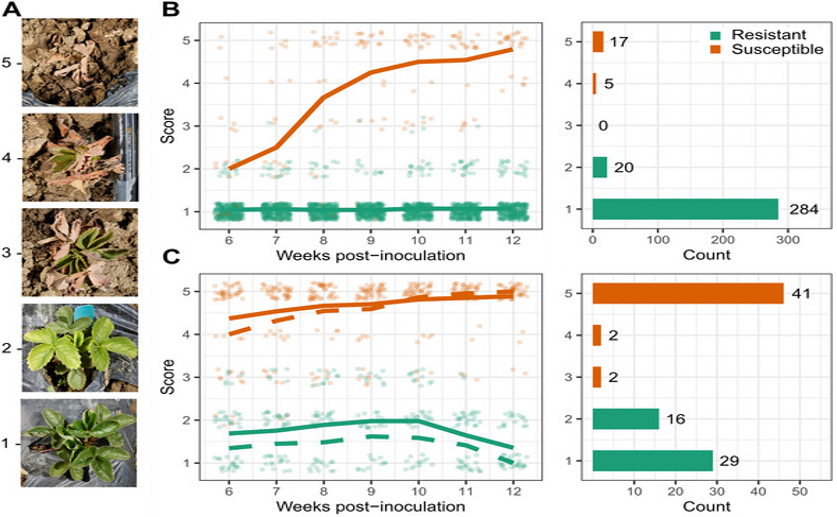
The varying levels of resistance to Fusarium wilt in 'Earliglow' strawberry progeny, from healthy (score 1) to dead (score 5), after experimental infection.

Image adapted from: Vachev et al. / CC BY (Source)

Key Findings

  • Researchers studying strawberry plants in California identified a new gene, FW7, on chromosome 2A that contributes to resistance against Fusarium wilt
  • The effect of FW7 was initially hidden by another gene, FW6, located on chromosome 2B, a phenomenon called epistasis, where one gene masks the effect of another
  • Identifying genetic markers linked to FW6 and FW7 allows breeders to select for plants with combined resistance genes, potentially increasing durability against the disease
Fusarium wilt is a devastating disease affecting strawberry plants, causing significant yield losses globally. The disease is caused by the soilborne fungus Fusarium oxysporum f. sp. fragariae. While genetic resistance exists in certain strawberry varieties, identifying and utilizing these genes effectively is crucial for developing durable disease control strategies. Researchers at UC Davis[1] have been working to uncover the genetic basis of this resistance, previously identifying several resistance genes (R-genes) located on chromosomes 1A, 2B, and 6B that provide protection against the most common race 1 strain of the pathogen. This latest study builds on that previous work, focusing on the heirloom strawberry cultivar Earliglow, which was suspected of possessing additional resistance factors. The team discovered a new dominant R-gene, named FW7, located on chromosome 2A – a location where resistance genes had not previously been found in strawberries. Interestingly, the effect of FW7 was initially masked by another dominant gene, FW6, found within a previously identified cluster of resistance genes on chromosome 2B. This phenomenon, known as epistasis, occurs when the expression of one gene influences the effect of another. To pinpoint the location of FW7, the researchers employed a technique called bulked segregant analysis (BSA). This method involves creating pools of seeds – one pool containing only resistant plants and another containing only susceptible plants – and then performing whole-genome sequencing on each pool. By comparing the genetic differences between the two pools, scientists can identify regions of the genome that are strongly associated with resistance. This approach has been successfully used in other plant breeding programs to efficiently map genetic loci controlling important traits. The BSA revealed a clear signal for FW7 on chromosome 2A, allowing the researchers to narrow down the region containing the gene. Further analysis identified candidate genes within this region, as well as specific genetic markers (SNPs – single nucleotide polymorphisms) closely linked to the FW7 gene. These SNPs are particularly valuable for marker-assisted selection, a breeding technique that allows growers to identify and select plants carrying the desired resistance alleles without having to grow out and test each individual plant. The identification of FW7 is significant because it expands the known repertoire of resistance genes available for combating Fusarium wilt. Importantly, the study demonstrates that multiple resistance genes can be stacked or “pyramided” within a single strawberry plant to enhance durability. The ability to combine FW7 with independently acting R-genes, such as FW6 and those previously identified on chromosomes 1A and 6B, will be critical for preventing the pathogen from overcoming resistance through evolution. Understanding the genetic basis of resistance is further informed by advancements in genomic technologies. For instance, techniques like haplotype phasing[2], which estimates the combinations of genetic variants inherited together on chromosomes, are valuable for dissecting complex genetic architectures and improving the accuracy of marker-assisted selection. While not directly used in this study, these methods could be employed to further refine the mapping of FW7 and identify even more closely linked markers. Similarly, high-resolution assembly techniques[3] could be used to create a more complete and accurate reference genome for strawberries, facilitating the identification of candidate genes and understanding their function. The work at UC Davis lays the foundation for future research aimed at identifying the specific gene underlying FW7 and developing even more resilient strawberry varieties.

AgricultureGeneticsPlant Science

References

Main Study

1) Whole‐genome sequencing bulked segregant analysis uncovered FW7, a Fusarium wilt resistance gene masked by epistasis in octoploid strawberry

Published 22nd October, 2025

https://doi.org/10.1002/tpg2.70136


Related Studies

2) Fast two-stage phasing of large-scale sequence data.

https://doi.org/10.1016/j.ajhg.2021.08.005


3) Haplotype-resolved de novo assembly using phased assembly graphs with hifiasm.

https://doi.org/10.1038/s41592-020-01056-5


Related Articles

An unhandled error has occurred. Reload 🗙