Gene editing onions becomes easier with new technique

Jenn Hoskins
23rd October, 2025

Gene editing onions becomes easier with new technique

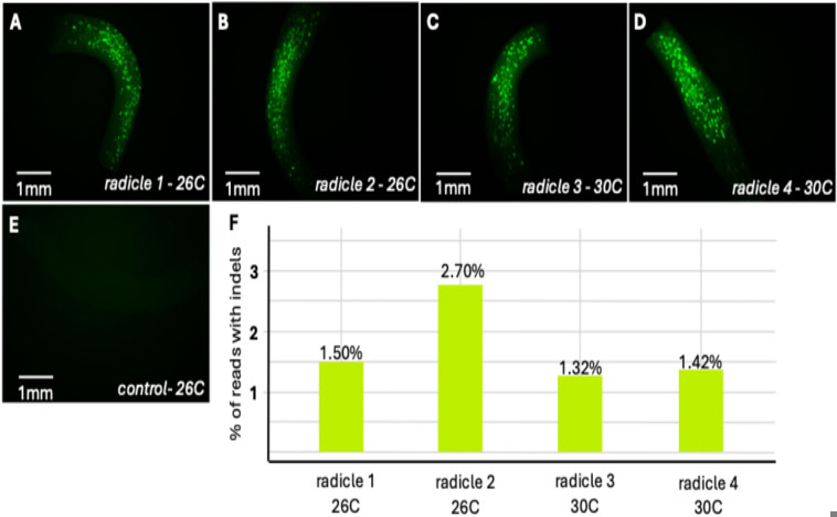
This figure demonstrates the successful delivery of gene-editing tools into onion root tips, visualized by the expression of a glowing fluorescent protein, and confirms the resulting DNA mutations through sequencing analysis.

Image adapted from: Mora et al. / CC BY (Source)

Key Findings

  • Researchers developed a new method to efficiently edit onion genes without permanently altering their DNA, a process crucial for disease resistance improvements
  • Adding plasmids with developmental genes alongside the editing tools significantly increased editing success, reaching up to 12% of regenerated plants with altered genes
  • Transient expression of genes, avoiding stable DNA integration, boosted editing rates and minimized unintended genetic changes in the onion plants
Onion crops, vital for global food production, face ongoing challenges from diseases like downy mildew. Traditional breeding methods to improve disease resistance can be slow and complex. Gene editing offers a faster and more precise alternative, allowing scientists to modify plant genes to enhance desirable traits. However, a significant hurdle in gene editing is getting the editing tools into plant cells and ensuring the changes are stable and inherited in future generations.[1] Researchers at the University of Wisconsin-Madison have recently developed a new protocol to overcome this challenge in onion plants, focusing on the AcDMR6 gene which confers resistance to downy mildew. The core of this new method involves delivering a complex called a ribonucleoprotein (RNP) into onion cells. RNPs consist of the Cas9 enzyme, which acts like molecular scissors, and a single guide RNA (sgRNA). The sgRNA directs Cas9 to a specific location in the plant’s genome – in this case, the AcDMR6 gene – where it makes a precise cut. Crucially, this approach aims to avoid permanently inserting foreign DNA into the onion genome, a concern with some earlier gene editing techniques. A key problem with RNP delivery is that editing events are often infrequent. To address this, the Wisconsin-Madison team employed a strategy of ‘transient gene expression’. This means they delivered additional plasmids alongside the RNP. These plasmids contained genes that temporarily boost plant development and a gene conferring resistance to the antibiotic hygromycin. By briefly exposing the cells to hygromycin after RNP delivery, they could selectively enrich for cells that had taken up the plasmids – and, hopefully, also the RNP. The results were striking. Without the additional plasmids, no editing of the AcDMR6 gene was observed in the regenerated onion plants. However, when the plasmids encoding developmental regulators and hygromycin resistance were co-delivered with the RNP, up to 12% of the regenerated plants showed evidence of edited AcDMR6 alleles. This included plants with changes to all copies of the gene (homozygous), plants with mixed changes (biallelic), and plants with a combination of edited and unedited genes (heterozygous). Some plants also showed a ‘chimeric’ pattern, meaning some cells were edited while others were not. This success is particularly notable when compared to previous studies. Delivering RNPs alone often yields low editing rates, and can sometimes lead to unintended DNA insertions at the target site[2][3]. The addition of DNA plasmids in biolistic delivery, while increasing editing efficiency, has been shown to increase the frequency of random DNA fragment insertion[3]. The Wisconsin-Madison team’s approach, however, avoids these issues by utilizing transient expression, meaning the plasmids are not permanently integrated into the genome. Interestingly, the use of transient expression to enhance editing aligns with findings in potato[2]. That study demonstrated the effectiveness of delivering RNPs without DNA integration, but also highlighted challenges with obtaining high mutation frequencies and the potential for unintended inserts when using RNA produced via in vitro transcription. The current study’s success in onion suggests that co-delivering plasmids for selection purposes can overcome some of these limitations. Furthermore, this method builds on the broader understanding of RNP delivery established in rice[3], which showed that the delivery platform itself can influence the frequency of unintended DNA insertions. By carefully controlling the delivery method and utilizing transient expression, the Wisconsin-Madison team minimized the risk of off-target effects. The success in chickpea[4], which also utilized DNA-free CRISPR/Cas9 editing, further supports the potential of this approach for a wider range of crop species. The protocol developed by offers a significant advance in onion gene editing, providing a pathway to produce plants with improved disease resistance without relying on stable genetic transformation. The ability to efficiently recover gene-edited lines could have major implications for onion breeding programs and potentially be adapted for other crops as well.

AgricultureGeneticsPlant Science

References

Main Study

1) Efficient production of gene-edited onion (Allium cepa) plants using biolistic delivery of cas9 RNPs and transient expression constructs

Published 19th October, 2025

https://doi.org/10.1007/s00299-025-03626-3


Related Studies

2) Genome editing in potato via CRISPR-Cas9 ribonucleoprotein delivery.

https://doi.org/10.1111/ppl.12731


3) High-frequency random DNA insertions upon co-delivery of CRISPR-Cas9 ribonucleoprotein and selectable marker plasmid in rice.

https://doi.org/10.1038/s41598-019-55681-y


4) First Report of CRISPR/Cas9 Mediated DNA-Free Editing of 4CL and RVE7 Genes in Chickpea Protoplasts.

https://doi.org/10.3390/ijms22010396


Related Articles

An unhandled error has occurred. Reload 🗙