Better designs for drip irrigation can improve water flow and prevent blockages

Jenn Hoskins
27th October, 2025

Better designs for drip irrigation can improve water flow and prevent blockages

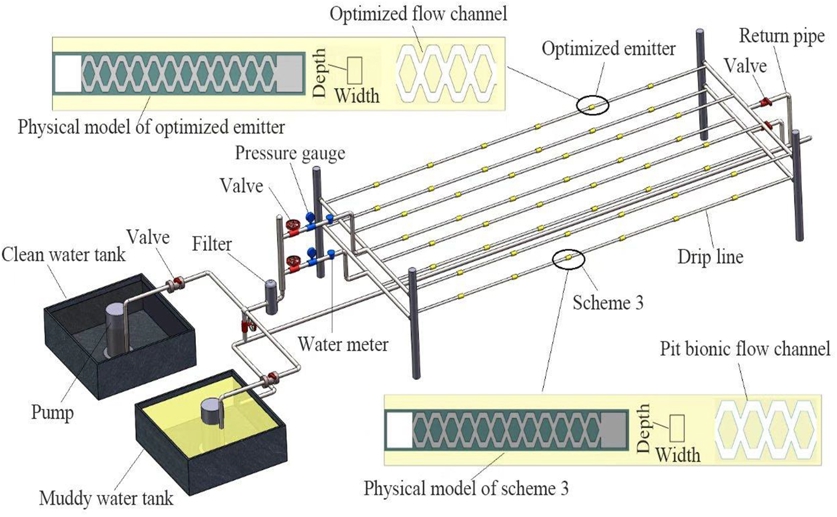
The physical short-period clogging test device.

Image adapted from: Zhao et al. / CC BY (Source)

Key Findings

  • This study, conducted at Heilongjiang University, investigated designs for drip irrigation emitters inspired by plant structures to reduce clogging
  • Traditional drip emitter designs create low-speed vortex zones where sediment accumulates, but a new “scheme 3” design significantly reduced these vortexes
  • Optimizing scheme 3 further, by rounding corners, improved water flow and reduced blockage by 13-15% and decreased sedimentation rates by 58% across multiple particle sizes
Drip irrigation is a highly efficient method of delivering water directly to plant roots, minimizing waste and maximizing growth. However, a significant problem hindering its widespread adoption is the clogging of the small channels within the emitters – the devices that release the water. Blockages reduce water flow and require frequent cleaning or replacement, increasing costs and labour. Researchers at Heilongjiang University[1] have been investigating ways to overcome this issue, focusing on designs inspired by natural structures. The core reason for clogging lies in the low-speed vortex zones that develop within traditional drip emitter channels. These areas allow sediment and particles to settle, gradually building up to form blockages. The recent study addressed this by designing four different pit bionic drip irrigation emitter structures, meaning they were based on the principles of how nature solves similar fluid dynamics problems. To understand how these designs performed, the researchers used computational fluid dynamics (CFD) – a method that uses computer simulations to model fluid flow – to analyze the velocity and turbulence within each structure. The CFD simulations revealed that three of the designs (schemes 1, 2, and 4) still exhibited significant low-speed vortices in the return water zone. Scheme 3, however, showed a much milder vortex pattern, suggesting a reduced tendency for particles to deposit. This initial finding led to further optimization of scheme 3’s structure. To investigate particle behaviour, the researchers combined CFD with the discrete element method (DEM). DEM simulates the movement of individual particles, allowing them to track the trajectory of 0.1 mm sand particles within the flow channels. This revealed that scheme 3 had a lower probability of sand particle deposition compared to the other designs. The optimized scheme 3 was then tested with eight different sizes of sand particles to assess its anti-clogging performance under realistic conditions. The results showed a significant improvement: the optimized model had 13.34% and 14.51% higher relative traffic in the third and fourth stages of the experiment, indicating less blockage. Crucially, the maximum allowable particle size before clogging occurred was nearly double that of the original scheme 3. Sedimentation rates were reduced by an average of 58.02% for particles ranging from 0.120 to 0.245 mm in size. These findings build upon earlier work exploring bionic designs for drip irrigation. For example, research has shown that mimicking the leaf structure of the fig tree Ficus religiosa can improve irrigation efficiency through controlled water stream convergence and drainage[2]. While that study focused on overall water delivery, the current research directly addresses the issue of clogging by focusing on the internal flow dynamics of the emitter itself. Furthermore, previous studies have demonstrated the potential of optimizing drip emitter flow channels using genetic algorithms, focusing on parameters like tooth stagger value and flow channel angle[3]. This study takes a different approach, leveraging plant bionics as the initial design principle and then refining that design through CFD and DEM simulations. The research also highlights the importance of understanding the sensitivity of blockage to different particle sizes, a crucial factor in real-world irrigation systems. The results demonstrate that optimized drip irrigation emitters, inspired by plant structures and refined through computational modelling, offer significantly better anti-clogging performance under multiple particle size conditions. This advancement has the potential to make drip irrigation a more reliable and cost-effective water management solution.

AgricultureSustainabilityPlant Science

References

Main Study

1) Structural optimization of pit bionic drip irrigation emitter to improve hydraulic performance and anti-clogging performance

Published 24th October, 2025

https://doi.org/10.1371/journal.pone.0334698


Related Studies

2) Efficient agricultural drip irrigation inspired by fig leaf morphology.

https://doi.org/10.1038/s41467-023-41673-0


3) Structural optimization and hydraulic performance analysis of bionic pit flow channels based on a genetic algorithm.

https://doi.org/10.1038/s41598-022-26569-1


Related Articles

An unhandled error has occurred. Reload 🗙