How compost and lime improve bean growth and soil health in acidic conditions

Jenn Hoskins
23rd October, 2025

How compost and lime improve bean growth and soil health in acidic conditions

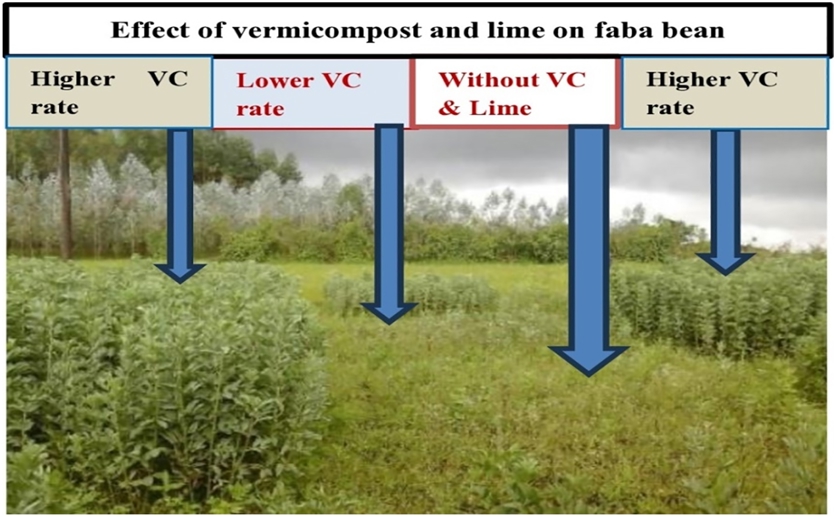
Vegetative response of Faba bean to the applied vermicompost and lime in non-responsive strongly acidic soils at Guagusa Shikudad district.

Image adapted from: Alemayehu et al. / CC BY (Source)

Key Findings

  • In western Amhara, Ethiopia, strongly acidic soils limit faba bean production, requiring soil improvement strategies
  • Combining 10 tonnes of vermicompost per hectare with the full recommended lime rate maximized faba bean grain yield at 2.41 tonnes per hectare
  • Applying 5 tonnes of vermicompost with the full lime rate proved most economically viable for farmers, balancing yield and cost
Soil acidity poses a significant threat to crop production globally, and is a particularly acute problem in Ethiopia. This degradation reduces the ability of plants to absorb essential nutrients, ultimately limiting yields and impacting food security. Researchers at Adet Agricultural Research Center, in collaboration with the Nepal Agricultural Research Council, recently investigated ways to improve faba bean productivity in western Amhara, Ethiopia, through a combination of vermicompost and lime application[1]. The study focused on faba bean, an important legume crop in the region, grown in soils known to be strongly acidic. Soil acidity reduces crop yields and degrades agroecosystems[2]. The experiment, conducted over two cropping seasons (2021 and 2022), tested various combinations of vermicompost – organic matter produced by earthworms – and lime – a material used to raise soil pH. Treatments included different amounts of vermicompost (0, 5, 10, and 15 tonnes per hectare) combined with no lime, half the recommended lime rate, and the full recommended lime rate. These were arranged in a randomized complete block design, a standard method for agricultural research ensuring reliable results. Soil pH is a measure of acidity or alkalinity, with lower values indicating higher acidity. The analysis of soil samples before and after planting revealed that both vermicompost and lime significantly increased soil pH and reduced ‘exchangeable acidity’ – the amount of acid present that can harm plant growth. This is consistent with established knowledge about liming practices, which have long been used to ameliorate acidic soils and improve nutrient availability[2]. The researchers found that combining 10 tonnes of vermicompost per hectare with the full recommended dose of lime (5.6 tonnes per hectare) resulted in the highest faba bean grain yield, reaching 2.41 tonnes per hectare. A slightly higher application of 15 tonnes of vermicompost with the full lime rate yielded the greatest biomass production (5.90 tonnes per hectare). The control group, receiving no vermicompost or lime, produced the lowest yields. These findings build upon previous research demonstrating the benefits of integrating organic and inorganic fertilizers[3]. The study highlights the synergistic effect of combining vermicompost and lime, meaning the combined effect was greater than the sum of their individual effects. Vermicompost improves soil structure and provides essential nutrients, while lime directly addresses the acidity issue. The positive impact on soil properties like pH and organic carbon content aligns with observations from other regions where liming improves soil fertility[2]. Interestingly, the study also identified an optimum application rate. While higher doses of vermicompost and lime increased yields, the combination of 5 tonnes of vermicompost per hectare with the full lime rate proved to be the most economically viable, providing a good balance between yield and cost. Similar findings have been reported in northwest Ethiopia, where integrated vermicompost and lime applications significantly increased soil fertility and malt barley yields[4]. Furthermore, the reduction in exchangeable acidity observed in this study is crucial. High exchangeable acidity can lead to aluminum toxicity, which inhibits root growth and reduces nutrient uptake. By reducing acidity, vermicompost and lime create a more favorable environment for faba bean roots to thrive. The research also echoes findings from other Ethiopian studies showing that the combined application of amendments enhances the availability of phosphorus and other macronutrients[5], essential for plant growth and development. The researchers recommend the integrated use of organic and inorganic fertilizers with lime to restore productivity in strongly acidic agricultural soils in the study area and similar regions.

AgriculturePlant Science

References

Main Study

1) Effect of vermicompost and lime on faba bean (Vicia faba L.) grain yield and soil properties on non-responsive acidic soils of Western Amhara, Ethiopia

Published 21st October, 2025

https://doi.org/10.1371/journal.pone.0334687


Related Studies

2) Liming impacts on soils, crops and biodiversity in the UK: A review.

https://doi.org/10.1016/j.scitotenv.2017.08.020


3) Integrated fertilizer application improves soil properties and maize (Zea mays L.) yield on Nitisols in Northwestern Ethiopia.

https://doi.org/10.1016/j.heliyon.2021.e06074


4) Effects of vermicompost and lime on acidic soil properties and malt barley (Hordeum Distichum L.) productivity in Mecha district, northwest Ethiopia.

https://doi.org/10.1371/journal.pone.0311914


5) Effects of lime and vermicompost application on soil physicochemical properties and phosphorus availability in acidic soils.

https://doi.org/10.1038/s41598-025-02053-4


Related Articles

An unhandled error has occurred. Reload 🗙