How shrubs and trees affect tick populations on the Great Plains

Greg Howard
16th October, 2025

How shrubs and trees affect tick populations on the Great Plains

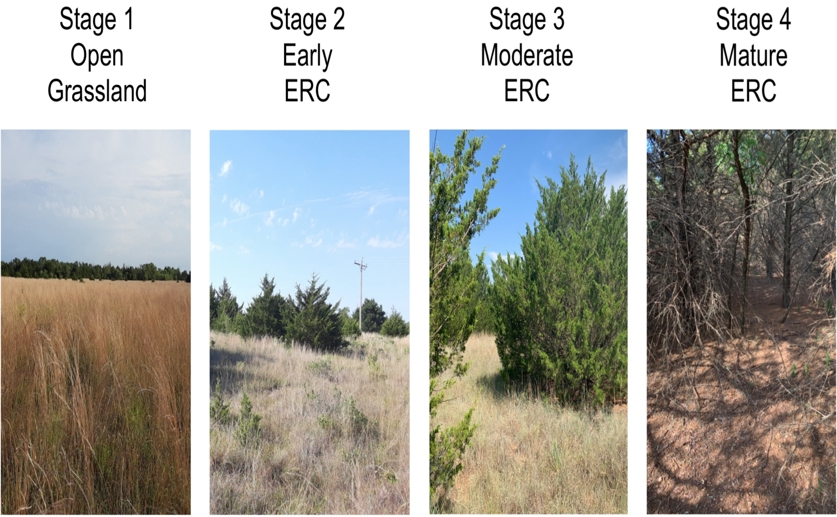
Examples of increasing levels of eastern redcedar encroachment into grasslands in Oklahoma, USA.

Image adapted from: Propst et al. / CC BY (Source)

Key Findings

  • In Oklahoma grasslands, tick populations, specifically lone star and American dog ticks, increase when eastern redcedar trees begin to grow
  • The highest tick numbers were found in the early stages of tree expansion, suggesting that preventing or removing young trees is most effective for tick control
  • Grassland ticks, like the maculate tick, were less common as eastern redcedar trees spread, indicating that changes in land cover affect different tick species uniquely
Vector-borne diseases, transmitted by insects like ticks, are a growing global health concern, affecting a significant portion of the world’s population. In the United States, ticks are responsible for the majority of reported vector-borne illnesses. Understanding the factors that contribute to the increasing prevalence of these diseases is therefore critical. One key factor is land cover change, alterations in the natural environment due to human activity. A recent study conducted by researchers at Oklahoma State University and Qingdao Agricultural University[1] investigated the impact of woody plant encroachment (WPE) on tick populations in the Great Plains region of the U.S. WPE refers to the expansion of trees and shrubs into grasslands, often driven by practices like fire suppression. The study focused on eastern redcedar (ERC), a common encroaching tree in this area, and its effect on three tick species of medical importance: Amblyomma americanum (lone star tick), Dermacentor variabilis (American dog tick), and Amblyomma maculatum (maculate tick). The researchers collected ticks from sites in Oklahoma representing open grasslands and varying stages of ERC encroachment. They used two methods: CO2 trapping, which attracts ticks with carbon dioxide, and flagging, where researchers drag cloth through vegetation to collect ticks. Analysis of the collected ticks revealed a clear pattern. Both A. americanum and D. variabilis were found in higher numbers in the early stages of ERC encroachment compared to open grasslands. This suggests that the initial expansion of trees provides favorable conditions for these tick species. However, A. maculatum, a tick typically associated with grassland habitats, showed the opposite trend, with lower abundance in areas experiencing ERC encroachment. These findings build upon previous research identifying A. americanum as a significant vector for multiple tick-borne diseases, including Bourbon virus and Heartland virus[2][3]. Earlier surveillance programs in Kansas, for example, detected both of these viruses in A. americanum ticks, highlighting the species' role in disease transmission. The current study complements this work by demonstrating how environmental changes, specifically WPE, can influence the abundance of this key vector. The results suggest that preventing ERC encroachment, or removing it early in the process, may be the most effective way to manage tick populations. Allowing encroachment to progress to later stages appears to have a more complex effect, with differing impacts on the three tick species studied. The study underscores the importance of considering land use practices and their potential consequences for public health. Landowners, managers of public and private lands, and public health officials should be aware of the risks associated with ERC encroachment and implement appropriate educational and management strategies to protect communities from tick-borne diseases.

EnvironmentEcologyPlant Science

References

Main Study

1) Effects of woody plant encroachment on abundance of multiple tick species in the U.S. Great Plains

Published 15th October, 2025

https://doi.org/10.1371/journal.pone.0332832


Related Studies

2) Surveillance for Heartland and Bourbon Viruses in Eastern Kansas, June 2016.

https://doi.org/10.1093/jme/tjy103


3) Surveillance for Tick-Borne Viruses Near the Location of a Fatal Human Case of Bourbon Virus (Family Orthomyxoviridae: Genus Thogotovirus) in Eastern Kansas, 2015.

https://doi.org/10.1093/jme/tjx251


Related Articles

An unhandled error has occurred. Reload 🗙