Pollen in Cave Sediments Reveals Past Vegetation on the Guizhou Plateau

Jim Crocker
24th September, 2025

Pollen in Cave Sediments Reveals Past Vegetation on the Guizhou Plateau

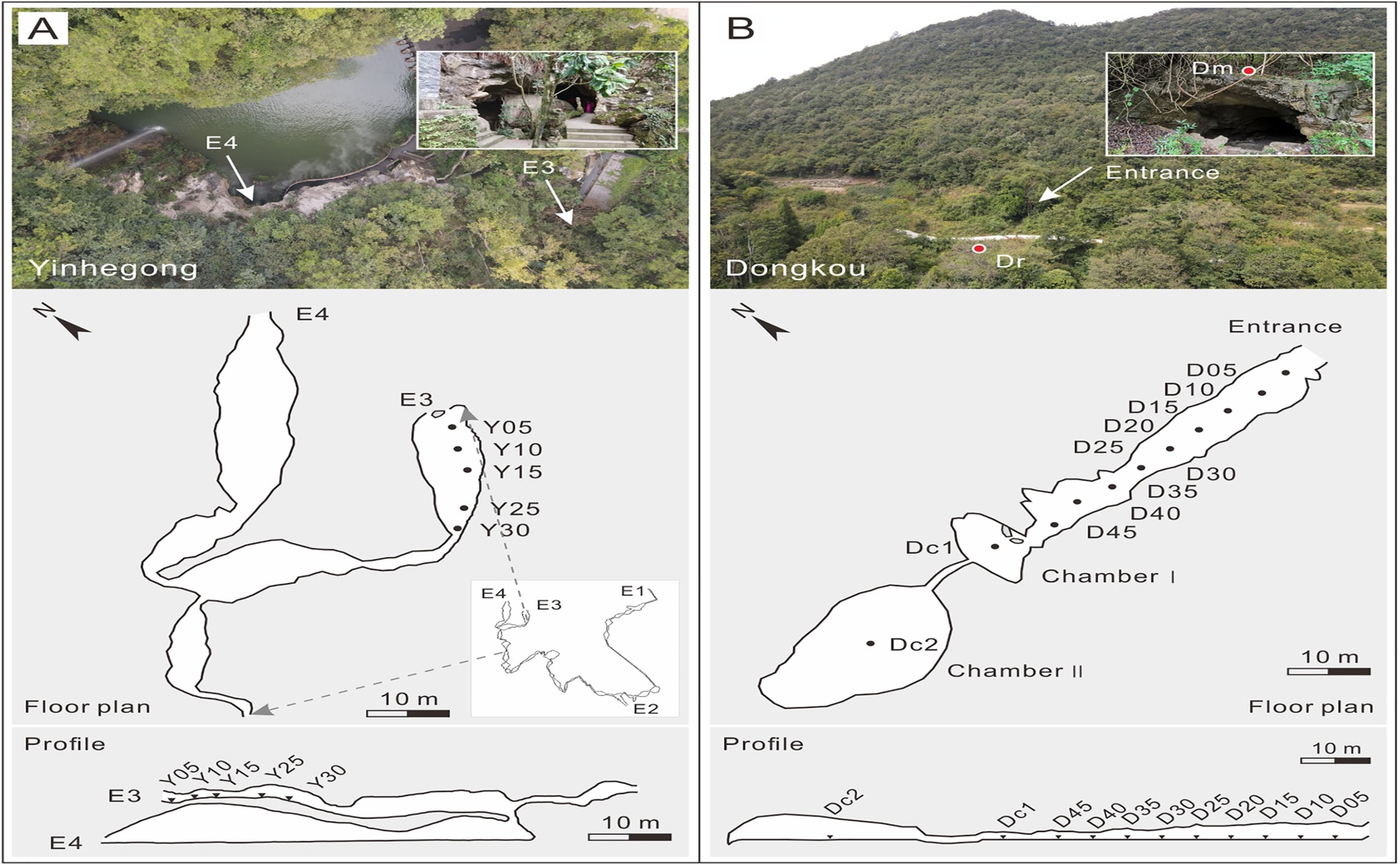
These site plans illustrate the complex multi-entrance and multi-chamber geometries of Yinhegong (A) and Dongkou (B) caves, detailing the specific sampling transects used to confirm that surface sediments near the entrances reliably preserve the pollen signature of the surrounding Pinus massoniana-dominated vegetation.

Image adapted from: Tang et al. / CC BY (Source)

Key Findings

  • In caves on the Guizhou Plateau, China, pollen found within 5-15 meters of entrances closely matches the vegetation outside the cave
  • Pollen records further inside the caves were less reliable, but improved ventilation can help represent external vegetation better
  • Factors like humidity, animal activity, and plants growing inside the cave can affect pollen distribution and require careful sampling near entrances
Cave sediments are valuable sources of information about past environments and human activities. A key component of this information is fossil pollen – tiny grains that can reveal what plants grew in an area, and therefore what the climate and landscape were like. However, determining how accurately cave pollen reflects the environment outside the cave has been a long-standing challenge, particularly in caves with complex structures. A recent study by researchers from Guizhou Education University, the Chinese Academy of Sciences, East China Normal University, and National Cheng Kung University[1] addresses this issue, focusing on caves in the Guizhou Plateau region of China. The core problem lies in caves acting as ‘traps’ for pollen. While this can be useful, it also means the pollen record isn’t a simple, direct reflection of the surrounding vegetation. Pollen can be blown in, carried by animals, or even produced by plants growing inside the cave itself. This can distort the signal, making it difficult to reconstruct past environments with confidence. The study involved collecting surface sediment samples from two caves with different internal structures – some with multiple entrances and passages, others with a single entrance and several chambers. These samples were then analyzed to identify the types and quantities of pollen present. Crucially, the researchers also collected pollen samples from surface soil and fresh moss outside the caves to act as a baseline for comparison. The results showed a strong correlation between the pollen found in sediments near the cave entrances (within 5-15 meters) and the pollen from the external environment. This suggests that pollen entering the cave through these openings accurately represents the vegetation outside. Furthermore, the high pollen concentration in these areas made them ideal for analysis. This is important as low pollen counts can make accurate identification difficult. Moving further into the caves, the pollen concentrations decreased. While improved ventilation did help to increase the representation of external pollen, the overall signal was weaker. This highlights the importance of carefully selecting sampling locations within caves – focusing on areas closer to entrances where pollen is more likely to originate from outside. The study also acknowledged that factors within the cave itself can affect pollen distribution. Humid conditions, animal activity, and the presence of plants growing inside can all contribute to spatial variations in pollen assemblages. This means that a single sample may not represent the entire surrounding environment, and multiple samples from different locations may be needed to create a complete picture. These findings build upon earlier work in North Africa, such as the excavations at Haua Fteah[2]. While the Haua Fteah research focused on establishing a chronology of human occupation using multiple dating methods, it also relied on pollen analysis to understand the paleoenvironment. The current study provides a framework for interpreting pollen data from cave environments, which can be applied to sites like Haua Fteah to refine our understanding of past vegetation and its relationship to human activity. The ability to accurately interpret pollen records is crucial for reconstructing the environments inhabited by early humans. Interestingly, the need for careful pollen extraction and processing techniques, as highlighted in a separate study focusing on bat guano deposits[3], aligns with the challenges identified in. Both studies emphasize the importance of removing contaminants and ensuring the quality of the final pollen sample to obtain reliable results. The methods for removing humic acid and inorganic matter from guano deposits, while specific to that environment, demonstrate the attention to detail required for accurate pollen analysis in any sedimentary context. In essence, the research team’s work provides a valuable guide for archaeologists and paleoecologists working with cave sediments. By understanding how pollen enters and distributes within caves, and by carefully selecting sampling locations, it is possible to use pollen analysis to reconstruct past environments with greater accuracy and confidence.

EnvironmentEcologyPlant Science

References

Main Study

1) Pollen assemblages and distribution characteristics in surface sediments of karst caves on the Guizhou Plateau, southwestern China

Published 22nd September, 2025

https://doi.org/10.1371/journal.pone.0333003


Related Studies

2) The chronostratigraphy of the Haua Fteah cave (Cyrenaica, northeast Libya).

https://doi.org/10.1016/j.jhevol.2013.10.001


3) A comprehensive procedure for pollen extraction from bat guano deposits in organic and detrital matrices.

https://doi.org/10.1016/j.mex.2023.102405


Related Articles

An unhandled error has occurred. Reload 🗙