Evaluating the Future of Three Rare Plants Under a Changing Climate

Jenn Hoskins
19th September, 2025

Evaluating the Future of Three Rare Plants Under a Changing Climate

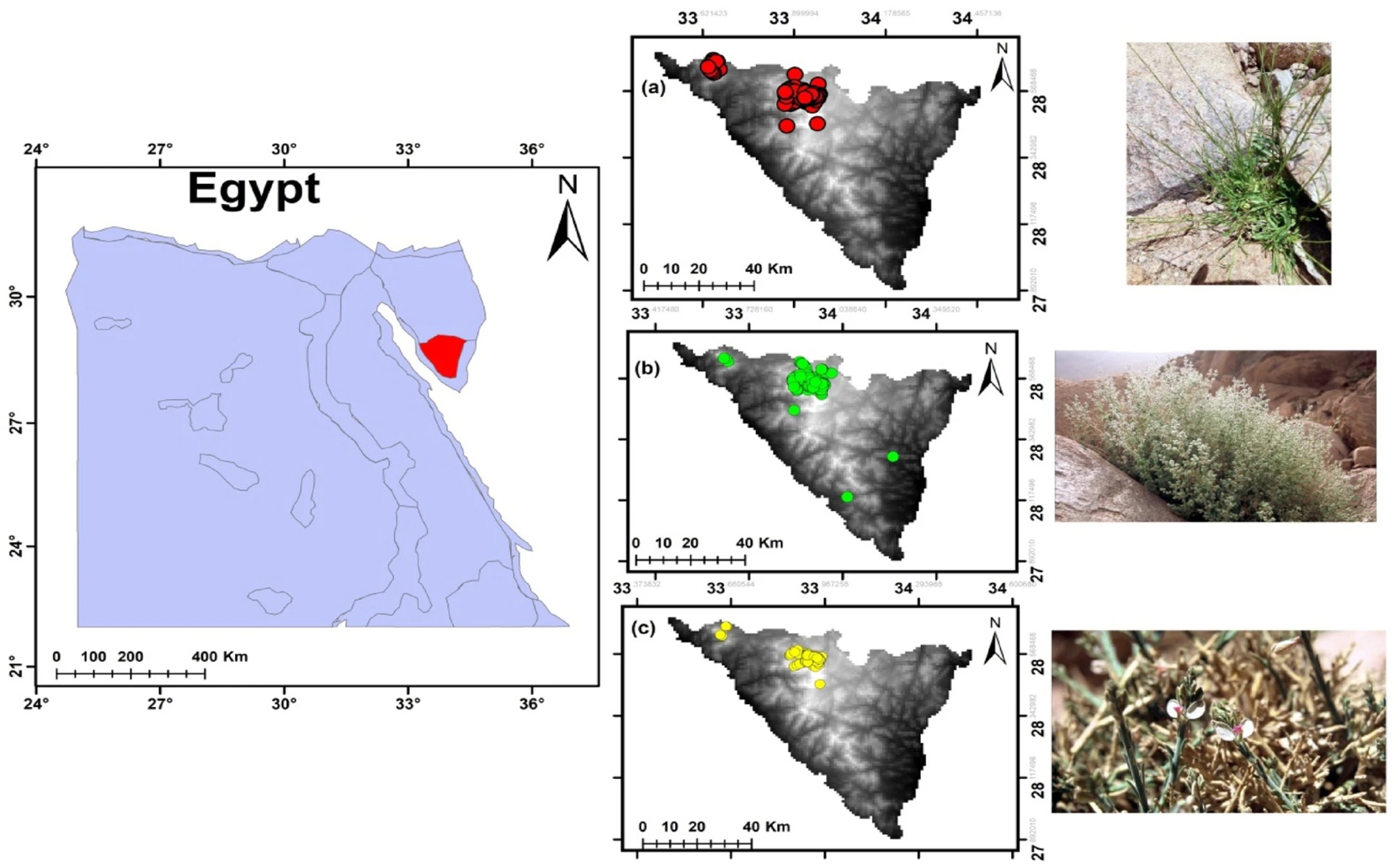
Distribution maps highlight the restricted occurrence within the Saint Catherine Protectorate of three endangered endemic species: Anarrhinum forskaohlii subsp. pubescens (a), Origanum syriacum subsp. sinaicum (b), and Polygala sinaica var. sinaica (c).

Image adapted from: El-Khalafy et al. / CC BY (Source)

Key Findings

  • This study, conducted in Saint Catherine Protectorate, Egypt, assessed the risk to three endangered endemic plants due to climate change
  • Models showed wind, temperature, and soil characteristics were the most important factors determining where these plants could survive
  • While two species are predicted to expand their ranges, one species, Origanum syriacum subsp. sinaicum, is expected to see a decrease in suitable habitat under future climate scenarios
Understanding the impact of climate change on plant life, particularly species found only in specific locations (endemic plants), is crucial for effective conservation efforts. Mountainous regions are especially vulnerable, as these ecosystems often support unique species highly sensitive to environmental shifts. Recent observations indicate a decline in endemic plant populations, with drought and high temperatures identified as primary threats.[1] Researchers at Kafrelsheikh University recently investigated this issue in the Saint Catherine Protectorate (SKP) in Egypt, focusing on three endangered endemic plants: Anarrhinum forskaohlii subsp. pubescens, Origanum syriacum subsp. sinaicum, and Polygala sinaica var. sinaica. The study aimed to assess the current risk level of these plants, according to the International Union for Conservation of Nature (IUCN) criteria, and predict how their distribution might change in the coming decades due to climate change. This was achieved using species distribution models (SDMs). SDMs are statistical tools that relate a species’ known locations to environmental factors, allowing scientists to predict suitable habitat based on those factors. The researchers incorporated various bioclimatic variables (temperature, precipitation, wind) and soil characteristics into their models, utilizing four different algorithms – generalized linear model (GLM), Random Forest (RF), Boosted Regression Trees (BRT), and Support Vector Machines (SVM) – and combining their outputs into an ‘ensemble model’ for increased accuracy. The results showed that the Random Forest and GLM algorithms performed best in predicting the distribution of the endemic plants within SKP. This suggests these methods are particularly effective for modeling species in this type of environment. Importantly, the analysis revealed that wind and climate variables were the most influential factors determining where these plants could survive. Specifically, for A. forskaohlii subsp. pubescens, wind, temperature (Bio9 and Bio3), water content in the soil, and elevation were key predictors. Similar patterns were found for O. syriacum subsp. sinaicum and P. sinaica var. sinaica, with wind, temperature, soil composition, and elevation consistently emerging as important variables. Projecting into the future, the models indicated a concerning trend for O. syriacum subsp. sinaicum. Under various climate change scenarios (SSP585 and SSP126, representing different levels of greenhouse gas emissions), its potential range is expected to decrease. Conversely, A. forskaohlii subsp. pubescens and P. sinaica var. sinaica are predicted to expand their ranges, at least under the modeled conditions. This study builds upon existing knowledge of extinction rates and the factors driving biodiversity loss. While previous research has established that current extinction rates are significantly elevated compared to background levels[2], pinpointing the specific climatic drivers of extinction has remained a challenge. The work from[3] highlights the importance of considering specific climate changes, finding that changes in hottest yearly temperatures are more strongly associated with local extinctions than changes in mean annual temperature. The Kafrelsheikh University study similarly emphasizes the importance of specific variables – particularly wind – that may not be captured by broader climate metrics. Furthermore, the finding that some species may be able to expand their ranges while others contract aligns with observations in marine ecosystems[4], where species are shifting their distributions in response to warming temperatures. However, the ability of a species to shift its range depends on its dispersal capacity – how easily it can move to new suitable habitats. The research from[3] showed that many species may not disperse quickly enough to avoid extinction, but also highlighted the potential for niche shifts (adapting to new conditions) as a crucial survival mechanism. The expansion predicted for A. forskaohlii subsp. pubescens and P. sinaica var. sinaica suggests they may possess some capacity for adaptation or are located in areas with more favorable dispersal opportunities. The study also indirectly touches upon the importance of rare species.[5] demonstrated that a substantial proportion of plant biodiversity is comprised of rare species, often concentrated in climatically stable regions. The endangered status of the three plants investigated in underscores the vulnerability of these less common species to environmental change and the need for targeted conservation efforts. The researchers emphasize the urgency of implementing protective measures, including laws and regulations to safeguard these endemic plants, as well as exploring strategies like reintroduction and both in situ (protecting them in their natural habitat) and ex situ (protecting them outside their natural habitat, such as in botanical gardens) conservation planning.

EnvironmentEcologyPlant Science

References

Main Study

1) Assessing and updating the environmental and conservation status of three endangered endemic plants in light of potential climate change in Saint Catherine Protectorate, Egypt

Published 16th September, 2025

https://doi.org/10.1186/s12870-025-07127-z


Related Studies

2) Estimating the normal background rate of species extinction.

https://doi.org/10.1111/cobi.12380


3) Recent responses to climate change reveal the drivers of species extinction and survival.

https://doi.org/10.1073/pnas.1913007117


4) Global warming is causing a more pronounced dip in marine species richness around the equator.

https://doi.org/10.1073/pnas.2015094118


5) The commonness of rarity: Global and future distribution of rarity across land plants.

https://doi.org/10.1126/sciadv.aaz0414


Related Articles

An unhandled error has occurred. Reload 🗙