Studying How Hornwort Provides Homes for Tiny Life in Changing Waters

Jenn Hoskins
3rd July, 2025

Studying How Hornwort Provides Homes for Tiny Life in Changing Waters

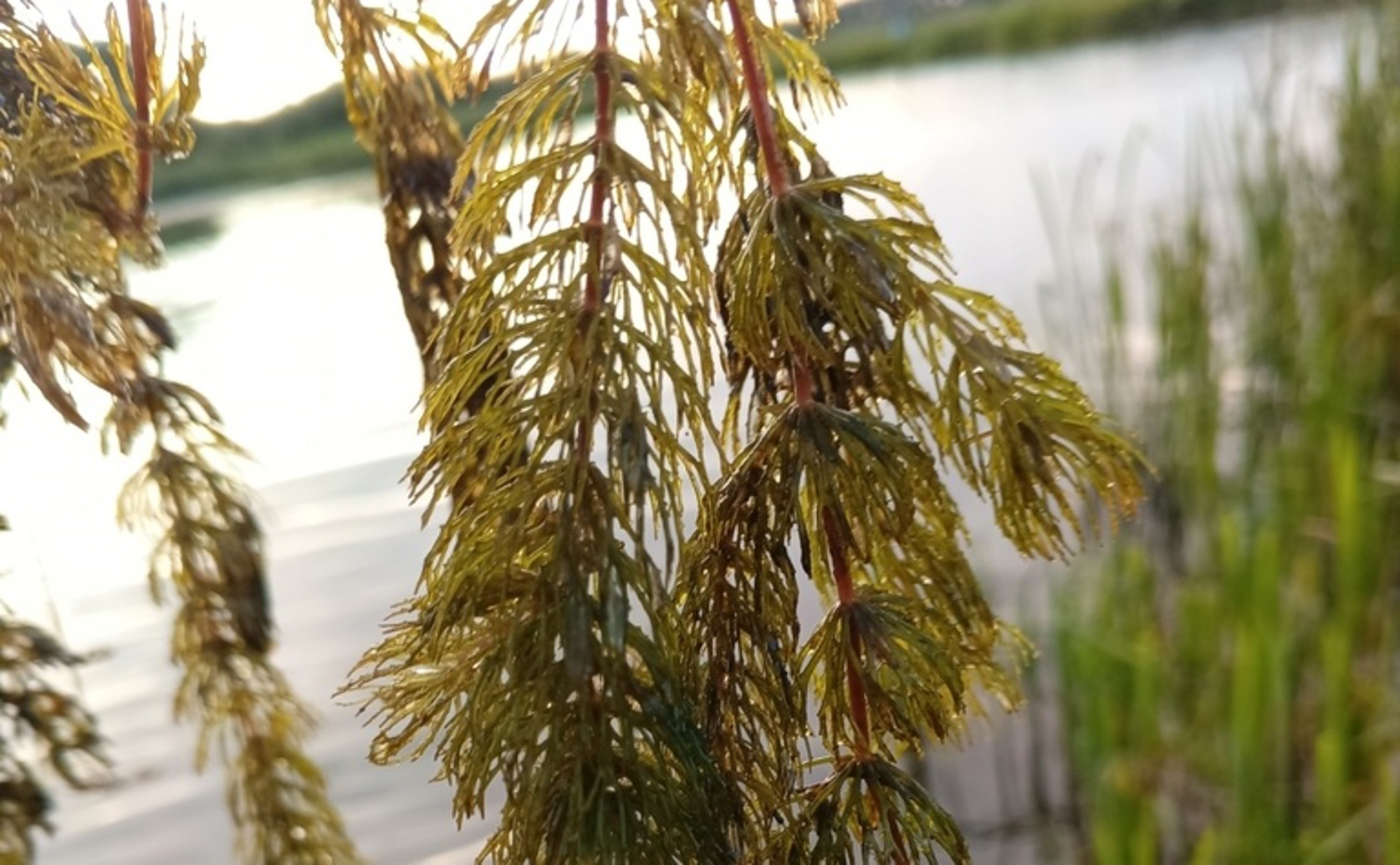
Coontail (Ceratophyllum demersum)

Photo adapted from: Maria Kohanovskaya / CC BY (Source)

Key Findings

  • Researchers at the HUN-REN Centre for Ecological Research developed easy, non-damaging methods to measure the surface area of a common aquatic plant, Ceratophyllum demersum
  • Their key finding is that the plant's surface area strongly correlates with its easily measurable length and weight, allowing scientists to quickly estimate epiphyte habitat
  • These new methods provide a fundamental tool for ecological studies, helping understand how plant surface changes impact water quality, nutrient cycling, and pollutant removal
Submerged plants are vital components of aquatic ecosystems, particularly in lakes and wetlands. They provide essential habitat and resources for a myriad of microscopic life forms, collectively known as epiphytic organisms, which live on their surfaces. These epiphytes play crucial roles in maintaining water quality and overall ecosystem health, for instance, by processing nutrients or accumulating pollutants. However, accurately determining the total surface area these plants provide for epiphytes, and how this area changes under varying environmental conditions, has been a significant challenge for scientists. Addressing this gap, researchers at the HUN‐REN Centre for Ecological Research have developed practical methods to quantify the total surface area of Ceratophyllum demersum, a widespread submerged plant[1]. This study focused on understanding the plant's morphological diversity across different habitats and devising simple ways to estimate its surface area without damaging the plant. They found that the total surface area of C. demersum shoots, ranging from 73 to 143 centimeters in length, typically varied between 147 and 313 square centimeters, with the largest plant examined boasting a surface area of 3352 square centimeters. The key finding of this research is the strong correlation between the plant's total surface area and easily measurable characteristics like its shoot length and fresh weight. This means scientists can now estimate the available habitat for epiphytes by simply measuring these features in the field. For example, a change in shoot length of just 10 centimeters can result in an approximate 15 square centimeter change in total surface area, while a 100-gram change in fresh weight corresponds to a substantial 5400 square centimeter change. This ability to quantify changes in surface area provides a fundamental tool for various scientific and practical applications, from ecological studies to environmental remediation efforts. The importance of quantifying this surface area becomes clear when considering the functions of the epiphytic communities that inhabit these plants. Submerged macrophytes, which are aquatic plants visible to the naked eye, are well-known for their role in nutrient cycling and their use in ecological restoration to mitigate eutrophication – the excessive richness of nutrients in a lake or other body of water, frequently due to runoff from the land, which causes a dense growth of plant life and death of animal life from lack of oxygen. Epiphytic microbial communities on the leaves of submerged macrophytes, such as Vallisneria natans and Hydrilla verticillata, significantly contribute to nitrogen removal from water through processes like nitrification and denitrification[2]. Nitrification is the biological oxidation of ammonia to nitrite followed by the oxidation of the nitrite to nitrate, while denitrification is the process where nitrates are converted back into nitrogen gas, effectively removing excess nitrogen from the ecosystem. Studies have shown that the leaf surface, or phyllosphere, of these plants harbors a greater diversity of bacteria and exhibits higher potential denitrification rates compared to the surrounding water[2]. This highlights that a larger plant surface area, which can now be more easily quantified by the methods in, directly supports more of these beneficial microbial processes. Beyond nutrient cycling, submerged macrophytes and their associated epiphytic biofilms – the complex communities of microorganisms encased in a self-produced polymeric matrix – are crucial for removing pollutants from contaminated waters. Ceratophyllum demersum, the same species studied in, is known to accumulate large amounts of macro- and trace elements, making it valuable for biomonitoring water pollution and for phytoremediation, which is the use of plants to remove contaminants from soil and water[3]. The amount of elements accumulated by these plants varies significantly with seasonality, the vertical position of the plant material, and importantly, the presence of a biofilm cover. Research has shown that plants with well-developed epiphytic microbial communities can accumulate two to five times more elements than those without a biofilm[3]. This reinforces the critical need to accurately measure the surface area that these pollutant-accumulating biofilms inhabit. Furthermore, studies on metal(loid) pollution in wetlands, where metal(loid)s are a group of elements that include both metals (like lead and copper) and metalloids (like arsenic) which can be toxic, have revealed that epiphytic biofilms generally accumulate higher concentrations of these contaminants than the submerged macrophytes themselves[4]. This further underscores the importance of the surface area provided by the plant as a habitat for these efficient pollutant removers. The morphology of submerged plants, and thus their available surface area, is dynamically influenced by environmental factors. For instance, Vallisneria natans responds to increased water depth by increasing its leaf length and width, and by enhancing its antioxidant enzyme activity and photosynthetic efficiency to cope with light stress[5]. While these adaptations allow the plant to survive in deeper waters, excessively deep conditions (e.g., 200 cm) can still be detrimental. Sediment nutrient levels also play a role, influencing the plant's root system to enhance nutrient absorption[5]. The methods developed by the HUN‐REN Centre for Ecological Research allow scientists to quantify how these environmental changes, which alter plant growth and morphology as described in[5], in turn impact the available habitat for the vital epiphytic communities. This integrated understanding helps in developing more effective water level management strategies and ecological restoration efforts in shallow lakes, ensuring not only the survival of the plants but also the health and functionality of the entire aquatic ecosystem.

EnvironmentEcologyPlant Science

References

Main Study

1) Methods to Explore Changes in the Extent of Habitat Provided by Ceratophyllum demersum Shoots for Epiphytic Organisms in Changing Environments

Published 30th June, 2025

https://doi.org/10.1002/ece3.71612


Related Studies

2) Epiphytic microorganisms of submerged macrophytes effectively contribute to nitrogen removal.

https://doi.org/10.1016/j.envres.2023.117754


3) Significant impact of seasonality, verticality and biofilm on element accumulation of aquatic macrophytes.

https://doi.org/10.1016/j.envpol.2021.118402


4) Metal(loid) accumulation levels in submerged macrophytes and epiphytic biofilms and correlations with metal(loid) levels in the surrounding water and sediments.

https://doi.org/10.1016/j.scitotenv.2020.143878


5) Response of a submerged macrophyte (Vallisneria natans) to water depth gradients and sediment nutrient concentrations.

https://doi.org/10.1016/j.scitotenv.2023.169154


Related Articles

An unhandled error has occurred. Reload 🗙