Nutrient Balance in Forest Leaves, Debris, and Soil

Jim Crocker
27th August, 2025

Nutrient Balance in Forest Leaves, Debris, and Soil

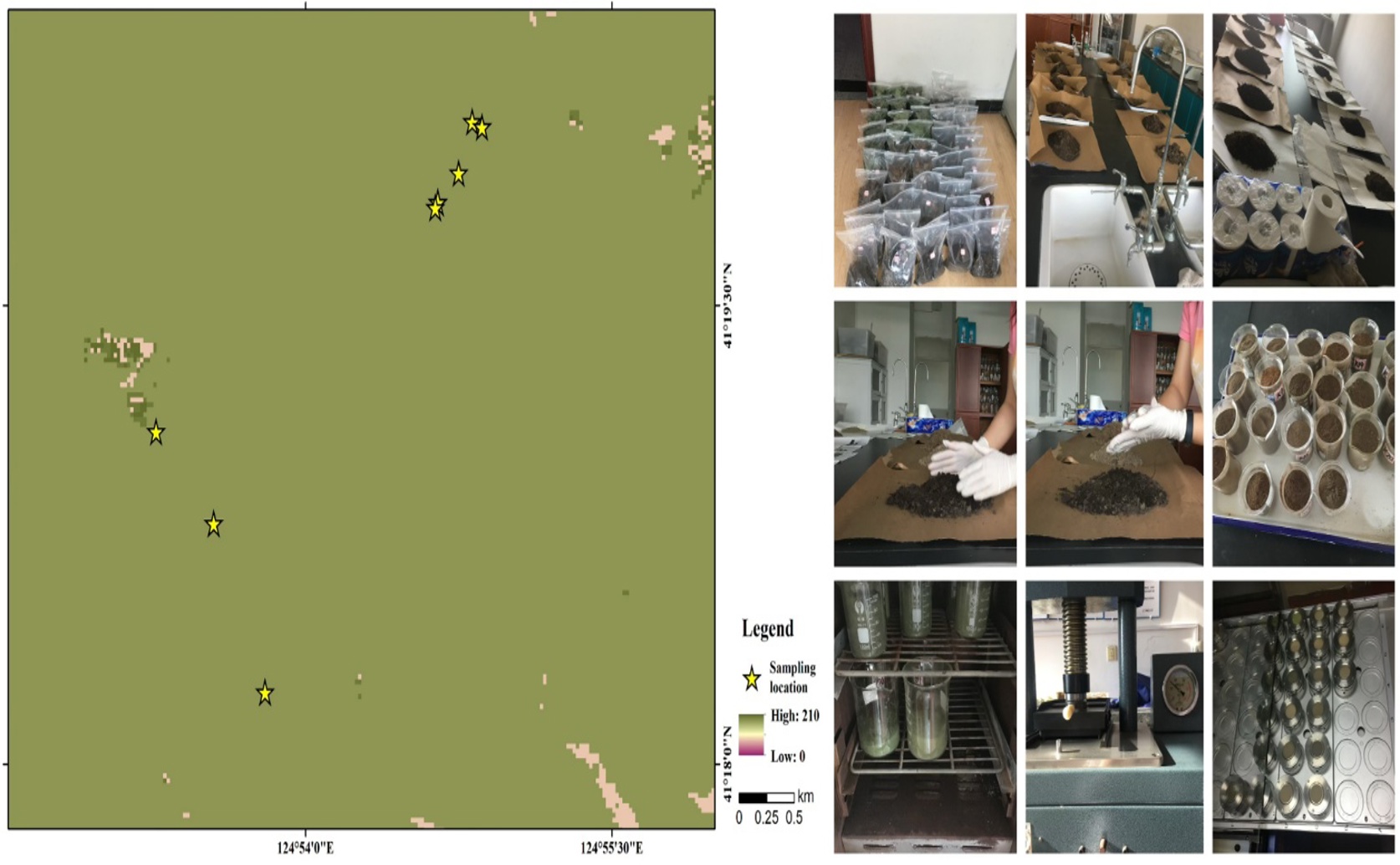
The location of sampling points and laboratory process.

Image adapted from: Wang et al. / CC BY (Source)

Key Findings

  • In the periglacial forests of northeastern China, phosphorus is the main nutrient limiting plant growth, due to slow weathering and high runoff
  • Despite low phosphorus availability, the forest ecosystem efficiently cycles phosphorus from leaves to soil through decomposition processes
  • Plant species adapt to nutrient limitations, with broadleaf trees rapidly cycling nutrients and coniferous trees conserving them, contributing to ecosystem stability
Forest ecosystems play a vital role in the global cycling of essential nutrients like carbon (C), nitrogen (N), and phosphorus (P). Understanding how these nutrients move through different parts of the ecosystem – from leaves, to decaying matter (litter), to the soil – is crucial for predicting forest health and resilience, especially as climate change alters environmental conditions. A key challenge is identifying which nutrient is most limiting to plant growth in a given ecosystem, and how efficiently nutrients are recycled. This is particularly important in colder regions like the periglacial forests of northeastern China, where nutrient availability can be low. Researchers from Liaoning Normal University and Western Carolina University[1] recently investigated these nutrient dynamics in the block stream forest community of Laotudingzi Mountain, a region characterized by paleo-periglacial landforms. The study focused on the ecological stoichiometry of C, N, and P – essentially, the balance of these elements in living organisms and their environment. They analyzed 13 dominant tree species, separating them into broadleaf and coniferous types, to understand how nutrient limitation and movement occurred within this ecosystem. The researchers used a technique called X-ray fluorescence spectroscopy (XRF) to measure the concentrations of these elements in leaves, litter, and soil. XRF allows for rapid and non-destructive analysis of elemental composition, providing a detailed picture of nutrient distribution. The results of the study revealed that phosphorus was the primary limiting nutrient in this forest. The ratios of nitrogen to phosphorus (N:P) in leaves, litter, and soil were all below globally recognized thresholds indicating P limitation. This means that plant growth was most restricted by the availability of phosphorus, rather than carbon or nitrogen. Interestingly, the study highlighted efficient phosphorus cycling within the ecosystem. The amount of nitrogen in leaves was positively correlated with the amount of phosphorus in the litter, and negatively correlated with the amount of carbon in the litter. This suggests that as leaves decompose, phosphorus is released into the litter layer, and the rate of this release is influenced by the carbon content of the decomposing material. Furthermore, the researchers observed a strong connection between phosphorus levels in the litter and the soil, demonstrating that litter decomposition is a major source of phosphorus replenishment in the soil. These findings build on previous research that has shown the importance of microbial activity in litter decomposition[2]. The study[2] found that different tree species attract different fungal communities, which in turn affect the rate of decomposition and nutrient cycling. While that study focused on the role of fungi, the current research emphasizes the critical role of phosphorus as a driver of these processes in periglacial forests. The current study also echoes findings regarding the regional importance of invertebrates in litter decomposition[3], as decomposition rates are intimately tied to nutrient cycling. The researchers also observed what they termed “stoichiometric plasticity”. This refers to the ability of the ecosystem to adapt to nutrient limitations. Despite inefficiencies in carbon and nitrogen cycling, the study found that accelerated phosphorus mineralization – the conversion of organic phosphorus into plant-available forms – compensated for these limitations. This acceleration was linked to lower carbon-to-phosphorus (C:P) ratios in the litter, suggesting that litter with a lower carbon content releases phosphorus more readily. This finding is significant because it indicates that the ecosystem possesses a degree of resilience to nutrient stress. The study also connects to broader understanding of carbon and nitrogen dynamics in forests during stand development[4], as the accumulation of carbon is often linked to nitrogen accretion. However, the current research highlights the importance of phosphorus as a potential limiting factor, something not necessarily emphasized in studies focusing solely on carbon and nitrogen. Additionally, the importance of species composition in influencing foliar nutrient content[5] is relevant, as the 13 dominant tree species analyzed in the current study likely differ in their nutrient uptake and decomposition characteristics. In conclusion, this study provides valuable insights into the biogeochemical processes operating in periglacial forests, emphasizing the importance of phosphorus limitation and the efficient cycling of this nutrient through the leaf-litter-soil continuum. The findings have implications for forest management and restoration efforts, suggesting that species selection and litter management strategies should prioritize maximizing phosphorus availability to enhance ecosystem stability in the face of climate change.

EnvironmentEcologyPlant Science

References

Main Study

1) Ecological stoichiometry between leaves, litter and soil of dominant species in the forest community of rock-stream periglacial landforms in Mt. Laotudingzi

Published 26th August, 2025

https://doi.org/10.1371/journal.pone.0328983


Related Studies

2) Dominant Tree Species and Litter Quality Govern Fungal Community Dynamics during Litter Decomposition.

https://doi.org/10.3390/jof10100690


3) Global contribution of invertebrates to forest litter decomposition.

https://doi.org/10.1111/ele.14423


4) Carbon and nitrogen dynamics during forest stand development: a global synthesis.

https://doi.org/10.1111/j.1469-8137.2011.03645.x


5) Foliar and soil nutrients in tundra on glacial landscapes of contrasting ages in northern Alaska.

https://doi.org/10.1007/s00442-002-0892-x


Related Articles

An unhandled error has occurred. Reload 🗙